Category Archives: Walks

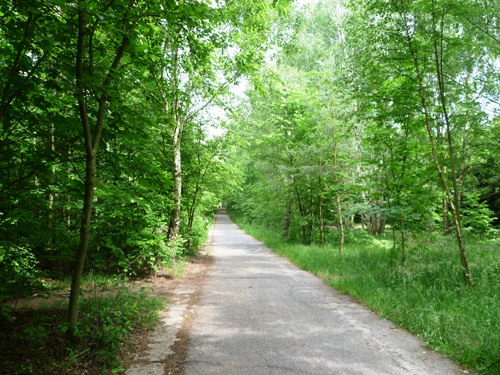
You shouldn’t always walk alone – Buckow, Germany

This piece was inspired by a walk in Brandenburg with Nicky and Greg Gardner. Nicky is the co-editor of Hidden Europe, and you can read her own impressions of the walk by following the link below.

Many writers would argue that if you want to walk for inspiration you need to walk alone. I have some sympathy for this view, and often find that a solitary walk gives me the time and space to get things clear in my head, finding solutions on the pavement or the parkland track to problems that seemed insurmountable sitting in the accusing glare of the anglepoise lamp on my desk. It is for this reason that I rarely leave the house without a small notebook in my pocket, using park benches, stone walls and tram-stops as temporary office space along the way.

But sometimes it is company and conversation that can make a walk inspiring, and so it proved on a wet Friday afternoon at the beginning of October, as I walked with friends around the lake at Buckow, fifty-odd kilometres east of Berlin. “Normally I am known for taking copious amounts of notes when I walk,” Nicky said to me, about halfway around, but her notebook, like mine, stayed firmly in the pocket. Instead, we talked.
Continue reading

Along the cliffs – Cabo de Gata, Spain

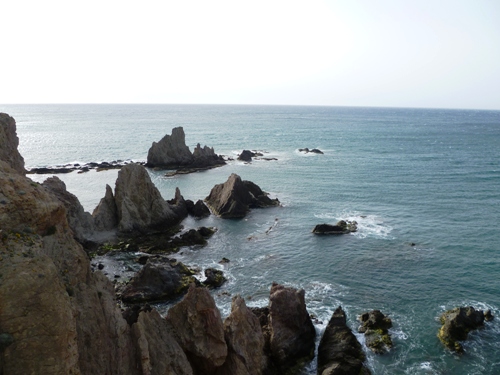
Our route took us out from San Jose, along a dusty, windswept valley until we began a steep climb up a crumbling track to a lookout point just below an old tower, where once they would light fires to pass messages and warning signals along the coastline. We paused for a moment, to catch our breath and to look back towards the town. The night before we had eaten fish down by the harbour and walked through the quiet streets towards our hotel. It was spring, and there was not much happening in the town, as everyone took to their local bars or their living rooms to watch Madrid in the Champions League.

The coastal path took us north, above jagged and dramatic cliffs, finding its way between the water and the dormant volcanos that give this corner of the national park such a distinctive look. The track had once been a mine road, and we came across abandoned buildings and old quarries that were a reminder of an industrial past in this corner of Andalucia. But all was quiet now, and in the ten kilometres we walked between San Jose and the Castillo San Felipe, where waves crashed against salt-eroded stone walls, we did not meet a single soul.

Continue reading

Where the wall was the water, Berlin

Yesterday I headed south to walk a stretch of the Berlin Wall Trail, between Griebnitzsee station and Wannsee. Heading south first by U-Bahn and then by S-Bahn we rocked along through the city in full train carriages, as people made their way to school, university or work. I was amazed at how many people disembarked at Griebnitzsee, but at the bottom of the steps down from the platform they turned right towards the University of Potsdam buildings, and within a matter of seconds I was standing virtually alone down by the water’s edge.

This footpath was once patrolled by East German border guards, and where a hotel now stands a watchtower gazed out across the water towards the thick trees of West Berlin on the opposite bank. Like along so many stretches of the Berlin Wall Trail, a cluster of cherry trees – a gift from the people of Japan to the people of Berlin – cast some shade across the footpath.

“You should see them in blossom,” a gardener said, who had followed me down the steps. “Beautiful. It makes a mess, but it is beautiful.”

Continue reading

A walk through the woods, Schorfheide

With each turn off the road dropped a category, from autobahn to overland street, to village lane, to dirt track. We were invited to a cabin on the edge of the forest, for a summer party around an open fire even if it was punctuated with bursts of rain. We stole the only solid dry hour of the afternoon to take a walk in the woods, following one of our hosts along the trails between the birch and pine trees, whilst the kids picked their way through the trees and the undergrowth. We were penetrating just a little way into the Schorfheide, one of Germany’s largest forests and part of the UNESCO-protected Schorfheide-Chorin Biosphere, that starts about fifty kilometres north of the Berlin city limits.

Continue reading

Along the edge of the city

On Saturday I met up with Nicky and Susanne from the wonderful Hidden Europe magazine, and we went for a walk from Lichterfelde in the very south of Berlin to the village of Teltow just beyond the city limits in Brandenburg. For a good stretch of the walk we followed the Berlin Wall trail, in a location where it was the dividing line not between the two sides of the city, but between West Berlin and the territory of the German Democratic Republic.

Apart from the neatly paved track upon which the guards once patrolled the no-man’s land, and the signs pointing the way, it would not be immediately obvious what it was we were walking on, so completely have traces of this old border been swept away. There were a few signifiers that something unusual had gone on here, such as the abrupt nature in which the city – including blocks of flats – gave way to the fields of the surrounding countryside, but for most of the walk it felt as if we were simply following a well-maintained and very straight footpath through the trees and alongside the fields.

Continue reading

Above the cliffs of Duino

In January 1912 the poet Rainer Maria Rilke was staying with the Princess Marie von Thurn und Taxis-Hohenlohe at the castle in the small village of Duino, just up the coast from Trieste. It was whilst staying there and walking along the clifftops, that the first line of what would become the Duino Elegies – one of his most celebrated works – came to him.

Who, if I cried out, would hear me among the Angelic
Orders? And even if one were to suddenly
take me to its heart, I would vanish into its
stronger existence. For beauty is nothing but
the beginning of terror, that we are still able to bear,
and we revere it so, because it calmly disdains
to destroy us. Every Angel is terror.

(Translated from the German by A.S. Kline, here)

Continue reading

Saturday Morning in Belfast

Phil Scraton on a springtime walk through the city:

I’ve always resisted routine, not sure why. Saturday morning in Belfast is an exception. Out of the house, through the park, along the river, across Botanic Gardens, pick up the Guardian, into the University, water the plants, catch up on work and home for lunch. How did this sequence, steps retraced time and again, become so regular? Is there a suppressed inner self yearning for sequence, a wandering spirit in search of a comforting route? Even when I took up running, I altered course each day, rarely covering exactly the same ground.

Mid February and there’s been no snow, no frost, no winter. What a difference a year makes. Returning from Berlin a year ago the challenge was water pouring through ceilings. Today the news tells of a drought in South East England and record high temperatures in the Midlands. Tomorrow the mercury falls to almost freezing. The seasons have levelled to a kind of constant Fall.

Leaving the quiet of the house, the noise is deafening. A cacophony of birdsong as the choristers assume Spring’s premature arrival … little wonder – the buds on the horse chestnut trees have broken, their new leaves dancing free of constraint. School hockey matches are under way and shrill voices echo through the houses. Within minutes I’m walking the tarmac track through the golf course leading into Ormeau Park.

Continue reading

After the Woods and the Water: Tenuous, traceable threads

Since December 2011 Nick Hunt has been walking from the Hook of Holland to Istanbul, following in the footsteps of the late travel writer Patrick Leigh Fermor who made the journey in 1933 and 1934, and whose two books based on the journey offer a fascinating portrait of a continent that would soon be wiped away by the Second World War. Nick will publish his own book based on his travels, and you can follow his progress on his blog After the Woods and the Water. What follows is a post from early January:

I’ve been walking for over two weeks, and it’s only just starting to occur to me that travelling this way is so much slower – indescribably so much slower – than any other form of transport. Apart from walking backwards, perhaps, or crawling on my belly. It’s an interesting adjustment. Bicycles pass me with speed and grace that I envy, but at least recognise as just a faster version of what I’m doing – making my way from one place to another – while cars, to my pedestrian eye, travel so incomprehensibly fast I have already started to think of them as something quite alien, engaged in an activity entirely different to my own. I’m wondering if the same is felt by geese when an aeroplane thunders in the distance. Continue reading

A Favourite Walk – The Rhoscolyn Headland

By Paul Scraton:

If there would be one walk I would love to have available to me every Saturday morning, it would be the short loop from Outdoor Alternative, around the headland to Borthwen, and then back up the gravel track to home. It is not a long walk, and if you don’t stop for the views across Anglesey to Snowdonia, or to explore the rock pools and sandy cove of Shelly Beach, or a quick ascent of Red Devil Rock, you can be out and back in less than half an hour. Continue reading

Walking the Berlin Wall Trail

Berlin’s Mauerweg – The Berlin Wall Trail:

Borders are always interesting places. As someone who grew up on an island where a land border meant waiting for the first signs of ARAF painted on the tarmac as we left Cheshire for North Wales, the idea of crossing from one country to another by car or, even better, by foot remains a fascinating proposition. For the urban wanderer borders are also the location for much that is worth discovering, whether it is the border between neighbourhoods, between the inner city and suburbia, or the edgelands that mark the often muddled and blurred boundary between the urban and its hinterland.

In Berlin of course we have a structure – or for the most part the memory of a structure – that if you follow its 160 kilometre length will offer up all of the above, as well as the reminder that once where Wedding becomes Prenzlauer Berg or Mitte becomes Kreuzberg was not just the matter of crossing a street from one neighbourhood to the next, but an international border guarded by concrete slabs, barbed wire, and guards with guns. Continue reading