Category Archives: Reflections

Women Climbers: From Lily Bristow to Lucy Creamer

.

By Sheila Scraton:

Last week in the Guardian I was fascinated to read a piece about women’s involvement in mountaineering in the early days of the development of the sport. It talks about some of the women pioneers, such as Lily Bristow and Lucy Walker, examples of the Victorian and Edwardian women who sought Alpine adventure and so often outraged those who thought that women had no place in such activities. This story certainly wasn’t new to me as I have been involved in women’s sport including mountaineering and climbing for the past forty years myself. The article traces the development of women’s early climbing, from the days when a woman sharing a tent with a man on an Alpine ascent scandalised society, through to the early part of the 20th century when women climbed the Matterhorn in skirts, making tenuous links between these early pioneers and the developing suffragist and feminist movement.

What was most interesting was not only the article itself but the responses it provoked on the site the next day.  As always many criticised the article for failing to mention certain pioneering climbers and not recognising the achievements of climbers today. Of course these criticisms are valid although no brief newspaper article can cover everything. What it did for me was get me reminiscing about my early days climbing! I never managed to be a pioneer of mountaineering or indeed a hard climber. I learnt to climb in the 1970s. By then women were benefitting from those who had gone before. I don’t mean Victorian women but women such as Nea Morin, Gwen Moffat, Jill Lawrence, amongst others, who throughout the 60s and 70s were pushing the boundaries of their sport.  My memories are of early days in the Llanberis Pass, Cwm Idwal, the cliffs on Holyhead mountain, the Devil’s Slide on Lundy Island. Of course there are many other days out in Scotland and the Lake District but it is these that are most precious in my memory bank. Continue reading

After the Woods and the Water: Tenuous, traceable threads

Since December 2011 Nick Hunt has been walking from the Hook of Holland to Istanbul, following in the footsteps of the late travel writer Patrick Leigh Fermor who made the journey in 1933 and 1934, and whose two books based on the journey offer a fascinating portrait of a continent that would soon be wiped away by the Second World War. Nick will publish his own book based on his travels, and you can follow his progress on his blog After the Woods and the Water. What follows is a post from early January:

I’ve been walking for over two weeks, and it’s only just starting to occur to me that travelling this way is so much slower – indescribably so much slower – than any other form of transport. Apart from walking backwards, perhaps, or crawling on my belly. It’s an interesting adjustment. Bicycles pass me with speed and grace that I envy, but at least recognise as just a faster version of what I’m doing – making my way from one place to another – while cars, to my pedestrian eye, travel so incomprehensibly fast I have already started to think of them as something quite alien, engaged in an activity entirely different to my own. I’m wondering if the same is felt by geese when an aeroplane thunders in the distance. Continue reading

My Favourite Walk – Annika Ruohonen

To celebrate the first two months of Under a Grey Sky, we asked contributors to send in a post on the subject of their favourite walk:

The best thing about walks is that they prevent me from doing anything. I pride myself on not ever having had a dull moment in my life. Well, the downside to that is that I find it difficult not to do anything. When I’m out on a walk I can’t write emails, arrange photos or write blog posts. Walking gives me the privilege of letting my thoughts flow freely and that, I think, is necessary if you want to be creative. I have sometimes found the solution for a problem at work while having a walk in the woods, quite suddenly without even trying to find it, or not knowing that I was looking for it. I don’t know if there is any scientific proof for it, but I feel that there is so much truth in the saying that having a walk clears you mind. Continue reading

Footprints in the Spanish snow

Sheila Scraton on a high walk in southern Spain:

Usually a winter holiday in Spain conjures up pictures of sun, sand and warm days as the welcome heat seeps into your bones after the long winter in northern Europe. We were visiting our cortijo (Spanish farmhouse) in the Alpujarras in Southern Spain for a couple of weeks, hoping for some warmth but realistic about the fact that the house is situated at about 1500 metres which is above the height of Ben Nevis (1350m), the highest mountain in the British Isles. The cortijo is above the village of Bérchules, a lovely mountain village perched above a spectacular river valley, the source of the Guadalfeo which flows from high in the Sierra Nevada to the Mediterranean sea.

As always the air is cool and clear in February but as soon as the sun appears from the south and shines straight at the cortijo, the heat can be felt and, even at low air temperatures, sun cream is needed!  Each morning we managed to enjoy breakfast outside on the patio although one morning we awoke to quite a surprise.  Overnight several inches of snow had quietly fallen and, as we opened the shutters, a black and white scene had replaced our normal February view of pink and white almond blossom across on the Contraviesa hills. As the sun arose opposite, the black and white was quickly replaced with a wonderful orange glow as the sunlight glittered on the snow flakes and the sky moved to a deep blue. Continue reading

Weather and the sense of a place

By Sharon Blackie:

We are told by the older residents of our local crofting townships that this autumn and winter have been the worst in living memory here in the Outer Hebrides. Wetter and windier. It’s true that we seem to have been battling gales since October, and the already boggy ground has been sodden for months. In November, on our personal blog, I wrote a post, The Gods of Days, in which I talked about wind and suggested that there was little point in living in a place where the dominant weather was wind and rain, and then sitting indoors and complaining about it when it was windy and raining. Of course, a lot of wind and rain has happened to us since November … and a couple of normally hardy friends are now jumping up and down and demanding that I recant and admit that wind and rain is a terrible thing and that I wish it were mild and sunny like everyone else does.

At one level there’s no question about it – I’m tired of battling the wind and sloshing about in the mud when it’s time to feed the animals and walk the dogs twice a day, because this has to be done whatever the weather. I’d be ecstatic if a few mild and sunny days happened along, and I’m eagerly anticipating spring like everyone else … but the truth about weather, about our relationship with weather, is very much more complicated than that. Continue reading

Public spaces and the right to roam our city streets

The latest Letter from Europe from our friends at Hidden Europe is concerned with the liberation of public spaces, especially in our cities, from the domination of the automobile:

“Many of Europe’s town squares and iconic city centre spaces have happily been rescued from the car. From Paris to Perugia, lovely central squares were for too long used as car parks. Now they have been reclaimed for pedestrians. The taming of traffic has massively improved Trafalgar Square in London and the Brandenburg Gate area in Berlin.”

The best parts of most cities are the spot where you feel like the pedestrian is winning over the car and bus, even if many “pedestrian zones” are nothing but open air shopping centres. It is true, for example, that you can drive your car alongside the Corniche in Beirut but the promenade along the sea-front is so wide and filled with walkers, joggers, food vendors, fishermen and cyclists that if you want a decent view out across the rocks and the water you’d better get out from behind the wheel and walk. Continue reading

Dance of the paddles: A reflection on sea kayaking to the Skerries

Andy Short on a winter paddle off the coast of Anglesey:

The Isle of Anglesey, off the North coast of Wales, is renowned within the sea kayaking community. Its location may be a mystery to many in the UK, but sea kayakers from Scandinavia to the States wax lyrical about classic trips the island offers, and ‘the Stacks’ and ‘the Skerries’ are foremost among them. These are trips which conjure among the initiated visions of epic tide races and awesome overfalls.

Anglesey – Ynys Mon in Welsh – is a large squarish lump of rock 25 miles from end to end, protruding impudently into the Irish Sea. Its very existence is like a challenge to the sea, whose tides sweep past on their daily lunar rituals, filling the Irish Sea with waters from the Atlantic and then returning them to whence they came. On stormy days it seems the Island is about to be washed away but the rock here is made of stern stuff. The exposed north and west coasts bear the brunt of the sea’s ravages, and include some of the oldest rocks in the UK. Psammites and Pelites formed some 550 million years ago with pre-cambrian limestone thrown into the mix provide for the robust cliffs that give sea kayaking trips here such a dramatic backdrop. Continue reading

Ghosts from my bookshelves: Exploring Paris

“Probably there is no real Paris, except if you have always lived there. For those of us who arrive only to go away, the place teems with ghosts.” – Clive James, A Postcard from Paris, 1980.

This trip to Paris was the first time I visited the French capital. It seems amazing that it took so long to get there. After all, it was always the cheapest flight from England, or a simple train ride from Berlin. We passed through it on our way to Versailles on a French exchange trip but I remember only the traffic beneath my window, the rain on the streets, and the fact that we were not allowed out of the bus. So that doesn’t count.

I always thought that I did not make it to Paris because it was so close. It wasn’t going anywhere and it was always going to be easy to get to so why not try something else? But now I think there was something else at work, namely those ghosts that Clive James was talking about in his article written over thirty years ago, who lived in the pages of some of my favourite books and that had painted a picture of the city that I was convinced the real thing could never live up to. Of the places represented on my bookshelves only New York can probably compete with Paris, and I have never made it there either, and it was this realisation that has made me sure that it was the fear of disillusionment and disappointment that kept me away from these cities for such a long time. Continue reading

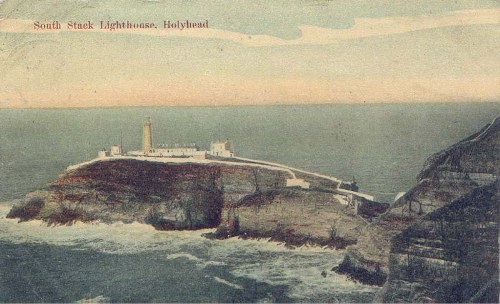
Above the white horses, South Stack

(South Stack Lighthouse in the 1910s, reproduced with permission from www.oldukphotos.com)

There are countless special places along the coastline of Wales, let alone the British Isles, but the cliffs around South Stack seem to stir the imagination of a great number of people. Bird-lovers head for nearby Ellins Tower and the RSPB centre, and the chance to aim their binoculars and telescopes at the guillemots, razorbills and puffins, not to mention seeking out the incredibly rare choughs, of which the nine pairs on the reserve make up 2% of the entire UK population. Continue reading

A song for the road

.

This morning I am taking a train to the Saarland, that little corner of Germany tucked in between France and Luxembourg. After that we move on to Paris for a few days and, who knows, we might pass the route I took on a rickety old bus during sixth form college between Leyland and Florence. That was a long journey, sitting two rows from the back and drinking vodka mixed with warm, flat orangeade with the cool kids from foundation art… Some of us studying History had somehow tagged a ride on this little tour to Tuscany, and whilst the Art students spent their days wandering from one gallery to the next, the rest of us were pretty much free to explore the streets of Florence and see what kind of mischief we could get up to.

We were pretty well behaved. This song was part of my soundtrack of that coach journey, and I can distinctly remember sitting on the bus at the Swiss border as rain hammered against the window listening to Glory Box, knowing that we were about to travel through some of the most spectacular scenery in Europe and that we would see absolutely none of it because it was the middle of the night. This is a theme of my travels, as I also managed to take a night bus from Dubrovnik to Trieste along the legendary Jadranska Magistrala – the Dalmatian coastal road – a journey that I now know to be one of the truly great road trips anywhere in the world. I have travelled it since, but the first time I did it I was sitting bolt upright in an uncomfortable seat, only darkness beyond the window, watching Rocky I, II, III and IV dubbed into Croatian as the night passed agonisingly slowly.

New posts might be a bit sporadic whilst I am away, but I will see what I can do – Paul.