Category Archives: Reflections

Liverpool

I have never lived in Liverpool, although for family reasons and one of the football teams, it is probably the city that I identify most with back home. Living in Berlin, and working in the hostel, it was the answer I gave when asked where I was from – unless the asker was from the UK, in which case I would add a “near” to the “Liverpool.” It was only if I heard a trace of a Scouse accent would I admit to Burscough which, despite its L40 postcode, never had the purple wheely bins.

Last summer we spent a couple of weeks back across the water, and I returned to Liverpool for the first time in a decade. Most cities will be different after a ten year absence, but I was struck by the dramatic nature of some of the changes in the centre of town, a re-development spurred (I presume) by the year as Capital of Culture in 2008. I couldn’t tell whether it was an improvement or not, and I guess I will leave that up to the locals to decide, but it was slightly unnerving to be standing in a place that I thought I knew and having absolutely no sense of direction or idea where I was in relation to anything else.

Continue reading

Watching football on the Rosenthaler Platz

“Aus dem Hintergrund müsste Rahn schießen, Rahn schießt – TOR, TOR, TOR!”

When did it start? The first tournament I watched in Germany was the Japan/Korea World Cup in 2002, and certainly bars and cafes broadcast the games, often pretty early in the morning, and those highly-paid superstars strutted their stuff on the perfectly manicured lawns of Tokyo and Seoul whilst the late-rising Berliner gazed bleary-eyed at the screen across the top of a foaming Milchkaffee. It was the same two years later in Portugal, although for the European Championships the games were at a more sensible hour, when drinking a beer during the first half was more socially acceptable…

Continue reading

From desert to bog, and back again

The latest installment of the Uig Journal from Sharon Blackie, editor of Earthlines Magazine:

I fell in love with my first desert before I fell in love with my first bog. That first desert was in southern California in the mid-’80s, where I (a young PhD student who had seen very little of the British Isles, let alone the world) was attending an international conference on neuroscience. I’m sure the impact that the desert had on me was all the greater for having spent the best part of a week navigating the lunacy of Disneyworld-obsessed Anaheim, and dealing with a curious sense of panicked dislocation caused by the impossibility of getting around it safely – or, sometimes, at all – on foot. I remember the first time that orange-pink shimmering landscape opened up like a flower draped around the stalk of the long straight road ahead. I remember more than anything the heart-stopping sense of freedom and possibility that seemed to unfold in the simple vastness of it – because this was the first time I’d experienced anything so radically beyond the confined and enclosed landscapes that were typical of the places I knew. I remember too the clarity and calmness that I felt, wandering for a while through that vivid uncluttered country. I went on to fall in love with other deserts, from Arizona to Alice Springs, but the memory of that one is sharper somehow, like the memories of other first loves.

Continue reading

Walking through memories, Berlin-Hohenschönhausen

This is the hundredth post on Under a Grey Sky. Before we begin, I would like to take the chance to thank everyone who has contributed to the website, as well as all of you who have taken the time to read it. Here’s to the next hundred…

A week or so ago we took the tram from where we live in Berlin-Wedding across the north of the city to Hohenschönhausen; part family outing, part mission to discover some of the secrets of this neighbourhood. It is not the most famous of Berlin’s districts, but as with everywhere in this city the streets of Hohenschönhausen had plenty of stories to tell.

There was Berlin history of course – from the site of the first Plattenbau built in the early 1970s to solve East Berlin’s housing shortage, via the only private house designed by Mies van der Rohe and a lesser-known housing estate by modernist architect Bruno Taut, to the thick walls of the Stasi Prison and a small, sidestreet Soviet memorial – but more personal than that were Katrin’s stories, as this is the neighbourhood where she lived throughout her teenage years.

Continue reading

What’s in a view?

George McKinney reflects on how we appreciate what it is we have before us, from the sun setting behind the island of Rhum to a Sea Eagle making graceful progress across the sky:

Of course the simple answer to the title-question is; whatever you see.  Line ten people up to watch the sun set behind the Scottish island of Rhum and you will find that each will see something different and the process of sharing their thoughts can add something for everyone.

This process is only disturbed if any of the ten argue to impose their own perspectives on the others or if one person adopts a position that seeks to degrade any other person’s contribution by suggesting that s/he is not competent to appreciate what is there before them all.

In his book, ‘How to be a bad bird-watcher’ Simon Barnes excellently captures this sentiment and defends the importance for individuals to have confidence to simply enjoy what they see.  If a bird is seen and the watcher marvels at its colours or actions, then that is absolutely fine as an end in itself.  The same is true for the feelings and thoughts that an individual might have when watching that sun go down behind Rhum.

Continue reading

Spirit of Place – the art of Diana Hale

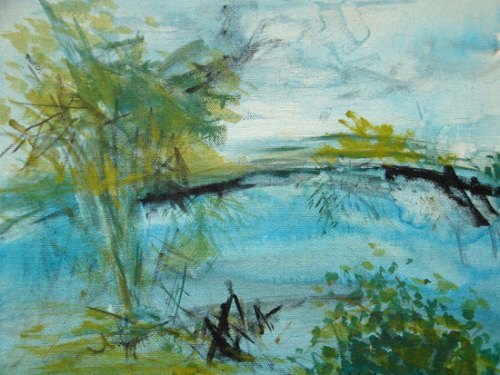
(above: Low Tide – Evening, 40 x 30 cms, acrylic on canvas, 2010)

We discovered Diana Hale’s art through her blog, and really enjoyed not only her paintings but also the words that accompanied them. We asked her to write a post on how the sense of a place influences her work:

Having nearly always lived near water, I do feel drawn to paint watery landscapes, whether rivers, streams, ponds, lakes or estuaries and marshes, shorelines. I like the ever changing nature of moving water and tidal variations. The same place can appear entirely different at different times of day. Changing light effects are enhanced by water. Water inevitably creates open spaces, often empty spaces. A sense of space is something I am aware of whenever I step outside into the open air and I can’t help but feel an immediate sense of liberation. Painting is one way of capturing this feeling.

It is possible to find empty spaces even in the city and I have several paintings of the Thames at low tide near the South Bank which show this. They could in reality be anywhere and I like the fact that they have a particular meaning and location to me but not necessarily to anyone else. They are both subjective and objective spaces.

Continue reading

This Storm Is What We Call Progress

by Tom Salmon:

London’s Imperial War Museum takes a seemingly paradoxical approach in its mission to explore the impact of modern warfare. Military hardware, tanks and other tools of war are removed from bloody battlefields to become the objects of children’s fascination. Meanwhile, a series of art and photography exhibitions like Don McCullin’s Shaped by War invite visitors to reflect more deeply on the human tragedy of conflict.

Ori Gersht’s exhibition This Storm Is What We Call Progress was one of the museum’s more philosophical exhibits, dealing with conflict, survival, memory, history and geography.

Continue reading

Unnamed and unacknowledged: exploring the Edgelands

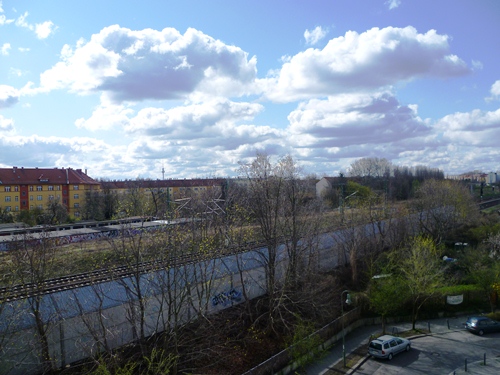
(above: Pankow, Berlin – Garages, Railway Lines and Allotments)

Edgelands: Journeys into England’s true wilderness is written by Paul Farley and Michael Symmons Roberts and is a fascinating book, exploring as it does those places that are neither city or countryside, but the edgelands in between. The two writers have a clear and obvious passion for these edgelands, which they describe in the introduction:

“Somewhere in the hollows and spaces between our carefully managed wilderness areas and the creeping, flattening effects of global capitalism, there are still places where an overlooked England truly exists, places where ruderals familiar here since the last ice sheets retreated have found a way to live with each successive wave of new arrivals, places where the city’s dirty secrets are laid bare, and successive human utilities scar the earth or stand cheek by jowl with one another; complicated, unexamined places that thrive on disregard, if we could only put aside our nostalgia for places we’ve never really known and see them afresh.”

Continue reading

Requiem for a Sycamore – Hatchet Field

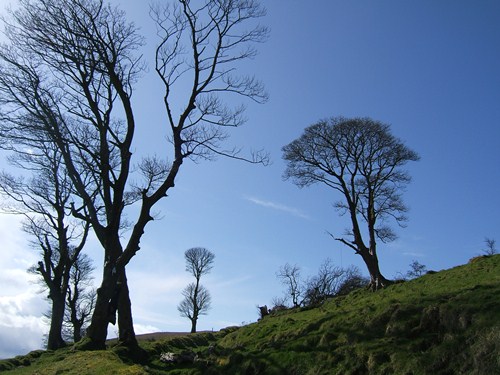
(above: Hatchet Field, photo: Ciarán Ó Brolcháin)

In yesterday’s article, Beatrix Campbell interviewed Terry Enright, whose poem Requiem for a Sycamore, pays homage to the small clump of trees that populate the Hatchet Field. The field is unique, its grassland and sycamores contrasting with the bracken and heather of the hillside.

Requiem for a Sycamore

I saw you looking down,
Majestic
Your mighty branches spread,
Like muscles on a giant,
500 thousand leaves, and more,
Love letters carved on your bark
The beauty of the hill

You were my shelter from the sun,
Cover from the rain,
I sat in the silence of winter snow,
A single Wren stared at me,
Wondering
Voices whispering in the wind,
High above everything

War in the streets below,
Spies in the grass,
Watching
Happy children swinging on a single rope,
Flying over Belfast without wings,
Oblivious
To the pain and joy you have seen

Now I sit on your prostrate corpse,
Felled by November storms,
I lament your passing,
Nature, like life itself,
Demands a price, we all must pay,
Still I cherish, the pleasure we have shared,
High up in the Hatchet Field Continue reading

Open to all – the tale of Black Mountain

(above: Divis and Black Mountain, taken from Cave Hill. Photo: Phil Scraton)

This month is the 80th Anniversary of the Mass Trespass of Kinder Scout, an act of disobedience by ordinary ramblers that had a massive impact on public access to open countryside, but there would remain many places that were off limits. In 2005, the people of Belfast finally regained access to the Black Mountain that overlooked their city. The following article by Beatrix Campbell originally appeared in the New Statesman, and we are grateful to Bea for her permission to re-publish it here:

The man stands at the peak of the Black Mountain and his eyes scavenge the startling Mediterranean blue of the sky above Belfast. “Where is the little bastard?” he murmurs. “Ah, there he is. Now isn’t that lovely?”

He’s spotted a skylark. The soundscape is silence and skylarks and meadow pipits and his feet on heath and heather and lush, black bog. It is the beginning of June 2005, and before the month is out the Black Mountain will be open for the first time to the people.

Terry Enright slowly turns 360 degrees. “I’ve never seen this before,” he says. “It’s never been so clear.” What he sees is Scotland far over to the east, and the Isle of Man, and when he turns inland there is Lough Neagh – the biggest lake in these islands – five of the Six Counties and Donegal on the west coast. Down below is the bowl of Belfast. “The people of Belfast never saw this. They live here but it’s not been part of their life.” Enright lives here, too, on a Ballymurphy council estate nesting at the bottom of the mountain that skirts the city skyline. But he made it his mission to move around the mountain. Continue reading