Category Archives: Berlin Journal

Fragments: A Berlin Journal – November ’24

A time to breathe. For the first time this year, there is nowhere I need to be other than Berlin or our little yellow house on the edge of the village. I wonder: will there be anything to write about for this journal, as the days shorten and the time spent at my desk increases? The year that stretched out, so full and bloated with plans even in the early weeks of the year, is now racing towards its conclusion. Should I be looking back when there is still a sixth of the year still to go? November does that to you. And there is one conclusion about 2024 that I am already sure of: I spent much of my time working with friends, which is all you can really hope for.

*

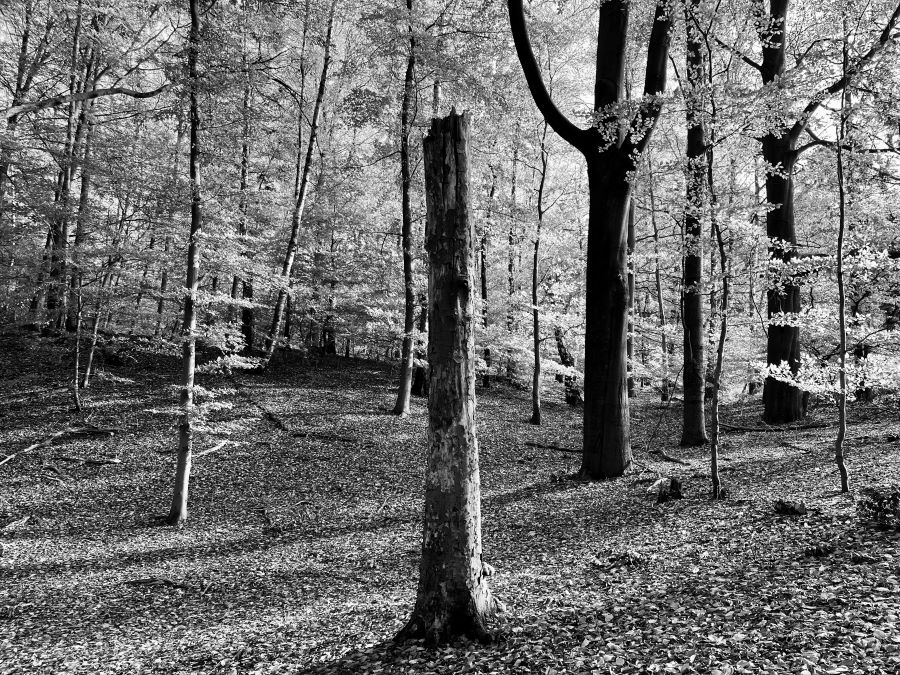
My run takes me out of the village and into the forest. The trees are a riot of colours, fading greens into glowing oranges, reds and yellows. The leaves that have already fallen crunch underfoot, frozen during a cold night. And where the path opens out, leading across the meadows, the frost on the ground reflects the light of a golden late autumn sun. 

We have made a plan that we shall run next year around the route of the Berlin Wall. A hundred miles through and around the city. I did it before, with three friends, but our relay team will be bigger this time. We shall run in memory of all who lost their lives at the border, and all those whose lives were impacted by the brutal division of the city. But we will also run for our friends in Nepal, to raise money and awareness for the schools, health post and sanitary facilities built by the Pahar Trust in hard-to-reach communities in the mountains.

*

I have been thinking a lot about purpose these days, especially when I am running. About why we do what we do. Not necessarily in our work (but that too), but just in how we spend whatever time we have. After all, we only go this way once.

Back in Berlin and I run through the autumnal streets that always remind me of my first days in the city, 23 years and half a lifetime ago. I spent the first half of this year injured, and wasn’t really able to run at all, so just being outside lifts the spirits on the greyest of days. And yet the idea of working towards something, of running towards something, like the Berlin Wall Trail next August and using this adventure to spread the word of the amazing work the Pahar Trust Nepal does, even gives a sense of purpose to putting one front of the other.

Lots of things in the world seem pretty desperate right now. How do you make sense of, let alone find an active response to, the situation in Ukraine, in Gaza, in Sudan and Yemen and the places we don’t even know about or choose collectively to forget? The answer is that you can’t.

On an edition of the Adventure Diaries podcast I listen to an interview with Matt Pycroft. Matt is a filmmaker who also runs a podcast of his own. He speaks well about purpose, about finding the thing that you feel you can do, because although we can’t do everything, it doesn’t mean we can’t do something.

As Matt speaks and I run, I am taken back to a jeep in Nepal, bouncing in the back seat as we make our slow progress across the mountains and up the valley to Sikles, in the shadow of the Annapurna range. I was there with Alan, from the Pahar Trust Nepal, and we had spent the previous week visiting schools and health posts. In the back of the jeep we began a conversation that has continued for a year, usually in messages, and especially in the face of the challenges Nepal has recently been facing.

What can we do, when landslides made worse by the climate crisis wipe out in hours more schools than the Pahar Trust has built in 30 years? Countries like Nepal will bear the brunt of what is to come. Home from my run, I note down in my social media post that in the face of climate crisis, economic instability, earthquakes and flash floods and landslides, building a school or fitting out a classroom can feel like attempting to stop an approaching train with an outstretched hand.

And yet. And yet.

We focus on what we can do rather than what we can’t. There are cracks and there are problems all over. A safe school is a good start. An excellent start. It is something than many of us take for granted, and it is real, impactful and worth every ounce of energy. So that is what we will do. One foot in front of the other. One step at a time.

It feels like purpose to me.

Outside the hotel I introduce myself to the guests and explain the importance of the day. We are walking a stretch of the Berlin Wall because it is the 35th anniversary of its fall. But the 9th November is more than just the Mauerfall. It is the day of the abdication of the Kaiser. Of the beer hall putsch. And of the pogroms against the Jews in 1938, when homes, synagogues and businesses were destroyed, and tens of thousands were arrested and imprisoned in concentration camps.

As we walk to Bernauer Straße, a number of the Stolpersteine or ‘stumbling stones’ that have been laid in the pavement outside the homes of victims of the Holocaust have been polished by those who live there now. A candle and a flower. A moment of remembrance and recognition.

*

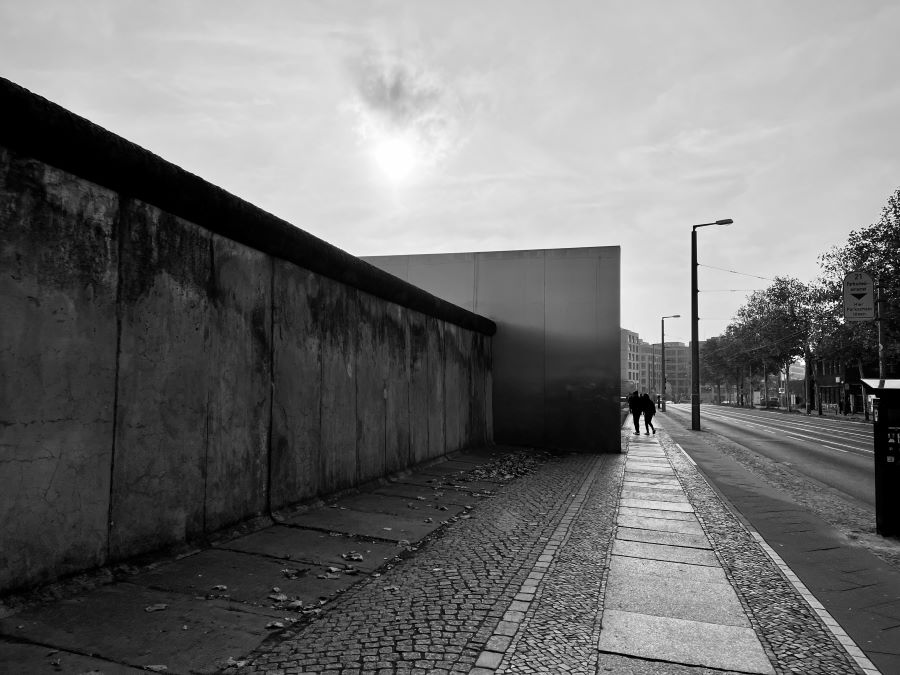
Some of the people I am walking with were not even born in 1989 and yet the legacy of the division can still be felt in the city. We feel it every day as we walk through Gesundbrunnen to Mitte, crossing Bernauer Straße. The architecture changes. The faces of the people on the street. The average cost of rent. Which kids are at which schools. At the same time, what remains of the Berlin Wall has been a memorial longer than it was ever a fortified border. 

At the memorial, a band plays while a young woman – also too young to remember the Wall standing – sings an old protest song and the crowd clap politely along. There are flowers at the memorials to the victims of the Wall, but the atmosphere is positive, even if the anniversary of both the collapse of the GDR and reunification is considered with a little more nuance than the simple celebrations that marked previous landmark editions.

*

The registration for the Berlin Wall Trail Run opens at the exact moment Gunter Schabowski bungled his press conference and began the events that led to a gate being opened at the Bornholmer Straße checkpoint a few hours later. It is a neat touch from the organisers.
Reading Beyond the Wall, by Katja Hoyer.

While the majority of East Germans in 1988 neither wanted the state abolished nor dreamt of imminent reunification with the West, there was a discernible expectation that the GDR needed to modernize its politics. The inflexible structures of government and the lack of public discourse, transparency and accountability that came with them had long been at odds with the dizzying speed of social reform. The GDR was a highly literate, highly skilled and highly politicized society, confident and proud in its achievements and keen to move forward. It was fertile ground for the seeds of reform and democratization.

*

We walk from Wiesenburg to Arensnest, following a path through the forested low hills and glacial dry valleys to Schlamau, and then across the fields of the High Fläming heath. We walk to the sound of gunshots getting ever – and ever more disconcertedly – closer. We meet two people in high-vis gear, a man and a woman, and their friendly dog. They ask us which way we want to walk and our route meets with their approval.

‘If you were going west,’ the man says, ‘I would have told you it’s probably not such a good idea.’

Another crack of the shotgun sounds beyond the prickly hedgerow by the edge of the path. 

The dog sniffs our bag.

We assure him that we are walking east, and hurry along. Another gunshot. A deer or a wild boar? The sky is grey and heavy and foreboding.

*

In Ziesar we spy what looks like a memorial out the back of the Bishop’s residence. From a distance, it looks like people have left candles and flowers and other fresh offerings. We cross the grass to see. Is it related to the anniversary of the Wall? A memorial for the lost Jewish community of the town? Soviet soldiers or their German counterparts?

It turns out to be simply the remnants of a happy evening in the park. Empty cans and wine bottles. Not everything is related to deep history. Sometimes, just the foggy memories of the long night before. 

I am writing about the North Sea coast of Denmark. This stretch of coastline, from Skagen down to the mouth of the Elbe, just downstream from Hamburg, is a place I have visited at the height of summer and yet, in my memory, is always windswept and reaching the end of summer. The waves and the wind eat away at the coastline, swallowing houses and villages, creating new islands with storm surges and redrawing the map at the cost of lives and livelihoods. 

In the piece, I quote Dorthe Nors from A Line in the World about a year (and a lifetime) of living on this coastline.

The people who developed the historical building practices along this line knew they weren’t living on a western coast. They were living on an eastern one: the eastern coast of the North Sea […] The North Sea is a nation without a capital, but with its own powerful identity. At the transition between sea and earth, its vast energy has nowhere to go and surges deep into the land […].

*

Christmas lights are starting to appear on balconies and window displays. I take a walk through the city, a thirteen-kilometre drift from Gesundbrunnen to Steglitz. When I first moved to Berlin I lived near the Botanical Gardens, and Schloßstraße was my shopping street. I registered my address and got my social insurance number at the huge tower block that is currently being renovated. I opened my first German bank account on the corner by the square. It is a place that reminds of early days, when this still felt like a foreign country, and to return there is to access some of those first feelings.

It is a place of waiting on the night bus for the driver to smoke a cigarette before he continued the journey. It is dark mornings on the S-Bahn platform, waiting in the snow. It is Christopher Isherwood and Die Ärzte, textbooks from the Goethe Institut and the roast chicken stand in the supermarket car park on a Wednesday afternoon. It is falling in love but having to wait and it is making a decision about whether the experiment has come to an end or if it should continue a little longer.

I walked Schloßstraße that day too. Another six months, to be spent in Prenzlauer Berg, on the other side of the city. The experiment would continue. Half my life, and it feels like yesterday.  

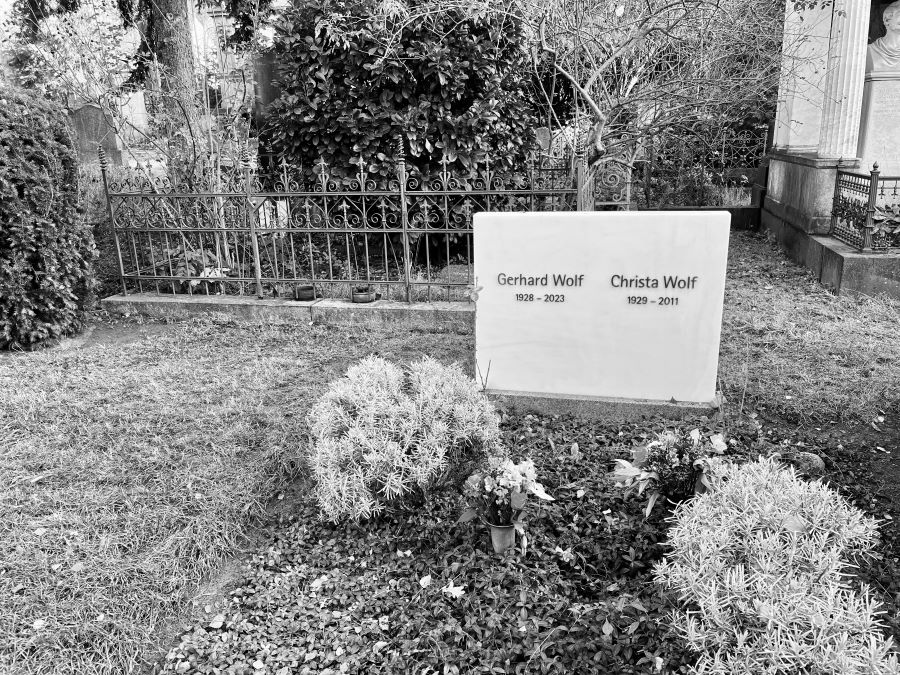
The morning after we launch A Dream of White Horses at Curious Fox in Kreuzberg, I walk with my friend Matt through more cityscapes of memory. We pass by old apartments and stomping grounds. Where Katrin was born and where Lotte went to kindergarten and school. We stop by the Dorotheenstadt cemetery to say hello to Brecht and Heinrich Mann, and to see the grave of Christa Wolf.

The last time I was here, the elegant white headstone had been removed. They were adding the name of her husband Gerhard, who died last year having outlived his wife by twelve years. In this month of the anniversary of the fall of the Berlin Wall, when I get home I find my copy of They Divided the Sky, translated into English by Luise von Flotow.

In the past, lovers who had to separate would look for a star where their gaze might meet in the evenings. What can we look for? 

‘At least they can’t divide the sky,’ Manfred said in a mocking tone. 

The sky? This enormous vault of hope and yearning, love and sorrow? 

‘Yes, they can,’ she said, ‘The sky is what divides first of all.’
Words & Pictures: Paul Scraton

You can find out more about the Pahar Trust Nepal and the wonderful work that is done to help hard-to-reach communities in Nepal by visiting their website

Fragments: A Berlin Journal – October ’24

It was sixty years ago today that the first Shinkansen or bullet train rocketed down the tracks in Japan, and it seems fitting that we have managed to time our first journey on the famous train on the exact anniversary. Tokyo station is alive with people, a mass that moves like a series of streams that all enter into the same pond, but once we are on the train all is calm, even at 300kph. We are heading first to Nagoya, where we catch a Limited Express train up into the hills and the town of Nakatsugawa. 

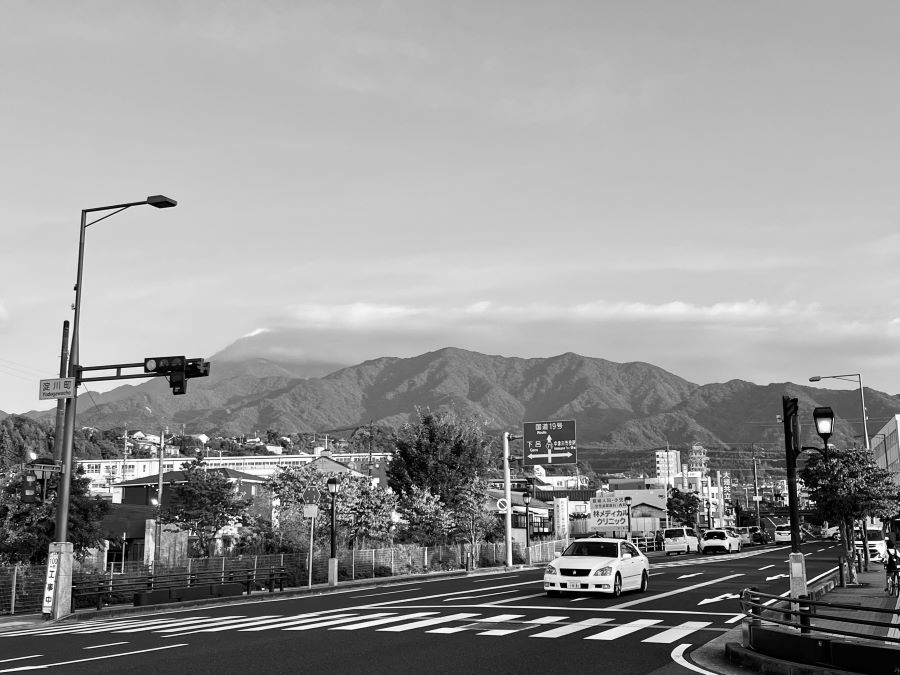
In the soft light of late afternoon, it makes a good first impression. The sun shines on the summit of Mount Ena. School kids walk home in their uniforms via the 7-Eleven, where the Kei cars are lined up in neat rows and the local drunk picks up his highball cans with unsteady hands as darkness falls and the surrounding mountains are left as dark shadows against the blackened sky. 

*

‘It’s twenty minutes,’ the elderly man says, pointing his walking poles towards a path that leads into the bamboo forest. ‘To the top. Twenty minutes.’

We thank him but before we can set off up the Shijuhachi-magari or the 48-curve path that will lead us to the top of the hill and the ruins of the Naegi Castle, his wife steps forward.

‘Where are you from?’

We tell them we are from Germany. They both nod and then look at each other. The man’s face is concentrated as he tries to find the words for the next question.

‘Germany… okay. Germany. But… East or West?’

*

We have walked out from Nakatsugawa to cross the Kiso river where, in a few years, a bullet train through the mountains will link Tokyo to Nagoya in an almost unfathomable forty minutes. Today it is just the construction workers and the friendly elderly couple, who have decided against the 48 curves and left us to it. We climb up through the mix of cypress, chestnut and bamboo, a winding trail that the feudal lords once climbed as an alternative to the more traditional approach to the castle, perhaps when their arrival needed to be a little more secretive and under the radar.

At the top the forest falls back to give us a view back across Nakatsugawa to Mount Ena and north to the hills where we will be walking tomorrow. We are here to hike part of the Nakasendō, the old route of the Edo between Kyoto and Tokyo that the various daimyō or feudal lords were expected to travel as they alternated between their home bases and the capital city each year. 

There were 69 stations or post towns on the route and although most, such as Nakatsugawa itself, have been swallowed by more modern towns and cities, with only a handful of historic structures still in place, there are a few that have been better preserved and have become something of a tourist attraction over the past hundred or so years after the Kiso Valley and its post towns were made famous by the writer Shimazaki Toson and his novel Before the Dawn.

Back in Nakatsugawa we visit a sake brewery right on the bend in the road that is an identifying feature of post towns along the Nakasendō, the street layout designed to slow down and confuse advancing armies. The sake was brewed with the waters that emerge from Mount Ena and was named for the holy mountain after the brewery got the blessing of the head priest of the Ena shrine in the form of a poem. 

May Sake brewed 
with the waters of Mount Ena
Bring joy to all those who drink it

It works for us.

*

We are being guided along the trail by Nick, an Englishman who has lived in Japan for more than a decade. As we walk from Ochiai, following the old road through sleepy villages and forests where the road still has its original stone paving, he tells us about the forests of the Kiso Valley and the sacred trees, including the Japanese cypress. It feels as if we have been waiting for this moment, collecting thoughts and questions throughout our first days in the country, waiting for Nick to answer them. So we hear about the history of the Nakasendō and the villages we are to visit, but also Japanese politics and society, the trees and the mountains, the folklore of the valley and Nick’s own personal story.

Along the way we ring bells to warn any bears that might be nearby what we are coming, and we stop for tea in a traditional Tateba. Once there would have been teahouses like this all along the trail, but this is one of the few surviving, staffed by mostly elderly volunteers who delight in finding out where the hikers who pass by have come from. Even on the other side of the world, nothing can compel a Yorkshireman to make a strike next to the United Kingdom, when he can take the chalk and simply add the word Yorkshire in a space beneath.

*

As we cross the Magome Pass the rain starts to fall, and we make our way down through the forest to reach Tsumago. The village remains preserved because of strict ownership rules, that basically make it impossible for anyone from outside the village to purchase property. But with villages along the Nakasendō suffering the same demographic problems as the rest of rural Japan, it remains to be seen how long this policy can be maintained. Already, the first houses are falling into disrepair, even though there must certainly be those from outside the village who would be interested in taking them on.

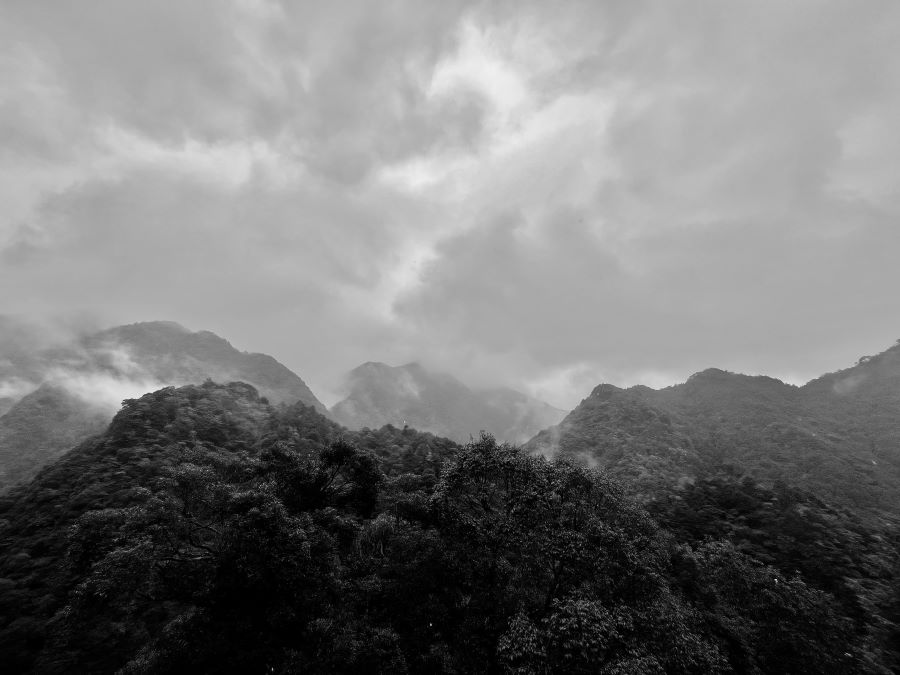
A rainy day in the forest. Akasawa is where forest-bathing therapy began in the 1980s, but today the rain has kept most people away. Instead we explore the woods with Tanaka-san, a volunteer ranger with a dry sense of humour and twinkle in his eye.

‘Have you ever seen a bear?’ we ask him, via Nick who is on hand to translate.

‘Not this year…’

*

The trip continues. It becomes a blur. In Otsu, on the shores of Lake Biwa, we discover an ‘Aloha’ festival complete with dancing girls and Hawaiian costumes, before we come across Oktoberfest, complete with bratwurst and beer and magic shows to a Schlager soundtrack. Our hotel is a mix of manga, anime and superhero collectables. We take the train to Kyoto and climb up through five thousand Torii gates before exploring the historic city and the castle where the Shogunate began and where it fell. In the castle, the floorboards creak. Nightingale Halls, supposedly to warn inhabitants of any intruders…

This is most likely a myth.

There is little romance in the information boards. Kyoto is filled with these stories of old Japan and visions, in its old houses, shrines and temples, of the deep history of the country. Which makes the station and its main hall like something out of a dystopian science fiction film all the more striking and surprising. The view from the top of the elevator is enough to make you queasy.

How do you process all this? On the island, perhaps. In the steep valley by the rushing river.

*

We take the train to Matsuyama. Shikoku. The smallest of the main islands. Everyone we have told about our plans to visit are delighted that we are going there. So much so that it has begun to feel like the goal of the journey, the main destination of the trip.

The train crosses the inland sea in the mist and drizzle. I scribble notes of what can be spotted through the window. A crane, in the rice field on the edge of town. A waterlogged car park beside the factory. A line-up of cars at the level crossing. Drainage channels and telephone wires divide the landscape into neat blocks as low clouds clink to the hillsides and bamboo groves among the trees look like collections of cloaked figures moving menacingly towards us.

Reading The Silent Cry by Kenzaburō Ōe, who grew up amidst the forests of Shikoku.

Born and bred in the depths of this forest, I still couldn’t escape the same stifling sensation whenever I passed through it on the way to our valley. At the core of that sensation lay emotions inherited from those long-perished ancestors who, driven on endlessly by the Chosokade, had plunged deeper into the forest until, coming upon a spindle-shaped hollow that had resisted its encroachment, they settled there.

Ōe describes Chosokade as, a creature of terrifying size that exists everywhere in time and space. There should be no whistling after dark in the forest of Shikoku as it can draw such beings towards you.

*

We drive through the rain into the island interior, following increasingly narrow roads until we reach the Iya Valley and its vine bridges, steep waterfalls, and a hotel by the roadside some 200 metres above the valley floor, where its hot springs emerge from the mountain and meet the river. The hotel has been built out from the steep hillside and is linked to the hot springs below by its very own funicular railway. We sit in hot water as the river runs by beneath us and the rain continues to fall. From the forest we can hear the sound of birds and monkeys and whatever else lives in the thick undergrowth. 

*

The house sits above rice fields and the Shimanto river. The valley is wide enough for a couple of fields width between the river and the hills to the north. The house is wooden, with a mix of Japanese and western rooms, and plenty of resident creepy crawlies. We spend our days exploring the valley and down the coast. The Shimanto river is wide in places, the landscape gentler than Iya but no less spectacular. Bridges cross the river without any barriers or railways, so that they can be submerged by the annual high waters without being washed away. Loudspeakers along the roadside broadcast daily bulletins but can also warn of flash floods. Or earthquakes. Or, down by the coast, of tsunami.

On the coast, in the Ashizuri-Uwakai National Park, we follow a short stretch of the Shikoku 88 Temple Pilgrimage, a 1200km hike between the temples and other sacred sites on the island where the Buddhist Priest Kūkai (Kōbō Daishi) is believed to have spent time during the 9th Century. 

As we move through the park we see many pilgrims in their distinctive conical hats, some with bamboo walking sticks. Others have bought their poles from Leki. Or Decathlon. Most of the pilgrims seem to be Japanese, but there are some foreigners on the trail, and at the Kongōfukuji Temple we observe a Japanese pilgrim and his Swedish counterpart start a friendship over their experiences and their weary feet.

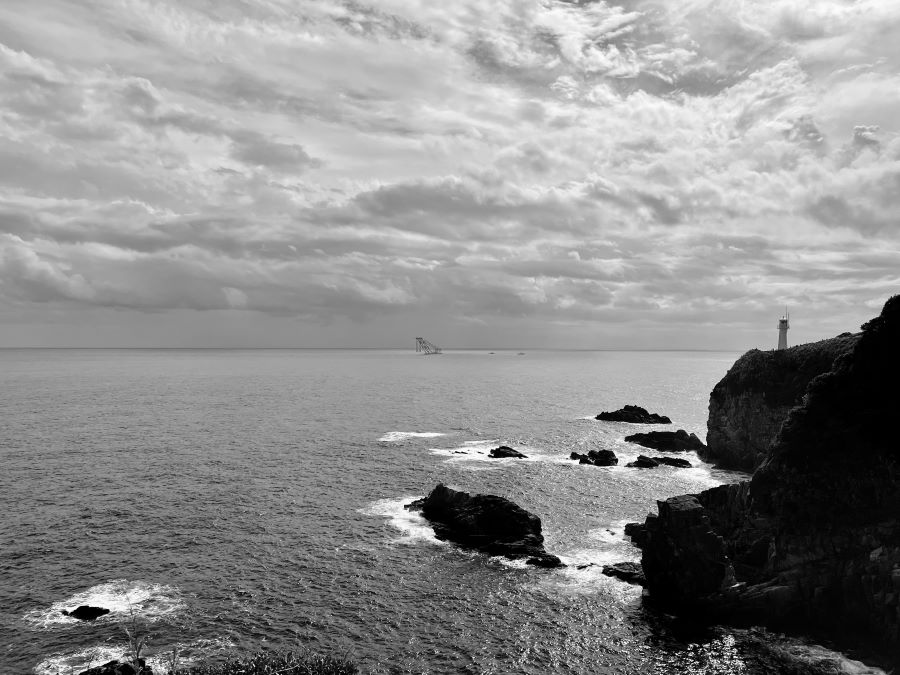
The coastline is magical, the white horses dancing on the Pacific as we look out from Ashizuri Cape and into the offing. We drive back to the house and towards the sunset, passing through small rural communities where, as in Tokyo amidst the bright lights of the biggest of big cities, the emotion that comes first to mind is melancholy. At this very moment, this seems to be a country filled with nostalgia for a once-imagined future. Even the things that seem advanced from a European perspective, are like what we imagined the 21st century to look like in the late-1980s or early-1990s. 

It is a future that has been slowed or even stalled. Overtaken. In the countryside the towns are neat and functional, but the number of abandoned or empty buildings are unavoidable. Weeds grow through the cracks of underused pavements and bicycle paths. The newspapers speak of ageing populations and managed decline. 

The wooden house creaks in the night and in the morning, the loudspeakers wake us with a cheerful tune and a message of when the mobile library will be passing through different parts of the valley. 

*

Hiroshima. If we felt like Shikoku was the ultimate destination of the trip, it was Hiroshima that was always on my mind when we first spoke of coming here. The ferry from Matsuyama approaches the city through the islands of the inland sea and you can see how the city developed into an almost natural amphitheatre, shaped by the river and the surrounding hills. For those who love the mountains and love the coast, there can be few better settings for a city.

And from the deck of the ferry, you can look up 600 metres above the apartment buildings and office blocks, where the sun shines blue, and know that it was there that the first atomic bomb was detonated. It is hard to hold the beauty of the scene and the horror of the story in the same thought, and you are not sure what to expect when the ferry docks and you finally step ashore.

*

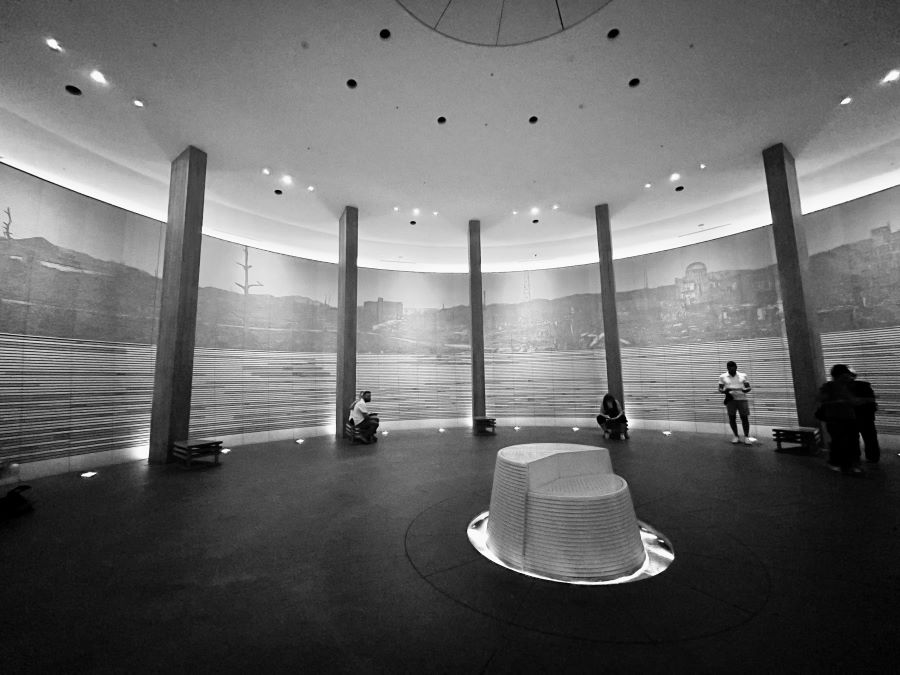
A city to fall in love with? It might just be. We walk through the Peace Memorial Park towards the Atomic Dome, pausing to spend time inside the memorial hall itself. It offers a moving tribute to the victims and a reminder that the damage done by the very nature of the weapons dropped on Hiroshima and Nagasaki meant that lives continued to be impacted in the most horrific ways for years and decades to follow.

We hold these stories, the mental and physical devastation of the bomb, close to us as we climb the nearby tower where we are greeted with a sunset view of the surrounding hills and a bar full of mostly young, cheerful and happy people, sharing drinks and the glorious scene unfolding before us. We sip our beers and wine among them, and the go to eat Okinomiyaki in a restaurant filled with members of a local young football team before walking streets full of joyful Sunday evening revellers.

Hiroshima offers so many lessons from its history, but it also offers something in its present that is hard to explain but pulls you close. It feels like a privilege to be here.

If the human race is fortunate enough never to experience an attack by nuclear weapons again, still the wisdom of the Hiroshima people who survived the worst days of human experience must be cherished.
– Kenzaburō Ōe, Hiroshima Notes.

*

Our last days in Japan pass in a whirlwind. A train ride and a night in Nagoya, watching young men dancing on the street as lights illuminate a spaceship disguised as a bus station and shopping mall. These magical apparitions that have followed us through the country help make the landscapes of Studio Ghibli make all the more sense, and it is fun to join the crowds at the Ghibli Park and in the Warehouse. Despite the number of people, or perhaps because of them, the sense of escape feels all the more real.

Our final night is in Hakone, taking the mountain train up from the coast until we reach our hot spring hotel. We have our own bath on the balcony, and can sit and watch the mist curl around the forested hills as darkness begins to fall and the town illuminates below us. Any farewell from a place that has so captured your heart can only feel bittersweet, but nevertheless, this feels like the perfect goodbye.

*

Reading Kusamakura by Natsume Sōseki:

But only when I am wrapped, naked, by these soft spring clouds of evening steam, as now, do I feel I could well be someone from a past age…

If the weather is right, you can see Mount Fuji from Tokyo. You can see it from Hakone. You can see it from the Shinkansen as it makes its way from Tokyo to Nagoya. Or in the other direction. Quite often, you can see if from the plane either as you arrive or as you leave. We haven’t managed to see Mount Fuji in all our time in Japan. Not in real life, anyway. Reading the great Matsuo Bashō on the way to Haneda, it is reassuring to know that we are not alone.

In a way
It was fun
Not to see Mount Fuji
In foggy rain.

*

At Alexanderplatz we sit outside the station, drink coffee and eat baked goods as visitors queue for the TV Tower and two drunk men get in an argument with a security guard. The weather has turned while we’ve been away, and Berlin has entered its best month. There is no question that my favourite time of the year in the city are the autumn months leading into the opening of the Christmas Markets. It is now that you realise just how many trees our city has, as they explode into a riot of colour and the pavements are scattered with the fallen leaves. 

The month has one more highlight left to give, almost forgotten until it is right upon us. I travel to Yorkshire, to Halifax and the Piece Hall where the Book Corner is hosting the launch of my new novel A Dream of White Horses. It is a book about family, about friendship and about searching for home in a fractured and fragmented world. I talk in the bookshop to Kevin from Bluemoose, my wonderful publishers, and we discuss writing, belonging and the themes of the book.

From the acknowledgements:

The title of this book comes from a famous rock climb at Gogarth at the north end of Holy Island/Ynys Gybi, itself just off the coast of Anglesey/Ynys Môn in North Wales. The first ascent of ‘A Dream of White Horses’ was by Ed Drummond and Dave Pearce in 1968, and although it has always been a climb way beyond my modest abilities, there is something about the name that has stayed with me since I first heard it during our summer camping trips to Rhoscolyn at the south end of the same island in the 1980s. More than anything, it seemed to explain perfectly how I felt about this special place when I was away from it and my longing to return. It still does to this day.

*

We visit friends in Karlshorst for a fire in their garden. They are about to fly south, to Namibia, as part of a journey around the world. The fire crackles as we drink beer and glühwein and talk about adventures past and those that are to come. The places that are important to us are not always those where we are born or even where we have lived. It is hard to describe how a place captures you. How you feel like you leave something of yourself there in order to be sure that you will return. 

I think back to the final morning in Hiroshima. I ran out from the hotel, following the path around the island that helps project the harbour from the inland sea. The tide was up, the waves breaking across the path as I went. Fishermen waited for the early morning catch. A few other runners, nodding as they went in acknowledgement. I looked out, away from the city towards the islands of the inland sea. Shikoku beyond. The wind had picked up and the first waves were breaking on what had been up to now still and calm waters.

What do you dream of, when you dream of white horses? To what places do your thoughts take you? How will you get there? And who will be there with you?

Words & Pictures: Paul Scraton

Fragments: A Berlin Journal – September ’24

State elections are held in Thuringia and Saxony, with depressing success for the AfD and a strong showing for the brand new “Left-Conservative” or “Left-Populist” party that has formed around Sahra Wagenknecht. Possibly the most concerning aspect of the results are that the AfD are the number one party for voters under the age of 35. That they are winning the youth vote speaks to the atmosphere of disillusionment and economic fear held by many young people, and not only in Germany. What will happen in next year’s federal election is anyone’s guess, but the dangers are very real indeed.

*

Katja Hoyer, writing in The Guardian, warns against the simple explanations and knee-jerk responses to the election votes. It must surely be possible to condemn the AfD for what they are, while also trying to understand where their vote – and indeed, that of the BSW – is coming from.

But easterners are far from anti-democratic. There were lively public debates everywhere in the buildup to the elections. People discussed politics at workplaces and at the kitchen table. Turnout was at a record high, with three-quarters of people casting their vote. East Germans are neither fed up with politics nor with democracy. They are fed up with not being taken seriously…

*

It is hard to be optimistic in times like these, but there remains something about September, and autumn in general, that suggests something of a new start. I have always felt that this is the actual time for resolutions. The football season is starting. The academic year too. A summer break to find inspiration for new ideas or new starts. Time to clear the desk. Get to work.

*

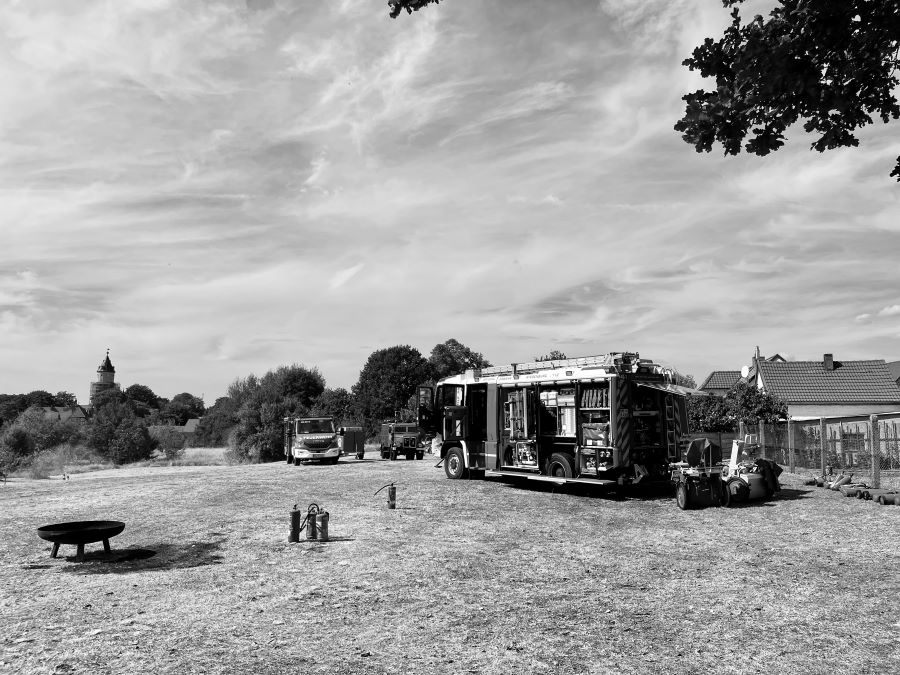
In Wiesenburg, it is the annual open day for the volunteer fire brigade. We grill sausages in front of the garage, where chairs are sent out for the older folks in the village to enjoy their coffee and cake, and biergarten tables and benches for everyone else. Kids clamber in and out of the fire engines and the bouncy castle, while the pea soup cooks in the bright red field kitchen. Throughout the day people come down from their houses with their pots, to buy a number of portions for the week ahead. ‘No need to cook for the next few days,’ one of the women says, as she carefully holds her pot full of soup with two hands. ‘Like being on holiday…’

My route to the airport starts on the Bellermannstraße before catching the Airport Express from Gesundbrunnen station to BER. We like to complain about airports, especially Berlin’s no-longer-so-new one. But familiarity at least breeds some understanding of how to mitigate its many faults. Pass through security in Terminal 2. Bring some food. Don’t trust that the pub on the other side of the passport control will be open. 

It seems to obey no logical timetable, and I wonder if the woman who always seems to be working there when it is open, lives somewhere in the non-Schengen end of the terminal, in that strange in-between place where you have officially left Germany without leaving the building, and that she opens and closes her pub simply when the mood suits her. 

*

As I travel once more to the UK, leaving Germany at that end of the terminal but not yet on the plane, let alone admitted to what I sometimes still call home, I am reading Ryszard Kapuściński. The Polish journalist and travel writer is describing a moment early in his career, when working in a small town on the very edge of Poland, close to what was then Czechoslovakia:

This mystery and quiet intrigued me. I was tempted to see what lay beyond, on the other side. I wondered what one experiences when one crosses the border. What does one feel? What does one think? (…) It must certainly be different. But what does “different” mean?

On a couple of occasions I have been asked to lead creative writing workshops, usually with a friend, on the subject of place writing, whether travel writing, essays or simply writing place in creative nonfiction. I’m not sure it is possible to actually teach writing, or even if the things that might work for me are of any use to the people sitting around the table. But it does make me think, especially when picking texts to share by writers far greater than I will ever be, about what tools you might need. 

Most of all I think you need curiosity. The desire to see what is on the other side. The interest to ask questions of people and places. The need to collect stories from the past and the present, to help you understand. To see what’s different and to find out what different means…

*

In a pub in Guiseley we arrive for the weekly quiz with about two minutes to spare. Thanks to our combined knowledge of musical theatre, European capital cities (and where they are located), an ability to differentiate between titles of country music songs and headlines in Take a Break magazine, we win by a solitary point. A four-pack of craft beer each and we will walk home in triumphant spirits. 

During the quiz I have one of those moments when I wonder, as we sit at the table in the corner, waiting for the next round (of the quiz or the drinks), what it would have been like if I hadn’t agreed to that job in a hostel cafe more than two decades ago. If Berlin had stayed an extended stopover on a long journey to Sarajevo. But there is not much time to ponder. There is a sheet of paper with Drag Queen Celebrity Lookalikes, and they are not going to identify themselves. 

‘The thing is, there is only so much water on the planet, right?

‘Right.’

‘So how can it be that there seems to be more rainfall now? They call these floods “once-in-a-century” events but they are happening more and more frequently. Or am I wrong?’

The two German guys are waiting to be called to board at Manchester Airport and are discussing the floods that are happening in Poland, Czech Republic and Germany.

‘It’s that it all comes at once. And the land is dry and can’t it soak it up… not at that volume.’

He switches to English.

‘Extreme Weather Events.’

‘Thing is, you can’t get insurance any more. Not if you live in a flood risk area. And loads of places are now flood risk areas that never used to be before.’

‘At least you don’t have a basement.’

‘True.’

‘And we live on the fifth floor…’

*

Every story on the Wrocław News website is about the rising waters in the Odra river and its tributaries. The city is bracing itself, but it looks like they might get away with this one. Other places are not so lucky. Meanwhile, changes to the monsoon in Nepal are causing major problems, from flooded rivers to landslides wiping out the roads that are often the only access to remote villages in the hills. We’re in the same storm, but we are not all in the same type of boat.

*

I’m invited to Osterode, a small town on the edge of the Harz mountains, to take part in a series of events linked to the 200th anniversary of Heinrich Heine’s Harz Journey, a walk which I followed for my own book that was published last year in Germany as Harzwanderungen. It is nice to be back in the town, with its half-timbered houses and views to the hills around. I walk some of the route and marvel at how much more of the forest has been ravaged by the bark beetles – another result of the climate crisis – since I walked these trails for the book four years ago.

‘The thing is,’ my host Lutz says, as I mention how different the landscape looks. ‘There is a new forest growing. And we might get away from these monoculture plantations and have a mixed forest like it was even before Heine was walking here. Anyway, you have to have hope. Otherwise, what else is there?’

I walk up the old postal road between Osterode and Clausthal-Zellerfeld. I came this way following Heine and now I am following myself.

Here the mountains grew steeper; beneath me the pine forests were swaying like a green ocean, and above me the white clouds were sailing through the blue sky. The wild landscape was tamed, so to speak, by its unity and simplicity.

Heine wouldn’t recognise the forest today. But even as he walked, two hundred years ago, the forest was already business; the Harz mountains cultivated land, like the fields of cabbages and sugar beet in the plains north of Göttingen where we both started our walks. Like Lutz said, maybe out of catastrophe there is a chance for something better to grow.

*

In Brandenburg, where the forest has been eaten by bark beetles and destroyed by fires that can be seen from Berlin, the AfD – who have their own thoughts on the climate crisis and the measures we might need to implement to mitigate the impact of what is to come – come second by a percentage point or two. A sigh of relief? At least it was only second? Can we find hope in results like these? 

*

The plane leaves Helsinki and flies north, ever north until we’re passing through the gap between Russia and Alaska and now we’re flying south. In Tokyo the first few days are filled with reminders of ten years before; the things that have changed, and those that appear the same in this wonderful, overwhelming and bewildering city.

We emerge from the subway in Akasaka to torrential rain. The post-work crowds fill the corner Izakaya, leaving no space for us until we are rescued from the downpour by a friendly man outside his pub. He finds us a table and we drip on the floor while drinking beers and lemon sour, nibbling on skewers and soy beans. 

Tokyo is a rush. Tokyo is a blur. Tokyo is understandable. Tokyo is unfathomable. It feels nostalgic – the nostalgia for an imagined future that never came true. A vision of what might have been and now feels a bit scuffed around the edges. A bit 1980s. A bit 1990s. A bit like us, really. Under heavy heavy skies, with the air warm and humid, there is a feeling of melancholy in this city, despite the cars and trucks and people, people and more people. 

We meet Daisuke in Shibuya and go for sushi in a tiny restaurant where they somehow squeeze is until a table in the corner, in front of the miniature kitchen where the rice is made and in front of the saki shelf, so that every time someone orders a drink I have to move to one side. And then we go to Golden Gai, where Daisuke drinks at a bar that is only accessible to those who ‘Mama’ – the third generation of women to run the establishment – determines are trustworthy. The bar was built in 1948, when Shibuya was still a barren field destroyed by the bombs of World War II.

Mama must trust us, must count us now as one of the ‘believers’, as she takes our photo for her special album and carefully writes down our names so that she gets the spelling right. On the wall there are pictures of her grandfather and grandmother from when they started serving drinks in 1948. Each bottle on the shelf has the name of the regular it belongs to.  It is everything you’d want a Japanese drinking den to be…

‘We are totally outdated but we cherish something that existed in the past but that is invisible nowadays…’

*

The runners gather at different meeting points, the part of the trail around the grounds of the Imperial Palace that is nearest to where they are coming from. Some leave bags and water bottles. They park their bicycles beside the water fountain. Others, in bigger groups, carry urns of something refreshing to be doled out afterwards. And then: we run.

The loop around the palace is about five kilometres, with each hundred metres marked by stone flowers laid in the pavement. On a Sunday morning there are so many of us that it is a surprise not to see numbers pinned to shirts. But no-one has organised this, except for whoever it was, years ago, that decided to mark the route and make it a thing at the very heart of the city.

There is an unspoken solidarity on the trail. Fast and slow. Japanese and foreign. Some will do one loop, staggering to a grateful halt after half an hour in this damp, muggy morning. Others will complete laps, counting up (or down) the kilometres until they reach their goal. 10k. A half marathon. A full marathon. More… But nobody except us runners are counting. It matters only to each person who puts one foot in front of the other and then does it again. Those who keep going.

*

In Omote-sando, between the boutiques that line the neat streets of low buildings, the crowd dressed in identical robes, beer cans tucked down the front for safekeeping, carry floats through the narrow streets while children bang drums and blow whistles and everyone, from participants to onlookers, record it all on their phones. Harvest time. 

The day begins at the Tsukiji Outer Market, all that now remains of what was once the greatest fish market in the world. A tourist trap? Undoubtedly so, but in the inside halls Tokyo residents still buy their fish that lies resting on mountains of ice, and the restaurant and other buyers have priority before the rest of us are admitted and the chefs come to buy their knives or get them sharpened at the workshops they have always used. Fresh, raw fish, eaten from styrofoam plates with disposable chopsticks has never tasted so good.

*

In Asakusa, a kind of bazaar leads from the gate to the Buddhist temple, and amidst the throngs of people shopping for all manner of tat, the first thing to notice are how many people are wearing traditional Japanese dress. It is only at the second glance that you realise that they are almost exclusively foreign, predominantly Chinese, and that they are being followed as they make their tiny footsteps through the crowds by a photographer who will document it all as part of the service.

Now we notice the number of shops that spell out KIMONO RENTAL in a variety of different languages and scripts. It is a chance for all of us to have a bit of old-fashioned Japanese cosplay in front of a real, and important Buddhist temple, while the odd, actual Buddhist might be there for reasons other than a guidebook checklist or a spot of dressing up.

We try to imagine the equivalent. Lederhosen or a dirndl to visit the Frauenkirche in Munich? A kilt before stepping into St Giles’ Cathedral in Edinburgh? It seems unlikely. 

*

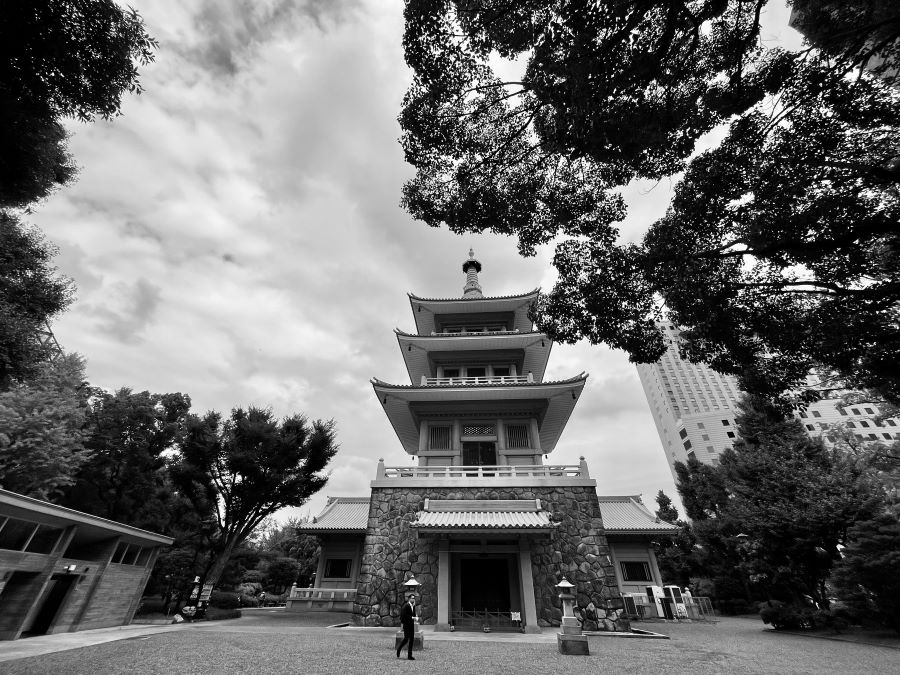
On 1 September 1923 the Great Kantō Earthquake led to a fire that claimed more than a hundred thousand lives. On 9 March 1945 the Great Tokyo Air Raid saw the US airforce drop 180,000 firebombs on the city in one night. It was the single most destructive bombing raid in human history, killing a hundred thousand people and leaving more than a million homeless. At Yokoamichō Park the Tokyo Memorial Hall remembers all those who were lost to the fires that raged during both events, and graphic images show the piles upon piles of charred bodies in the streets.

‘It was often impossible to tell if they belonged to men or women,’ the commentary on the information film bluntly explained, while outside it was possible to hear the sound of kids at break in the primary school on the other side of the fence while we contemplated the memorial to all the children lost to both events, little more than twenty years apart. 

Japan has a new Prime Minister. It looks like he will call an election. Meanwhile bombs rain down on Beirut and floods rip apart the Kathmandu Valley. To travel is to build connections in places. In a business hotel room in Tokyo, it all feels a long way away, as we try to make contact with those we care about and make sure everyone is safe.

*

In Ueno Park the city seems to retreat as we walk up the stairs. A moment or so earlier, we were sitting at a bar under the tracks, watching the crowds in the Ameyayokocho market, listening to the music, the calls of the vendors and the scream of the pachinko machines as the sliding door periodically opened across the street. And now it is as close to silence as it is possible to get in this city.

The wind blows the trees. Birds sing. The water runs from a fountain so that we can wash our hands before approaching the shrine. The gravel crunches beneath our feet. Across the pond filled with Japanese Lotus leaves we can see the apartment blocks, the hotels and the office towers, but on a bench by the water it is possible for a person to once again hear themselves think. What kind of witchcraft is this?

Words & Pictures: Paul Scraton

Fragments: A Berlin Journal – August ’24

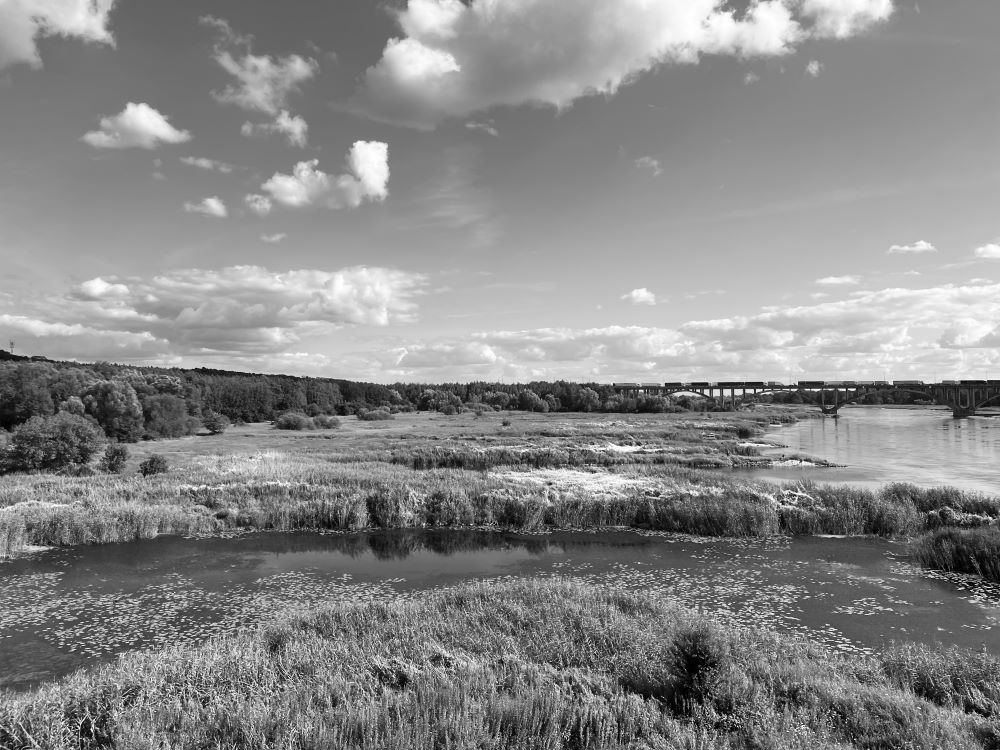
I am in Wrocław to both explore the former sewage irrigation fields on the edge of the city for a literary project, but also to dig into the history of the city and all the many peoples that have called this settlement on the banks of the Odra river home. Aleksandra, who is walking the fields with me, tells me about the traces of settlers in these wetlands by the river, long before the river was controlled or the sewage fields were created. 

We’ve shaped these places for longer than we’ve had a name for them, she says. The relics of the past lives of the fields can be found throughout. The houses were built on higher land, which is where those early settlers would surely have also lived. The line of old trees that follow what was once the Odra river, then an oxbow lake, now a reedbed. The cobblestoned street with its fruit trees, that linked the manor house with the rest of the world. The brick drainage channels from the 19th century and the concrete replacement from the 20th. 

There are many ideas of what the future might hold for the fields. Cheap land for housing. Ponds for migrating birds. Wild horses on the meadows. A wacky scheme to turn it into a Wrocław savannah, complete with roaming beasts. A safari park on the edge of the city. After the rain, the only beasts we can see are deer in the distance and thousands of snails on the footpath that we try our best not to squash.

*

At the OP ENHEIM gallery in town, itself once the home of a number of Jewish families in what was then known as Breslau, an exhibition gathers together the belongings of people who once called the city home and were scattered to all corners of the earth. Their descendants have allowed the return of these Jewish Breslauers’ belongings to what was once their home city, if only for a while. Objects that have wandered the world, to the UK and Sweden, the United States and Israel. Objects that speak not only to the history of a place, but to families and their stories.

Watches and school reports. Notes for a Bar Mitzvah speech. Cigarillo boxes and apartment nameplates, paints and brushes, a travelling chess set. There is a family film from a holiday on the Baltic sea in the 1930s, the children playing in the sand as swastika flags flutter in the breeze. A postcard written by the painter Heinrich Tischler from Buchenwald.

I’m doing well here, I don’t need anything.

Tischler was released from Buchenwald but died a month later from illness contracted in the camp. His family fled to England.

On a television screen, his grandson Nick tells some of the story, of his father’s feelings about the city where he was born, and his own relationship to a place he knows as Breslau through his family history and Wrocław through his own experience.

‘I say I’m coming to my hometown, which I think tells you something … I put forward Wrocław as a beacon of hope … a beautiful, vibrant, international and welcoming city. So for me, it’s a beacon of hope and a model for everyone.’

From Wrocław I watch city centres burn in England, as mobs run rampage and terrorise communities. It can be hard, in moments like these, to find much hope. But it is there, in those who stand up to the far right and face them down. It is there, in those who come out to clean up and show defiance in the face of this aggression and intimidation. Meanwhile it is those, a long way from the streets where people of colour are intimidated, hotels burn and shops are looted, who continue to fan the flames.

*

On the final Sunday in Wrocław I walk along the Odra and then follow Oława, one of its tributaries, past the corner of the city known as the Bermuda Triangle, back when it was the owner of a somewhat unsavoury reputation, and then beyond, to the edgelands of factories and big box stores, allotment gardens and tram depots. The river trail leads me to the very edge of the city and the extent of the tram lines. It is a peaceful way to end my time in Wrocław, a place that I feel a connection to. As I catch the train to Berlin, it is with a sense of the end of a beginning – the end of a chapter in a story. There will be more to come.

The Mitte Museum is located in Gesundbrunnen, in what was once Wedding, about half a kilometre from where we have lived for nearly fourteen years. Perhaps it is because of its proximity that I have only been once in all the years of living in the neighbourhood. Back then it was part of research into this corner of the city for a neighbourhood walking tour. Since then the museum has been renovated, and when friends ask if I want to join on a weekday lunchtime, it seems time for a revisit.

The museum is located in Pankstraße, in a building that once housed a school. The exhibition tells the story of the city as it grew, and especially the impact of industrialisation on Berlin. The old model, which shows the Gesundbrunnen spa as it was before the factories and the tenement blocks remains, along with the old maps, the sketches, the photographs. In this space built for learning, we are taught history through the layers that pile up on top of each other, and in the details of individual families and how they once lived.

*

After a damp spring and early summer, Berlin is hotting up. The first days of good weather lift the spirits of the city. A few days of thirty-plus temperatures and Berliners begin to become frazzled. Those who can escape to the lake or the coast will do so. Others find respite where they can. In the playground, children move with the sun, from one patch of shade to the next. Queues form outside the open air pools. Fans whirr and shoppers linger in the supermarkets with air conditioning. Evening brings cooler air. We open the windows wide with relief. But will we remember these days in the deepest of winter?

*

Outside the former Stasi headquarters in Lichtenberg, people begin to arrive about an hour before showtime. They get the first choice of the neat rows of white seats or the deckchairs on the grassy slope opposite the main entrance. They bring with them picnic baskets and coolers of drinks. Those – like us – who are a little less well-prepared, leave jackets on seats and make a quick run to the Späti.

This is an open-air cinema with a difference. Throughout the summer, the foundation in charge of activities in the former Ministry for State Security of the GDR are showing films somehow connected to the history of the building and the Stasi. They are in German and shown with English subtitles, and tonight it is time for Helden Wie Wir or ‘Heroes Like Us’, an absurd and sometimes fantastical comedy made in the late 1990s, when the events depicted were only a few years back.

The film is entertaining, and gets plenty of knowing nods of recognition and laughter from what appears to be a crowd with plenty of lived experience of East Germany. But it also begs some questions about the role of comedy in telling such stories. Is it always acceptable to play for laughs on subjects where the victims and their families are still living all around us? My instinct with these questions is that there should be no limits to where comedy and satire may go. It just needs to be good. And as we make our way back to the U5, to travel beneath Karl-Marx-Allee towards Alexanderplatz, I’m not entirely sure whether this particular film is good enough. 

I first heard a personal memory of the night the Berlin Wall came down beneath the horse chestnut trees that have offered shade to the drinkers of the Prater Garten in Prenzlauer Berg for more than a hundred years. As it happened, K.’s story didn’t have much to it. A newly qualified teacher, living on the tiny strip of Sonnenallee that was on the eastern side of the Wall, she went to bed in one reality and woke up in a very different one.

Back when she told me the story, K. lived with her partner A. in a tiny flat on Bornholmer Straße, just a few hundred metres from where the first gate was opened at the checkpoint on the bridge while K. slept across the city at her parents’ place, on 9 November 1999. I was new in Berlin and they looked after me, taking me to their favourite falafel place on Danziger Straße, bowling the bowels of the SEZ on Landsburger Allee, and – of course – for drinks in the Prater. There are some that don’t like the beer garden any more. It’s got too expensive. Too full of tourists.

But for me it reminds me of nights like those, when K. would tell her stories of growing up in a country that no longer exists, before they left Berlin to start a family and a new life on the other side of the world. Adelaide is a long way from Sonnenallee in November 1989. But then again, so is the Berlin of today.

*

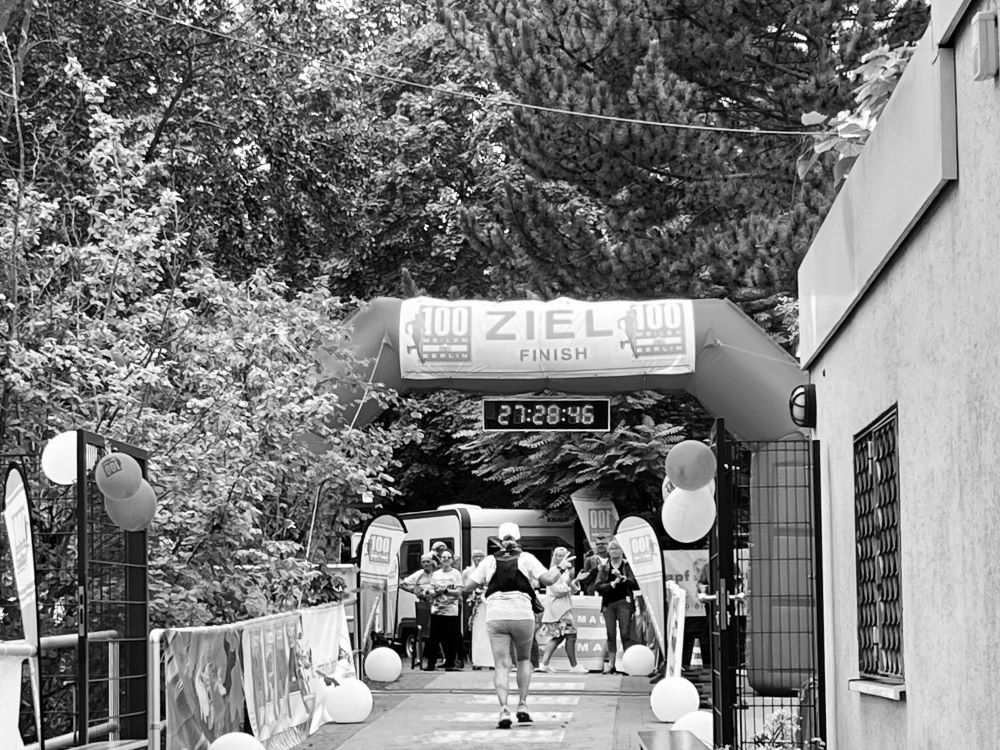
The Berlin Wall was begun to be built with the closing of the border on 13 August 1961, and every year on the closest weekend to the anniversary, runners from around the world make their way to the trail that now follows the route of the old dividing line, to take part in an ultra marathon. The Mauerweglauf is, like the Berlin Wall Trail itself, 160 kilometres through the city and around its edge. Some people take part in relay teams of two, four or even ten or more. Others complete the entire distance alone, out on the trail for a hundred miles, attempting to finish within the 30-hour cut-off.

A few years ago I ran as part of a relay team, and this year one of my teammates from back then (and one of the first people I ever met in Berlin) is running again. The start/finish line is in Gesundbrunnen, right by the Panke river and close to Wollankstraße station. I meet him at 7am, just before he is due to set off on the first leg for his four-person team. He is running the equivalent of a marathon, and I make plans to meet him again at a drinks station up in Frohnau, where the border ran between the West Berlin suburbs and the East German countryside, about halfway through his run.

In Frohnau, the sun is shining and the weekend strollers, joggers and dog walkers stop beside the path to applaud the runners who are strung out along the trail. We are about 22 kilometres into the total distance and there are about 138 to go. I spot a man in a yellow t-shirt, whose number indicates that he is a solo runner. 

‘I are you going the whole way?’ I ask him as he passes and he gives me a wry smile.

‘I’m going to try,’ he replies, and moves on – slow and steady – with a small wave.

I hope he makes it. If he maintains the pace he has managed so far he will finish almost exactly 24 hours after he started. I cannot imagine what will be going through his head at the finish, let alone in the witching hour, deep in the night, with more than a hundred kilometres in his legs and more than a marathon still to go.

*

I spend the day with my nephew and family for his birthday, get a good night’s sleep, and wander back down the Panke to the start/finish line at around nine in the morning. I hope the man in the yellow t-shirt made it. I sit on a bench by the finish line and sip a coffee, watching the last of the solo runners arrive at their destination and then I go for a run of my own, tracing the Berlin Wall trail backwards until I reach the backmarker, flanked by two volunteers on bicycles, who look almost as tired as the runners they are accompanying.

It is hard to describe how inspiring these runners are. As Berlin wakes up, or makes its way home from a big Saturday night, the last of the solo runners have gone long beyond 24 hours on their feet, but they are still moving forwards and still offer smiles to my words of encouragement. Some are accompanied by a bike rider, who can carry water for them or offer other support.

‘He’s about to finish for the tenth time,’ one of these riders says, of his friend who is now about a mile from the finish line. He offers me a handshake and I run alongside him for a second.

‘It’s nothing special,’ he says. ‘I’m nothing special.’

I beg to differ.

Each year, the Mauerweglauf is run in memory of one of the victims of the Berlin Wall. In 2024 they ran for Silvio Proksch. The Chronicle of the Berlin Wall tells his story:

25 December – 1983

On Christmas, the 21-year-old bricklayer Silvio Proksch is shot at while trying to escape over the Berlin Wall. He receives no medical assistance for quite a long time. Silvio Proksch bleeds to death in the “death strip”. The guard who delivered the fatal shot is awarded the Bronze Medal of the Border Troops.

The GDR State Security keeps the incident secret and spirits away the corpse of the dead man. In 1990/1991 two television journalists from German broadcaster WDR, Werner Filmer and Heribert Schwan, speak with Irene Agotz, the sister of Silvio Proksch, and document her memories of her brother’s escape attempt and the way the Stasi treated family members…

*

In Brandenburg, the election posters are being hung from the lamp posts ahead of the state election next month. There are also state elections to be held in Saxony and Thuringia. In all three former East German states, the polls suggest the AfD will emerge as the largest party, although all other parties have so far ruled out working with them, which means it remains unlikely that they will govern. Meanwhile, it appears that Germany is unable to impose a travel ban on Martin Sellner, a leading voice of the Identitarian Movement in Austria, who is travelling to Berlin, to speak to affiliates of the AfD on the subject of ‘remigration’.

In an interview with Deutsche Welle, Sellner says: ‘We’re not too radical. We’re just ahead of our times. In five to ten years, everyone in Europe will be calling for remigration.’

*

On Tempelhofer Feld, in the summer sunshine, Die Ärzte take to the stage for the first of three massive concerts in their home city. As well as band t-shirts there are plenty of anti-Nazi, anti-Fascist and FCK AFD merchandise on show. With the news of the day, the rise of the AfD, and the confidence of dangerous men like Martin Sellner, it is heartening to see such a public rejection of all that they stand for.

And we mustn’t forget, Bela B says, in between their songs that veer from the political to the absurd to the downright silly, that there are more of us than there are of them.

‘Wir sind mehr!’ 

The crowd responds.

I only hope he is right. That we are right. 

In temperatures beyond thirty degrees, the footballers of 1.FC Union Berlin and Hamburg’s HSV kick off the new season of the women’s Bundesliga 2. It has been a while since Union played in the national league, and never in the main stadium. It is a record attendance for the second tier of German women’s football, and although the result is a draw, there is enough to suggest the Eiserne Ladies will have enough to compete at this level and – perhaps, perhaps – even beyond.

*

If you want to escape the heat there are a couple of options. You can go north, or you can go up. It is time to return, for the fourth time in six summers, to the valley just beyond the Germany-Austria border, south of Garmisch-Partenkirchen. It is a region of Austria known as Außerfern, and is for many simply a place to pass through on the way to the higher mountains or Italy beyond. 

But for me it is a place to be. To climb the hills or walk the valleys. To cross back into Germany to swim in the lake. And to build memories upon memories of the previous visits, so that when we clamber atop a mountain and look across the valley, there are personal stories attached to the peaks that stand proud against the blue sky, and the towns down below. As always, the visit is too short, but then the Germans have a word that can be uttered in consolation (of course they do): Auf Wiedersehen. 

Fragments: A Berlin Journal – July ’24

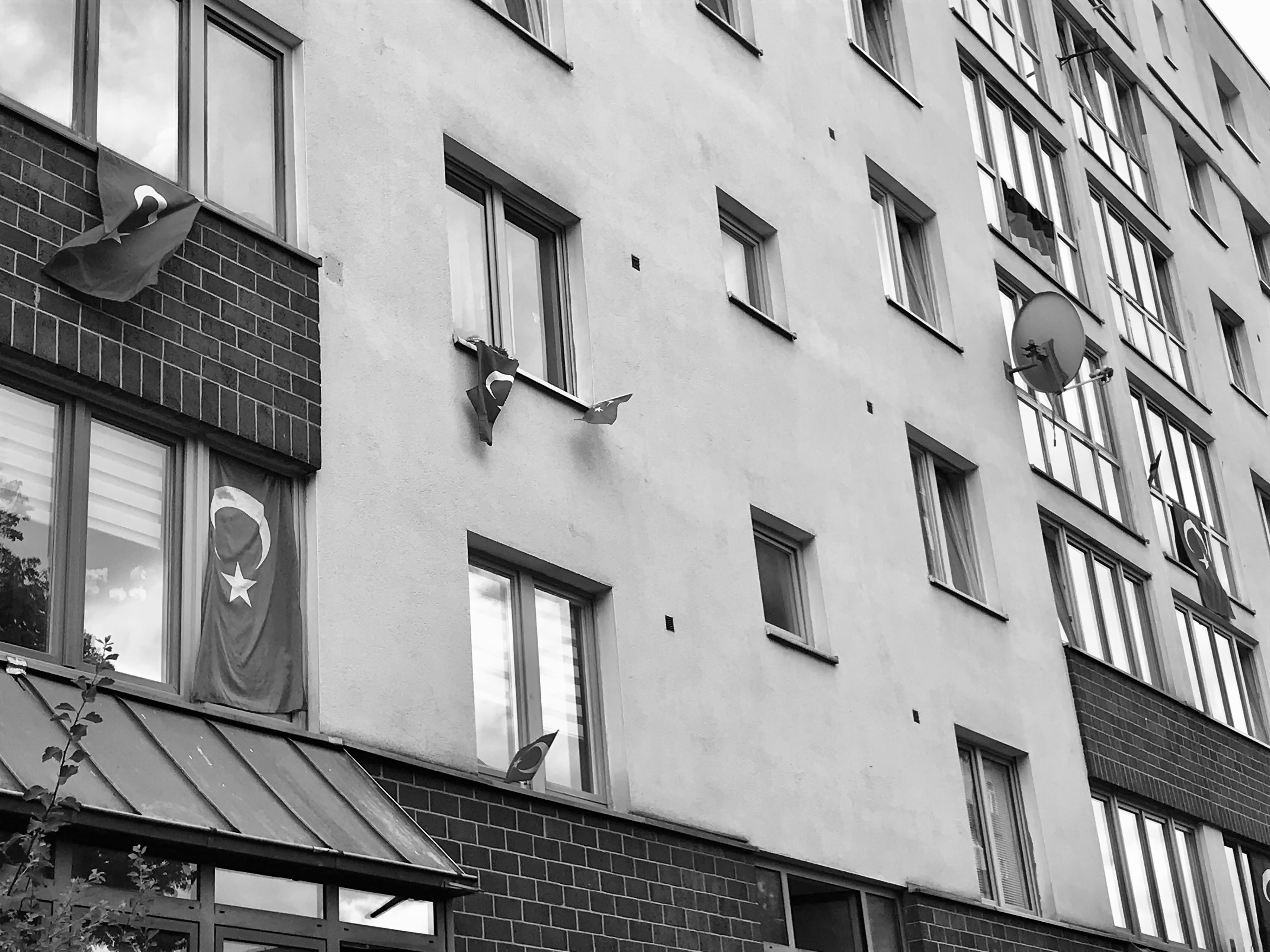
When the goal goes in it feels like our neighbourhood is going to explode. Even more so at the final whistle. Throughout the day I’ve seen flags everywhere. Outside the cafes and hanging out of car windows. Three young women on their way home from school or college all have their team kits on, hours before kick-off. When Germany plays, we can hear the goals go in by the delayed cheers of neighbours, the speed to which they see the ball hit the net depending on their cable or internet connection. But when it is Turkey, the noise is something else. 

If Gesundbrunnen is celebrating, it has to be said that it took some time. Maybe no-one expected them to get this far, but most of the flags and the knock-off merchandise for sale on Badstraße came after the first couple of good results. 

*

Another day. Another sport. Mark Cavendish rolls back the years to win his record-breaking 35th stage on the Tour de France. A few years ago he thought he would have to retire because he couldn’t find a team willing to give him a contract. What happened next is now cycling history.

Ten years ago we were on the side of the road in Otley and then up on the moors for the stages of the Tour de France in Yorkshire. The pubs in town changed their names. People dug out their old bicycles from the shed to spray-paint them yellow or white with red polka dots. One of the greatest things about what might be the greatest of all sporting events is its accessibility. You just have to look at a map of the stage and find your spot by the side of the road, and you can be a part of it. 

Hopefully one day I’ll get to see it in France. Despite everything, it is perhaps my favourite sporting event. Or maybe not even because of the bad parts of the race’s history. Maybe that is all just a part of it. The triumphs and the disasters. The incredible performances and the all-too-flawed heroes. It’s all about the stories. 

*

The third Salon Weißensee at Galerie Arnarson & Sehmer, this time with Marcel Krueger, Jessica J Lee and Dasom Yang. I read a work-in-progress, something that is part of the preparation for my residency in Wrocław later in the month. It is about the Karow Ponds.

These are all the stories of the edgelands. The gravel pits and drainage channels, places that once filtered the waste of four million souls that became an unplanned gift from the past to the present. Neither urban or rural, the ponds and their footpaths offer respite from a city they are part of and owe their existence to, and yet somehow feels so very far away when surrounded by the thick, heavy air of summer and the persistent buzz of insects.

If you follow the path beyond the last of the ponds, along the edge of the fields, you reach a small stream. You can follow that through a tunnel under the road and then another beneath the Autobahn. Now the old sewage fields stretch out towards the horizon. The last notes are scrawled at the top of an otherwise blank page.

Clusters of trees and huge electricity pylons. Gravel tracks and worn down desire paths. A red kite against a bleached blue sky.

This is Berlin.

I wrote.

But not quite.

In the hotel in Dömitz, overlooking the Elbe, the German team line up on the television screen ahead of their match with Spain. The first bars of the national anthem sound and the room falls quiet. It is a little awkward. One man stands up. He is about sixty, with white hair tied back into a tight ponytail. He wears a Germany shirt, but not one produced by Adidas or any kit supplier. His wife stays sitting next to him. He puts his hand on his chest and sings gently. His voice is soft, almost tender. The rest of the room watches the screen while listening to him. 

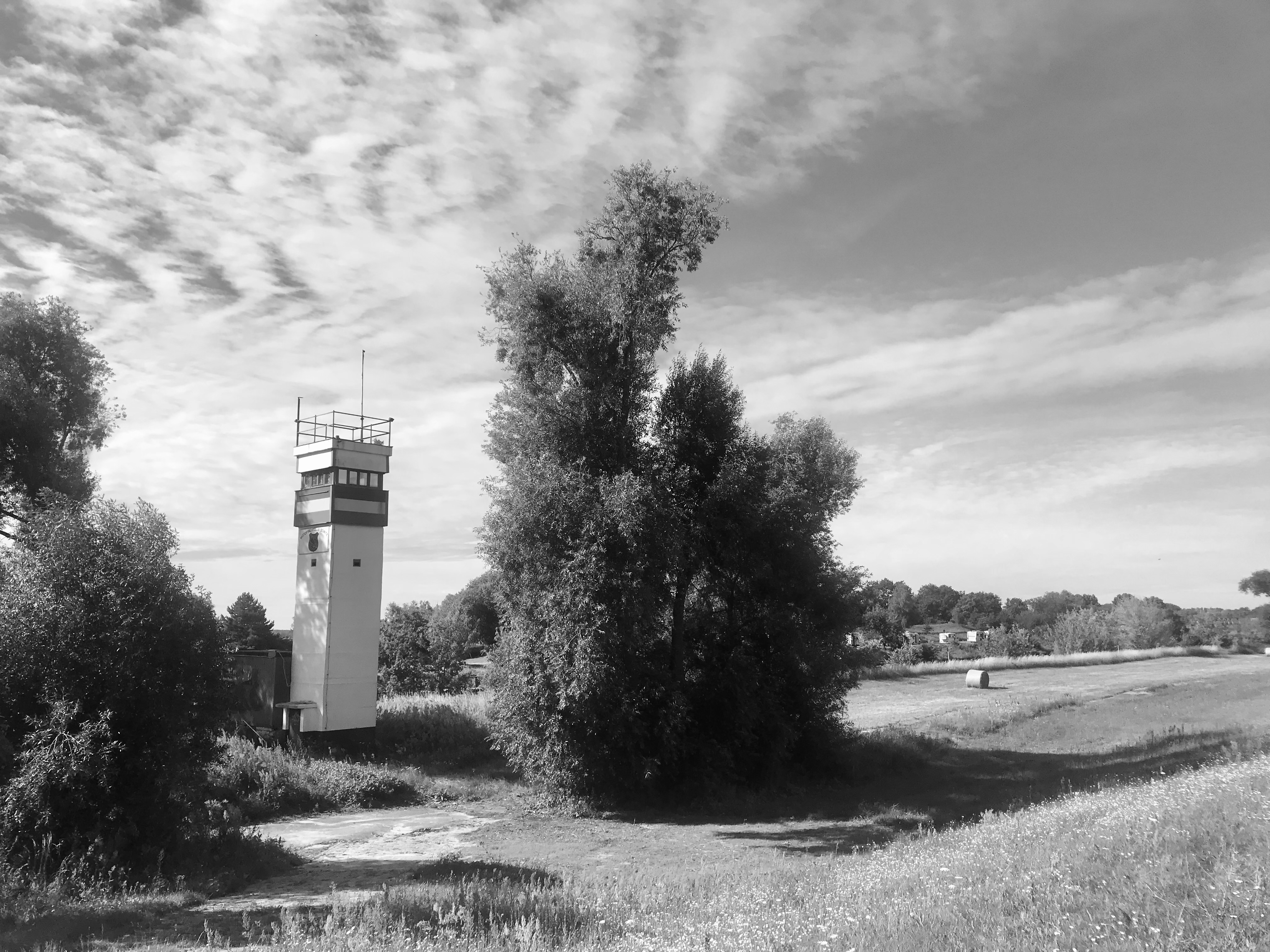
Beyond the television, through the window, we can see the Elbe. This stretch of the river was once the inner-German border, our hotel a grain-storage silo in a restricted zone, West Germany on the opposite bank. Across the harbour is a watchtower. It is the only real remnant of the border in sight. Later, I will meet a woman who lived in the town when it was hard against the border.

‘You didn’t really think about it,’ she said, about the fence at the bottom of her garden. ‘I felt sorry for the guard’s dogs. But otherwise it was just normal. We didn’t know any different.’

Back then, if she wanted to see the river she would have had to travel south, into Brandenburg and on towards Magdeburg, where the GDR controlled both banks and access to the dykes and paths no longer reserved to the men in the watchtowers and their dogs.

The anthem finishes. The man sits down. Conversation starts again. Germany give a good account of themselves, but in the end Spain are too strong. And so, despite their early performances, it looks like hope now rests with England.

*

Reading Kairos by Jenny Erpenbeck. In it, two characters in East Berlin discuss the national anthems of the two Germanys.

– Odd, really, the anthem of a socialist country starting with the most Christian word there is: Resurrected.

– I don’t think it’s odd. It’s just the way it is. You can only make something new after some thoroughgoing destruction.

*

We take a boat trip along the river. The guy sitting next to us has just come from the hospital. He had come here with his elderly father, taking the place of his mother who died a few months ago. His father fell sick and is now on a ward, although the man is hopeful that he will get better.

‘I didn’t know what else to do?’ he says, as if trying to justify his presence on the boat. ‘I visited this morning, but otherwise I just have to wait. And I always wanted to take a boat trip on the Elbe.’

He will get no judgement from me. We move out from the harbour and onto the river, the captain giving us snippets from time to time as most of his passengers try to decide what cake to have with their coffee. Overhead a white-tailed eagle soars. It is an incredible sight. We share the binoculars. Our waitress, delivering the cake, looks up and smiles, as if recognising an old friend.

*

What can you see in the shallows? An oystercatcher on the sandbank. An abandoned bucket from a long-ago fishing trip. Cattle at rest in the shade of a silver willow.

On the wall of Goethestraße 25 is a plaque dedicated to Anna Wolffenstein. She was the last Jewish resident of the town, before she was deported to the camps. I try to work out what her journey would have been. Most likely she would have been taken first to Schwerin and then to Berlin. From there it would have been a cattle truck from Anhalter Bahnhof to Theresienstadt, the fortress concentration camp on the Elbe. The same river that used to flow a hundred metres or so from Anna’s house.

The Jewish population of the town had been decreasing long before the Holocaust, but it was under the Nazis that the Jewish cemetery was finally cleared. I wander around for a while, trying to find it. A few steps lead up to an overgrown path between two fences, and then a green gate with a Star of David. A cluster of trees and a single memorial at the centre. All the remains.

One of the Jewish families of the town left for the United Kingdom. The father would return after the war, to East Germany and the restricted zone, to periodically tend to the grave sites of the family who had remained in the earth long after their descendants had fled or been murdered.

*

I already know that this month I will only spend seven nights in Berlin. From Dömitz, on the Elbe, we have a pit stop in the city before heading out to Wiesenburg. We walk through the dry valleys of the High Fläming Heath, known as Rummel, where legends linger in a place where folklore seems mostly to have been lost in the shifting of the sandy soil and the movements of people caused by war, disease, regime change and the shifting of borders.

*

Back to the Elbe and the modern engineering wonder of the ship canal bridge, crossing the river and transporting boats, barges and ships high above the river. In our corner of Germany it is rare to have a view, but climbing up the embankment to the level of the bridge seems to open up the sky. It reminds me of something Dorthe Nors writes in A Line In The World about her yearning for the west coast during her time in Copenhagen:

I want to wake beneath a sky that is grey and miserable, but which creates a space of colossal dimensions in a second, when the light comes ashore. A horizon is what I want, and I want solitude.

The sky is anything but grey and miserable today, but as we stand on the bridge, the swallows ducking and diving beneath us, we have a horizon and we have the place pretty much to ourselves.

I take the train to Wrocław for my residency, funded by Culture Moves Europe and supported by the BWA Galleries of Contemporary Art. I am there to make connections and start work on a project titled The Fields, all about the former sewage irrigation fields of the city, that share a history with similar spaces in the edgelands of Berlin. But I am also travelling to learn more about Wrocław itself, the culture and the history of a city that has had many names over the years.

As with most Central European cities, Norman Davies writes in his book about Wrocław, the problem of nomenclature is a thorny one. When a city has a different name for every nationality that lays claim to it, to prefer one version over another is to make a political statement and to risk causing offence. Nonetheless, a ready solution comes to hand when one realises the choice does not lie between two stark alternatives – Breslau or Wrocław – but rather between the scores of variants which the historical sources contain.

Davies decided to title each period of the city’s history with the name most appropriate for that era, based on the historical sources. It is something I have wrestled with before, especially in relation to Germany and Poland. My solution was always similar: to name the place based on the period I am writing about. And so, in 1945, the Allied bombs fell on Swinemünde. In 2015, I visited Świnoujście to tell that story among many others about the Baltic shore.

*

Going backwards in time:

Wrocław 

Breslau

Bresslau

Presslaw

Vretslav

Wrotizla

But what do you call the place when no-one knows that the city’s name actually was? Davies goes for ‘Island City’.

And when he is not sure?

Whenever we are in a quandary we use the name that was first introduced by literate Latin-speaking clergy more than a thousand years ago and which is still with us: VRATISLAVIA.

*

I explore the fields with Katarzyna from the BWA and Piotr, a musician and sound artist from Gdańsk. We discover traces of the infrastructure among the reeds and long grass, pick our way through the riparian forest that stands between the old sewage treatment fields and the Odra river, and peer through the fence at the pump house. 

Piotr collects the sounds of the fields, from the calls of the finches and the yellowhammers, our footsteps on the path and distant sounds of the trains heading out from Wrocław. The pulpits are empty of their hunters and the sky is quiet, except for the beating wings of a marsh harrier and the occasional buzz of the light aircrafts that have quite possibly the best view of all.

*

How do you experience the stories of a city? In Wrocław I walk from where I am staying in the southern suburbs and into the city centre, getting a feel for the neighbourhoods I would otherwise only pass through by choosing to move on foot. I read books about the city and novels by Polish writers. I meet artists and curators and people working for literary and cultural foundations, and I have conversations with my new friends and all manner of Vratislavians. And as the days pass by, I make some stories of my own. I find my corners, my places. Ones that I will return to and look for when I come back to this city in the months and years to come. 

The reedbeds and desire paths along the Ślęża river. The shaded trails of what was once a cemetery and is now the Grabiszyński park. The shelves and cosy corners of the Tajne Komplety bookstore. The alleyway outside, and the tables of the Proza bar. The preposterous train station. The galleries of the BWA. The cafes, bars and restaurants under the railway tracks, where I sit and chat and share ideas with Katrin, with Kasia and Aleksandra, and with Berenika. 

And of course: the fields.

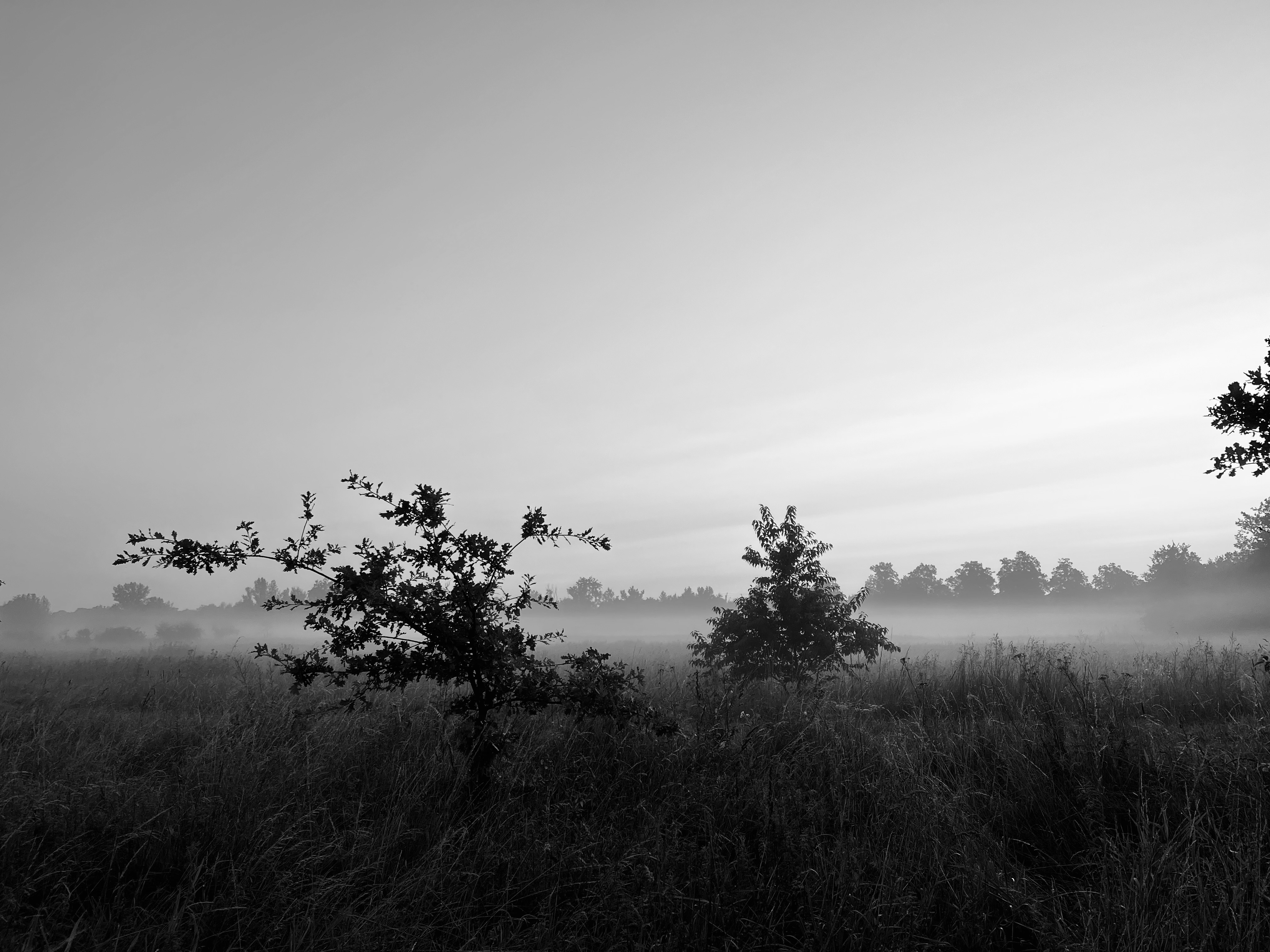
We travel to the fields at first light, Kasia collecting me from outside the house at 4.30am. We arrive as the sun is just pushing up above the trees of the forest in the distance. Mist hangs above the fields as we follow old cobblestone roads and make our own paths through the long grass to find a place to simply sit and be for a while. We see deer grazing in the distance. We hear moorhens, goldfinches, golden orioles and the sound of the train to Poznań. I am about to write that we have the place to ourselves but of course we don’t. We might be the only humans though.

*

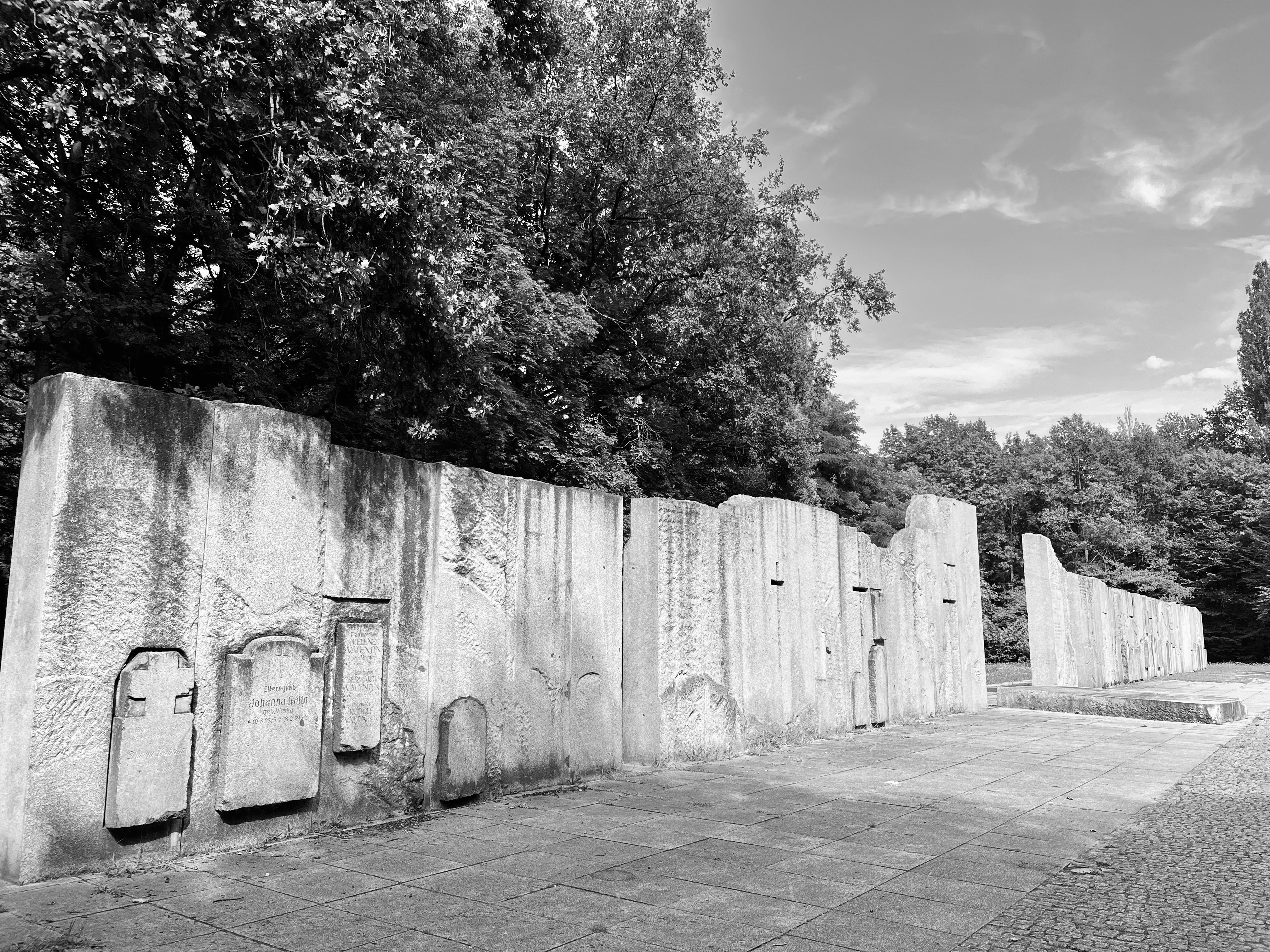
In Grabiszyński park you’ll find the Monument to Common Memory, a recognition – created in 2008 – of the more than forty cemeteries that were destroyed in the transition from German Breslau to Polish Wrocław after the redrawing of Europe’s borders at the end of the Second World War. It is, I think, an important recognition of the history of the place. We can only find belonging if we build relationships, and we can only build the relationships through recognition of what has gone before.

The memorial has been created using surviving headstones of graves from the old cemeteries, including inscriptions in both German and Hebrew. The dedication is in both Polish and German and is to the memory of the former residents of our city buried in cemeteries that no longer exist.

It reminds me of the Cemetery of Lost Cemeteries in Gdańsk, a place I wrote about in the novel BUILT ON SAND and which has a similar function in that city. There, the fragments of shattered headstones, with inscriptions in German, Polish and Hebrew and which represent the city’s former residents of all faiths, whose resting places were destroyed during the Second World War or in the years after.

How do we remember, when memory is painful? How do we remember, when memory is contested? How do we remember, when there is no longer anyone around who can recall the times before?

We built relationships to places by writing our own stories too. Katrin arrives for the weekend and we spend the day walking the city. The Island City still has islands, even if the Cathedral Island is no longer an island (and Museum Square doesn’t have a museum in it). The exhibition at BWA Studio is called KROKI or STEPS is all about walking:

When we walk, the horizon of our experience is defined by the distance we are able to cover on our own feet. The collective exhibition KROKI / STEPS refers to the conceptual and performative foundations of the contemporary reflection on walking in art – from the motif of pilgrimage, through political steps, to walking in the aspect of the migration crisis.

*

The month ends but my time in Wrocław is not over yet. Still, I am asked to give a presentation about my residency for the team at the BWA. I make it about memory and the importance of stories, two things that speak as strongly in this city.

In thinking about how we create, how we write, and how we tell stories, it is in the power of those who have gone before that I take solace. In the words of Sebald or Drndić. In the journalism of Joseph Roth or the drawings, sculptures and woodcuts of Käthe Kollwitz. The British poet Ruth Padel once wrote that ‘No poem ever stopped a tank. But,’ she added, ‘by putting vivid words, memorably together, in ways that resonate more loudly the deeper you go, poetry can address huge issues very powerfully.

I finish with some words I had already written, a few years ago for an essay for a Norwegian journal. It was titled Against Forgetting. In this city, where the population almost completely changed in a matter of years, it felt right:

The stories we choose to tell will help us shape what comes next. There is a famous line from Hegel that tells us we learn from history that we do not learn from history. It need not be the case. Yet we need to keep telling the right stories, the truthful stories. Even when there is no-one left to remember it is within our power, those who remain, not to forget.

*

I meet Kuba from the Wrocław Culture Institute. We talk about many things; about stories and memory, the history of this city, what is remembered and what is forgotten. And we talk about belonging and how we built a relationship with a place. He tells me about the flood of 1997, when much of the city was underwater. Of course, as there hadn’t been a major flood since Breslau had become Wrocław, there was a certain missing collective or folk memory, which perhaps made the situation worse than it might otherwise been. But something else happened too.

It was, Kuba says, that people had to really fight for the city for the first time. It was a turning point. People had to fight for the city, they had to work for the relationship they had for the city, and they started to feel belonging. And something else too. When the high water mark was added to buildings, to show future generations what they had to fight against, it was alongside the high water marks of previous disastrous floods. The details of 1997, recorded by Polish hands, would go alongside those recorded by Germans. 

The history of the city is shared.

Words & Pictures: Paul Scraton

Fragments: A Berlin Journal – June ’24

Hundreds of young people – mostly young women – queue patiently on the square between the arena and the Spree, the river glistening like the glitter on the faces around me and that clings to the homemade merchandise lovingly created for this moment. There is a kind of uniform, based around white tank-tops scrawled with song lyrics, fishnet tights and big don’t-mess-with-me boots. Tinny versions of bad idea right? sound across the square as last minute tik tok videos are filmed to mark the occasion.

‘Don’t push!,’ the security guard shouts as he moves the crowd closer to the doors. ‘Walk! Move slowly!’

Despite the excitement for the concert, for that moment when Olivia Rodrigo will bound onto the stage full of enthusiasm for life, no-longer-teenage angst and sarcastic lyrics about idiot ex boyfriends, everyone does what the security guard says. No one wants to miss the show.

The atmosphere is wholly positive. I exchange knowing looks with other dads, but we are all seemingly pleased to be here. The show crashes into action at 8pm and for the next two hours the vast majority of the crowd sing and feel every word. Caught in the middle of it all, I cannot help but smile. 

I am a long way away from the time of life Olivia Rodrigo is exploring, explaining and sharing with her fans, but there is something about it all that takes me back. The hopes and fears. The anticipation. The dread. There is not a single part of me that would go back, but I am happy for the young people all around me that this woman on stage is one of their guides.

‘If you are here with your best friend, give them a hug.’

‘If you are here with your mom or your dad… give them a hug.’

Lotte and I are still hugging when the next song starts. The girls behind us, a chaotic mix of Disney Club and Riot Grrrl, belt out every word. Their voices are going but they do not care. Soon enough it is all over, but the songs carry on, down the street and blasted from car stereos, shouted at the tops of their voices. Ten thousand young women spread out into the night, walking taller on their heavy black boots. There’s fun to be had. Love to be won and lost. Mistakes to be made.

Fuck it, it’s fine. 

*

Two weeks out from the European Football Championships the state broadcaster ARD publishes the results of a survey that shows 21% of people in Germany would like to see more white players in the national team. It is part of a documentary that explores issues of racism in Germany, but as a headline the intentions of why the questions were asked are lost amid the hand-wringing of the press and the understandable annoyance and anger of the German team’s manager and players. It is a statistic that begs so many questions. Not least: if you asked the same in England, France or Italy, what would the answer be?

On Franz Kafka’s birthday, reading his diaries that have been published in English in a new translation.

In periods of transition, as the past week has been for me and at least this moment still is, I’m often seized by a sad but calm astonishment at my emotionlessness. I am separated from all things by a hollow space, to the boundary of which I don’t even push myself.

This speaks to how I sometimes feel both in the UK and in Germany, as if I started a period of transition more than twenty years ago and never came out the other side. 

*

Our house in Wiesenburg is at the top of a small rise – ‘on the mountain’, one of our neighbours once said – and the only running water nearby are a couple of streams that spend most of the year as dry ditches. But our conversation over the back fence is of the floods in southern Germany; horror stories from family members close to Lake Constance that give more detail to the images flashing up on the evening news.

Whole streets are turned to rivers. Houses have chunks taken out of them by the power of the water. Cars are lifted from their parking spaces and carried away.

Jahrhunderthochwasser.

Flood of the century. And yet, they are happening with an ever increasing frequency.

Meanwhile, the polls suggest the biggest losers of the upcoming elections will be Europe’s green parties, and the most gains for those who insist the world is not burning, the flood waters are not rising, and that the climate crisis is the invention of shadowy, global elites.

‘People will only take it seriously when it impacts them directly,’ we used to say. Now I am not even sure about that. We can see and feel it all around us. Melted glaciers. Ravaged forests. Jahrhunderthochwasser that comes every couple of years. And still we don’t learn.

*

Lotte is eighteen. It seems improbable, impossible even. A midnight taxi ride through empty Berlin streets to a Pankow hospital. Katrin admitted but I was sent home. Nothing will happen until the morning, they said. So I stayed up all night and watched episodes of Teachers and listened to Pulp and waited for the sun to rise and the new adventure to begin.

Now it feels like we are at the starting line again. Only, Katrin and I are increasingly going to be onlookers rather than active participants. It’s exciting and scary and a bit discombobulating. Lotte seems to be taking it in her stride. I think we did alright. 

Election day. We vote in the function room of the Luisenbad library, once the entrance hall of a grand dancehall almost completely lost to the bombs of the Second World War. Back in 2016, not long after the Brexit referendum in the UK and just ahead of Trump’s election to American President, Marcel Krueger and I read from Joseph Roth’s The Man in the Barbershop in the library courtyard as part of an event on the subject of ‘Democracy without Populism’.

Marcel read the original German and I read the English translation of an essay Roth wrote in 1921 about a boorish man who enters a barbershop in Berlin and starts to fill the room with his thoughts and ideas. More than that, he wants agreement on where his thoughts take him.

“The farther north you go,” he says, early on in his monologue, “the more nationalist people are. In Hamburg they’re really excited about Flag Day. Well, you’ll see. It’s on its way. Can’t be stopped. On, on!”

Roth’s essay was a warning about the rising tide of nationalism in Germany. Twelve years later, he would leave Berlin with Hitler’s appointment to Chancellor, having long understood where the times were heading.

You will have realized by now that we are drifting towards great catastrophes, he wrote in a letter to his friend Stefan Zweig on his departure. Apart from the private — our literary and financial existence is destroyed — it all leads to a new war. I won’t bet a penny on our lives. They have succeeded in establishing a reign of barbarity. Do not fool yourself. Hell reigns.

From the barbershop to the Chancellory to bombs on the ballroom and the gas chambers of the east. As we leave the polling station the sun is shining.

*

We head south, to Köpenick and the stadium on the edge of the forest. 1.FC Union Berlin’s women’s team are playing their promotion play-off and 18,000 fans have filled the stadium on all sides. The team do their bit, winning comfortably to all-but ensure their status in the Bundesliga 2 next season. We leave the stadium in high spirits, and cannot bring ourselves to check the exit polls just yet. Let the good mood linger a while longer.

*

The AfD polls strongly across the country and especially in the eastern states. The far-right makes gains across the continent. In Germany at least, this is a vote from the young as well the old, with 16% of under-25s voting AfD, an 11% gain on the election five years ago. A sense of insecurity, economic worries and lack of hope for the future, are some of the factors given for the vote that appears to be mirrored in other countries across the continent. 

In Sylt, a group of young party goers film themselves singing ‘Foreigners Out!’ while one of them gives a Hitler salute in the background. In Politico Nicholas Vinocur and Victor Goury-Laffont use the election results and the media furore about Sylt as a starting point to explore why some of Europe’s young people (the majority still vote for left-leaning parties) are turning towards the far right.

The answer is a hodgepodge of factors ranging from Europe’s cost-of-living crisis to the isolation many youths suffered during the COVID lockdown years to a delayed backlash following the bloc’s 2015 migration crisis when nearly two million migrants flowed into the bloc. But there are also more intangible factors, linked to the fact that many young people experience politics solely via social media platforms like X and TikTok where far-right content glorifying the “Great Replacement” theory and linking immigration to violence runs unchecked.

In France, a snap election is called. In Germany, the coalition stumbles on. In the UK, no longer taking part in the European elections, Reform polls in the high teens ahead of the general election next month. 

Is the man in the barbershop confident once again?

*

At the Topography of Terror in the centre of Berlin, the exhibition is filled with tourists as well as groups of young people from Germany and beyond, brought to this site of memory as part of school trips to Berlin, to hear the story of how the Nazis used violence and terror to take and maintain power, and what the consequences were.

Inside, a temporary exhibition titled ‘Weimar under Attack’ explores the violent beginnings of the Republic, around about the same time Roth was listening in to the conversations of the city for his essays and newspaper articles..

Violence, the exhibition states, is commonly accompanied by unrestrained language. From the beginning of the Weimar Republic, the political rhetoric is frequently abusive, defamatory, vitriolic (…) Political opponents are declared “traitors”, “criminals” and “enemies” – exclusionary terms that suggest they must be combated with all means available, ultimately also physical violence.

It is of course too simple to draw parallels between then and now. History never repeats itself in exactly the same way. But it is worth listening for the echoes. 

A walk through the city with a friend. Last night, Nadine played at the Privatclub. Today we wander through sunny streets and try to make sense of how the world has changed since we last saw each other, before the pandemic. Before the explosion in Beirut. Before Ukraine. Before Gaza. It is hard to find the words. 

*

A fleeting visit to Belfast once more. We look at the weather radar to try and find a gap between the showers. Our walk takes us along the river and then up to the Giants Ring. There are subtle changes in the month or so since we were last up here. Everything is a little greener. More flowers are in bloom. The city is still hidden in the hollow between where we stand and the Belfast hills beyond. 

Back at the house, having got back before the rain came, I flick through Heinrich Böll’s Irish Journal in the kitchen.

The rain here is absolute, magnificent, and frightening. To call this rain bad weather is as inappropriate as to call scorching sunshine fine weather. You can call this rain bad weather, but it is now. It is simply weather, and weather means rough weather.

*

On a Friday evening in Guiseley, on the other side of the Irish Sea, we sit on picnic benches beside the cricket pitch and watch the kids play as the European Championships are shown on the big screen in the bar behind. We watch sport to escape. To entertain and distract. To think about something else, for ninety minutes or the period of an innings. 

Back home in Germany there are hundreds of thousands of fans drinking and dancing, mixing on the streets, in the squares and in the stadiums, and for the vast majority of the time it is peaceful, joyful and a lot of fun. The Scottish team are woeful but the fans are honoured and welcomed guests. The Dutch team are not much better but their supporters paint the town orange. The German fans revel in a team that has not (yet) let them down.

Is it just bread and circuses? Or can it bring us something else, something positive in a time when everything seems hopeless and lost?

Rules in the fan parks and public viewing zones banning any flags (read Palestinian or Israeli) that don’t belong to a participating nation remind us that the wider world can never be ignored for long. And it leads to the question of how we can possibly celebrate the skill of Musiala or a goal by Georgia, the talents of a sixteen year-old Spanish kid or the drama of a last-minute equaliser, when so much of the world is burning.

*

Reading Ivan Klima, Czech novelist and survivor of Theresienstadt. His novel Love and Garbage was banned under communism in Czechoslovakia in 1986, but became a bestseller once the ban was lifted after the collapse of the regime and the coming of democracy.

The amount of freedom is not increasing in our age, even though it may sometimes seem to be. All that increases is the needless movement of things, words, garbage and violence. And because nothing can vanish from the face of our planet, the fruits of our activity do not liberate us but bury us. 

*

We walk out from Menston and up onto the hills and to the moor. These are places filled with memories. Ten years ago we walked here on the day before the Tour de France started in Yorkshire, and we saw Team Sky roll their way along the narrow lanes on a final warm-up before the Grand Depart. Today, the group of cyclists we meet at the cafe where we stop for tea and bacon sandwiches are riding battery-powered gravel bikes. As we walk on, we spot curlews and lapwings, red kites above the reservoir and hear the sound of oystercatchers a long way from the seashore. The path back down into the village takes in an old shooting range, a millpond hidden by a patch of woodland and the clash of architectural styles that tells the story of a place over time, the needs and priorities of any given age, and the things that change and the things that stay the same.

*

Lotte’s school career is over. She gets her Abitur diploma at a ceremony by the lake. For seventeen years she has been going to the same street in the centre of Berlin, first for her childminders, then for nursery, then primary school and then secondary school. Her Grade 1 primary school teacher is here to see her pick up her diploma, as is her form teacher from secondary school and so many others who helped her along the way. 

We see our fellow parents, some of whom we met while sitting on tiny kindergarten chairs at a first parents’ evening back in 2009. We remember those who were there then and who are no longer with us. And we marvel at the young people that sit in front of us in their gowns, even though it only feels like yesterday that we were having to make sure they had enough nappies and wet-weather clothes in their little cubby holes outside the playroom.  

In many cases, we have not seen each other for a couple of years, as a global pandemic and our children’s increasing independence means no meet-ups at the school gates or for an end-of-year picnic. I’m not sure how we parents are all handling it, but the young people seem ready for the next steps and the adventures to come. It is going to be a change for all of us.

*

The morning after the party. We stayed in the hotel by the lake, and so I run / hike up the trails from the lakeside and into the Müggelberge – Berlin’s mini mountain range. This is the city’s highest natural point, and the sign points to Berlin’s highest mountain. But history in this place will always have its say, and there are “mountains” made of the rubble of war and the refuse of a city that reached out to where I am standing now that are now higher than the Großer Müggelberg and its fleeting views of the lake and the city beyond. 

At the top a cyclist takes a selfie with the summit cross while a woodpecker hammers at one of the trees that surround us. And then I follow the trail down, a steep winding path that takes me back to the lakeshore to hear those stories of the night before, after the parents exited stage left, heads full of memories, and let the kids get on with the first dance of the rest of their lives. 

Words & Pictures: Paul Scraton

Fragments: A Berlin Journal – May ’24

Waiting for an early May Day train back into the city, there is time to explore the old railway sidings and overgrown tracks beside Wiesenburg station. They once led to an industrial complex beside the station, where only a couple of buildings and the old gate remain. Part of the property is now a nature- and disc-golf course. The rest is being prepared for a new ‘co-living village’, the future set out in a weather-faded sign hanging from the outer fence. Progress, it seems, is slow. Another springtime brings new plants to grow up through the cracks. The only movement behind the fence comes from some heavy bees moving between the flowers. But it is May Day after all.

*

In the newly renamed English-language magazine The Berliner, the history of May Day in the city is told, from the first rally held at the Neue Welt in Hasenheide in 1890 to the present day. The piece quotes Rosa Luxemburg, writing 130 years ago:

As long as the struggle of the workers against the bourgeoisie and the ruling class continues, as long as all demands are not met, May Day will be the yearly expression of these demands. And, when better days dawn, when the working class of the world has won its deliverance then too humanity will probably celebrate May Day in honour of the bitter struggles and the many sufferings of the past.

*

The garden grows. There are birds everywhere. Wagtails and black redstarts. Blackbirds and housemartins. As dusk arrives, so do the bats. The first barbecue of the year turns into a campfire. We spend time together talking, while staring into the flames as they flicker in the half-light. Down by the town hall, someone has chopped the May Tree down. Pranksterism, it seems, is a tradition. But not one appreciated by all. 

*

Down at Wannsee bathing beach, in the 1920s and early 1930s, bathers would stake out their territory according to political allegiance. Flags in the sand would declare this stretch for the Communist, another for the Social Democrats, and another for the National Socialists. Symbols sewn into the swimming trunks allowed everyone to know where you stood, even when in line for a portion of fries. Sunshine and beer would lead to territorial encroachment. Fights in the late afternoon. The police would come in along the alley through the woods. Berlin street violence transplanted via the S-Bahn lines to the lakeshore.

*

Today, the flags in the sands advertise outdoor brands. There are campervans and a climbing wall. Spin the wheel to win a rucksack or a sleeping bag. Try out a new kayak or a stand-up paddleboard. In the May sunshine we stand by the water’s edge and dream of the mountains and the coast.

The wonderful things in life are the things you do, not the things you have.

*

At BER airport, approaching midnight, things are settling down. The last of the flights have departed. The bakeries and cafes are closing. Security guards and police stroll the halls while those waiting for the very early morning flights are trying to make themselves comfortable on hard benches. In the corner, next to the lift for the railway platforms, there is a collection of sleeping compartments. They come with a bed, a dusk, air conditioning and a variety of lighting options.

Inside, the sounds of the airport are masked by the low hum of white noise. It feels somehow both futuristic and retro at the same time. Japan in the 1990s? To emerge from this cocoon at 4am, into an airport well on its way to waking up, is a strange and discombobulating experience.

The sun falls beyond the Belfast hills. All day the city has been alive to what is about to happen. The further we walked down the Lisburn Road, the percentage of people wearing fan shirts increased until, outside the Bowery pub, it seemed like everyone had bought into the day’s unofficial uniform. Every tour since Springsteen first crossed the Atlantic appears in the in evidence, the backs of all those shirts a collection of many thousands of hours on stage and many thousands of memories.

We all share something, on this playing field sandwiched between the motorway and the railway lines, and conversation comes easy.

‘I saw him in Cardiff. Brilliant…’

‘I’ve tickets for Wembley too…’

‘Did you go last year? I didn’t make it… My mum was having an operation and…’

There is relief and excitement. When your heroes are in their mid-70s, you wonder if this is the last time the E Street Band will come to town. Make it a night to remember, then. It surely is. From No Surrender to See You In My Dreams. The band play. Oh, can they play. Bruce apologises for his voice. No one cares. The sun sets beyond the hills. Tramps like us…

Darkness, but no one is ready to go home. Not yet. And so the band plays on…

*

We walk by the Lagan. Belfast’s river. Like all rivers, it has stories to tell. It links the countryside to the city. One community to another. Amy-Jane Beer, in a book picked up from the wonderful No Alibis bookshop in town:

Rivers are life, health, history, story, reflection, transmission, awe. They can be barriers and obstacles and boundaries, but more often they are corridors, portals, thin places or confluences. Like water itself, a river can be giver and taker of life…

From the river bank we climb up to the Giants Ring. What’s the story here? Nobody knows for sure. Lost to time. In the distance we can see those hills again. The outline of a face that inspired another story. Between us and there lies the city, but we cannot see it. It is hidden by the trees, by the grassy hillocks and thick bushes coming into bloom.

*

Cross the Irish Sea. In Manchester, between the showers, we walk through the city to the Castlefield Viaduct, part of a network of bridges that criss-cross the canals close to the oldest passenger railway station in the world. Liverpool Road station wasn’t used for long, and hasn’t even seen a goods train for about sixty years, but there are still plenty of trains passing this way and that, as we inspect the barges moored in the shadows beneath.

But not on the Castlefield Viaduct. This no longer carries trains. For years it was left to the elements and the seeds carried in on the Lancashire winds. Not so much rewilded as wilded-in-the-first-place, there grew a soft green carpet where the tracks once ran. One section is now managed by the National Trust, a Mancunian High Line with raised beds and space for classes and workshops, and other spots to simply take a break. On the day we visit they are making birdhouses as the tram rubbles by across the bridge next door.

Quotes from Octavia Hill, co-founder of the National Trust, remind us of the need for air and the sight of sky, while an artwork cast in iron speaks to the history of a place that was at the very epicentre of the Industrial Revolution.

Once a place of noise, industry and commerce, Castlefield is now a place of community, culture and recreation. Castlefield is authentic and it doesn’t stand still. It showcases what has gone before whilst opening its arms to the future.

Elbow in the new arena. A place of noise and community and culture. A night of joy. A perfect waste of time.

*

The People’s History Museum, right on the river, tells the story of the struggle for democracy and representation, from the Tin Plate Workers Oath and the Peterloo Massacre, to the International Brigades of the Spanish Civil War, the Clarion cyclists and fight for the women’s right to vote.

There is a small exhibit next to the story of the Co-operative movement that explores how music has played a role in many democratic struggles over the years. There is a poster for Nelson Mandela’s 70th Birthday Party at Wembley Stadium, when he was still locked in a South African prison cell. It was the first concert I can remember attending. But on this day, and in this place, the song that most quickly comes to mind is not from Dire Straits or Little Steven, but from Ewan MacColl:

I’m a rambler, I’m a rambler from Manchester way
I get all my pleasure the hard moorland way
I may be a wage slave on Monday
But I am a free man on Sunday

*

‘Welcome to the Manchester of Poland,’ Maciej says as we drive along the wide streets of Łódź, passing new office buildings, shopping centres and the crumbling remnants of the textile industry that built this city. Like Castlefield, plants have found their way into cracks in the brickwork, rooted in the legacies of the Industrial Revolution.

At midnight we walk through a crowded city centre to the old power station, now re-imagined as a film museum. Since the film school opened in Łódź in 1948, it is cinema as well as textiles that have put the city on the map. The two strands of history come together in The Promised Land, a film by Andrzej Wajda based on the novel by Władysław Reymont, set in the world of 19th-century Łódź. The past and the present came together during filming in the 1970s:

When Wajda began filming The Promised Land (1974), Łódź was still teeming with textile life, and some of the factories used equipment dating back to the 19th century. Today there is not much left of this Łódź…  

Still, a wander through the north of the city centre between thunderstorm showers offers traces and reminders. Łódź feels like a city that once knew exactly what it was for and is not trying to find itself again, now that the mills and factories and power stations have fallen silent. 

At the Łódź Literary House I talk with Maciej in front of a friendly festival crowd about Ghosts on the Shore. It was my first full-length book, written between 2015 and 2016, and published in English seven years ago this June. It has just been published in Polish translation. As I speak with Maciej, I try to remember the context in which I took those journeys to the Baltic coast and wrote the book. What has changed and what stayed the same. It was the time of a million refugees from Syria. There were anti-immigrant marches while a third of the population volunteered to help. I finished the book a few weeks before the Brexit vote in the UK. A Donald Trump Presidency seemed unimaginable.

A lot has changed. Some things have stayed the same.

After the reading we make a late night pilgrimage to the Hotel Savoy. It closed during the pandemic and is yet to re-open, but we were there to look at the plaque on the wall. It tells us, in Polish and in German, that Joseph Roth once stayed here in 1924. A hundred years after his visit – during which he was working on the novel titled Hotel Savoy – someone has stolen the sculpture of his face. So we are left with an incomplete memorial fixed to the wall of a shuttered hotel.

What next for the Hotel Savoy? What next for Łódź?

*

The joyful anticipation before a journey is always outweighed by the irritation of actually going… – Joseph Roth, writing for the Frankfurter Zeitung, June 1926.

*

In Warsaw… but not really. Not yet. From arriving on the train from Łódź, I travel with Kasia from the publishing house to their bookshop/office not far from the Jewish museum in what was once part of the Warsaw Ghetto. I spend the day between the books and on the Baltic shore, talking to journalists and readers about my memories of those coastline explorations. It is interesting what different readers focus on: the family stories or the parallels to Poland. The notion of borders, both political and geographic. What the sea holds and what the sea hides. The books written and the songs sung. Caspar David Friedrich’s Monk on a clifftop and how two people sharing a low stage in a Warsaw basement can have had such differing experiences of Greifswald.

The Old Town is thronged with people, most of whom seem to be a member of some kind of group. Adults with lanyards. School children with matching caps. Like much of Warsaw’s city centre, the Old Town was almost completely destroyed during the Second World War, and its reconstruction was one of the first ever attempts to resurrect a historic city core.

Elsewhere in the city, Warsaw seems to reach for the sky in a way that no other European capital, except maybe London, has gone in for. Huge steel and glass towers rise up as if trying to block the view of the Palace of Culture, itself a monumental wedding-cake of a building that refuses to be overshadowed. Indeed, it somehow seems to be all the more striking now surrounded by these taller neighbours.

At street level there are still gaps. I meet Ewa in a small bar tucked into the corner of the Palace of Culture, next to the theatre. It is the eclectic nature of Warsaw that makes it so special, she says. To get to her, I walked beside empty plots covered in gravel and what some people might call weeds, used as car parks for shiny Audis and BMWs. There were communist-era apartment blocks and 21st-century condos. The odd pre-war building that somehow survived the devastation comes as a shock, held together with green netting and wooden supports; the last standing clues as to what once stood on this particular street corner.

*

What was lost. At POLIN, the museum of Jewish life in Poland, history is told in an almost overwhelming exhibition. It starts in the dark forest that covered much of the Polish lands more than a thousand years ago. The museum’s name comes from the legend of the Jewish arrival in this forest; in these lands. Po-lin. Rest here. But the museum’s ceiling, fragmented and fractured, speaks to the rupture of what was to come. The rupture of the Holocaust.

From the moment I got off the tram from the station with Kasia, I have spent almost my entire time in the city within the boundaries of the Warsaw Ghetto. Almost half a million Jewish people were held within its walls until they were taken to the trains and the extermination camps. The central deportation point was called Umschlagplatz, and a memorial marks the spot.

Along this path of suffering and death over 300,000 Jews were driven in 1942-43 from the Warsaw Ghetto to the gas chambers of the Nazi extermination camps.

From the memorial I follow the road around to the Jewish cemetery, one of the largest in Europe. The dates on the headstones speak aloud the long story of Jewish life in the city. But the deepest wounds are reflected in the memorials. The mass grave of those who died in the Warsaw Ghetto. The orphans led hand-in-hand to the cattle trucks that would deliver them to Treblinka. To Jack Eisner, who survived, and to all those that didn’t.

*

Grandma Masha
had twenty
grandchildren.
Grandma Hana
had eleven
only I survived.
– Jack Eisner

*

On the Berlin-Warsaw Express, I eat schnitzel in the dining car as Poland passes by the window outside. I am reading Wojciech Nowicki:

“Rebuilding” is a key word in my part of the world, similar to other words like “war”, “besieged”, “murder”, like “liberation”, “exile”, “escape”, like “cemetery” and “displacement”, like “Regained Territories” and “post-German houses”. Here, if you dig a little deeper, it turns out to be fake, not original, a couple dozen years old at most.

On the train I sip my beer, the book face down now on the table as I watch the fields and forests, villages and towns, and I think of Gdańsk and Wrocław. Of Berlin and Dresden. Of Warsaw.

Home again. 

‘What does home mean to you?’ they asked me in Poland.

Not Germany. Not England. Both Germany and England. Maybe: the North. Whatever that means. Most probably: Berlin.

Wherever Katrin is.

*

At the Lobe House, a short walk from our apartment in Berlin-Gesundbrunnen, I watch a friend launch her book while the S-Bahn rubbles past, chickens peck at the soil and a fat rat makes an appearance through the open doors behind the stage. Jessica J. Lee writes about place and nature, borders and belonging, better than anyone I know. I treasure the chance to listen to her talk and carry her new book Dispersals home with me like precious cargo. 

These are essays, she writes in a note to the reader, written for a world in motion. Plants that, in dispersal, might teach us what it means to live in the wake of change.

*

We sit on the central reservation of Unter den Linden and drink a beer, across the street from the Aeroflot building and a few steps away from the memorial outside the Russian Embassy to all those killed following the invasion of Ukraine. Each time we come this way, more photographs have been added. More stories of those who have been lost to Russian aggression.

There are stories from Ukraine told too in the foyer of the Instytut Pileckiego on Pariser Platz.

The Pilecki Institute is simultaneously a research institute, a digital archive, a historical museum and an educational institution. Our work seeks to help defend the values of democracy and freedom from historical oblivion, as well as unveil a new perspective on the history of Europe by including the Polish experience of the 20th century in international discourse.  

We are there to listen to Marcel Krueger talk about his Great Uncle, about how he was a soldier in the German Army and a spy for Poland. How the story of a family from Olsztyn/Allenstein can show us how complex notions of nation, identity and home have always been, and why the world is rarely easily explained. 

At the end of Marcel’s talk he is asked about his Great Uncle and what he might say to us today, if he could.

‘Somehow,’ Marcel replies, ‘“never again” has become “no war” for many in Germany and I find it difficult to understand why. It seems the historical experience of a necessary military struggle for a just cause, the experience that violent resistance against a criminal opponent is not only morally imperative but can also be successful – a thing my Great Uncle Franz understood early on – is missing from the current debate. The legacy of the resistance fighters and partisans who defeated National Socialism after a long and difficult struggle is regularly commemorated in Poland, Ukraine and many other countries in central and eastern Europe, but not in Germany.’

*

Caspar David Friedrich turns 250 years old this year. A collection of his works are being shown in Dresden, Hamburg and Berlin to mark the anniversary of his birth. Right now it is Berlin’s turn, with Unendliche Landschaften or Infinite Landscapes at the Old National Gallery on the Museum Island.

Together with what feels like half of Berlin we walk through the halls and try to catch a glimpse of these landscapes; the coastlines and mountain ranges, the scenes lit by moonlight or at dawn and dusk. The small figures almost swallowed by the world around them. The contours of a country covered in mist and fog.

Friedrich, the exhibition tells us, saw the forest as a symbol of belonging, its evergreen trees expressing hope and consolation.

Today, the evergreen trees of the Harz Mountains, and the ranges along the German, Czech and Polish borders that were the main places of the artist’s wanderings and his inspiration, are ravaged by bark beetles and threatened by forest fires. The forest of Caspar David Friedrich’s imagination tells us a story not so much of hope and consolation but of the climate crisis.

*

The exhibition leaves me with more questions than answers, one of which is posed at the very start:

Where does the human being stand in relation to the world?

And if we cannot find the answer in these infinite landscapes, where might we find it?

Words & Pictures: Paul Scraton   

Fragments: A Berlin Journal – April ’24

Easter Monday and the Berlin streets are quiet as we move around the back of the university from Friedrichstraße station to the Gorki Theater for Heinrich Mann’s Der Untertan. The English-language translation of the novel was called Man of Straw; the tale of Diederich Hessling, whose snivelling and unswerving loyalty to authority, when combined with his hypocrisy and general unpleasantness, stands as a satire of Wilhelmine Germany and the type of patriotism that led the country to the ruinous battlefields of World War I. Mann completed the novel in 1914, on the eve of a war that he would become a vocal critic of, but it would only be published four years later as a very different Germany emerged from the trenches. 

In the decades that followed publication, Der Untertan would be seen as almost a premonition. The attitudes embodied in the character of Hessling were those that enabled the rise of the National Socialists. And today, it feels like those behind the production at the Gorki Theater have something to say about the current situation. Hessling’s story is told through twelve morality tales. There is humour and a bit of slapstick. Breaking of the fourth wall. It is funny and clever, but throughout you are forced to ask the question: just because the protagonist is laughable, doesn’t mean the place we get to is necessarily amusing. 

The play has English sur-titles and at least a couple of the translations – “drain the swamp” being the most on the nose – seem to be offering up a vision of Donald Trump as a 21st-century Hessling character. It seemed clear, even in 1918, that what Mann was offering was not just a portrait of the recent past but a warning for the future. In Berlin in 2024, there remain lessons worth heeding. 

*

The Trans-Pennine Express. Never has there been such a gap between the evocativeness of a train service’s name and the reality of the passenger experience. But today everything seems to be going smoothly between Manchester and Liverpool.

As we move through the suburbs we can look down on the gardens of semi-detached houses. There is a view through a window to a kitchen sink or a wooden table. Blinds pulled down in the middle of the day. A man smoking a cigarette out of an upstairs window. The gardens offer clues as to the personalities of those who maintain them. Neat lawns and tended flowerbeds. Is the overgrown tangle next door the result of laziness or an attempt at creating an insect-friendly garden? All are better than the plastic grass surrounded by white pebbles a few doors down. A single pot of basil outside the back door is the only growing thing between the tall wooden fences.

It is this vision of suburbia that I think of when I imagine myself on a train in the north of England. If I imagine a similar scene on a German train, I am looking down on the allotment gardens on the edges of Berlin. The divided plots with their sheds, lawns and beds for growing vegetables or flowers. Depending on the authority of each colony, some are almost regimented in their neatness. 

Here the gardens speak less of the personality of those who maintain them, and more of the people with the clipboards who move along the neat paths to judge them. Are you keeping up to standards? Has the hedge been trimmed? Is the compost pile out of control? It is a job for Diederich Hessling, for even in the Kleingartenkolonie there needs to be order and respect for the authority of those wielding the clipboards.

In Germany, I am still sometimes relieved to be able to use English, especially in doctor’s surgeries or in any dealing with officialdom. When in the UK, I enjoy the opportunity to use German on those who are not expecting it. Across the aisle at Anfield, a couple of men are enjoying the build-up to the Sheffield United match. When I offer to take their picture for them, I see the moment of brief worry cross their faces. Have they said something they shouldn’t, in this place where they thought no-one understands them? But they haven’t. They are just excited, like we are, to watch our beloved red men in these last matches of the Jürgen Klopp era.

I have been to Anfield in recent years – to visit the museum and to be part of the Hillsborough Memorial – but it has been a long time since I was in the ground for a match. That was 2007, and the stadium is almost 50% larger now and, of course, no players from back then remain. But the magic of catching a glimpse of the green of the pitch at the end of the concourse tunnel remains as electrifying as it was as a kid, as is the chance to join in with You’ll Never Walk Alone as kick-off approaches. 

It would be nice to say that it is enough to just be here. To soak up the atmosphere, regardless of what transpires on the pitch. But at this moment in time, there is still a chance of a title, so there are a lot of nerves in the ground and a real feeling of relief as Liverpool win 3-1. We don’t know what will happen next but we walk out into the dark and stormy night with hope in our hearts, if only for the time being. 

*

I have written about Rhoscolyn many times before, and of all the things I have committed to paper about places that mean something to me, it is those that I am the least happy with. It feels like I cannot do justice to the place and what it means to me. A gentle failure, then, of trying to write about the most important place in the world.

I have never lived here. Never called it home. If you add up all the time I have spent at Cerrig-yr-Adar since I was born it would come, at most, to about 40-50 weeks of my 45 years. Not nothing, but nothing compared to my Uncle and Aunty, and my cousins and their children, who have lived and worked here. And yet, it is the only place I have constantly returned to in my life. The only place that has a presence in all the different chapters I have lived so far.

Perhaps that is enough. The one place I hope I shall always be able to return to. And to try, and try again, to find the right words.

On Unter den Linden the half marathon runners turn the corner by the Aeroflot building and catch a glimpse of the Brandenburg Gate. Their race is nearly run, and for most it gives them the boost they need to run the last of the 21.1 kilometres. I have run this race a number of times and I know how they are feeling. Those who are finding it easy. Those who are suffering. Those who are elated, and those who want nothing in life at this moment in time than the possibility to stop. We clap and cheer and shout our encouragement in the springtime sunshine, and try to resist the temptation to think that maybe next year would be a good time to do it again.

*

In Wiesenburg our local red kite – who we have named Charlie – hovers over the gardens in the early morning. I am reading Kathleen Jamie’s Findings:

If you’ve seen the hawk, be sure, the hawk has seen you.

*

There is blossom on the cherry tree at the heart of our garden. The grass is getting long. The bats are dancing at dusk and the bees soundtrack the morning. Spring.

*

It is the anniversary of the death, in April 1945, of Dietrich Bonhoeffer. He was hanged by the Nazis in the dying days of their ‘Thousand Year Reich’, which would last a little more than twelve. At the Zionskirche in Berlin, where we walk numerous times in a week, there is a sculpture in his memory. Bonhoeffer was active at the church on Zionskirchplatz from 1931 until 1933, when Hitler was appointed Chancellor. There was already a schism in the protestant church over National Socialism, but Bonhoeffer was clear where he stood.

The church, he wrote, has an unconditional obligation to the victims of every social order, even if they do not belong to the Christian community. 

This was April 1933, only a few months after the Nazis came to power. The church has a responsibility to resist, Bonhoeffer argued, to not simply bandage the victims under the wheel, but jam a spoke in the wheel itself.

*

Wiesenburg is alive to the sound of birds. In the garden, we hear the bicycle-pump call of the great tit. Blackbirds. Sparrows. Wood pigeons. There are wagtails on the wood pile next door and a black redstart on the compost heap. Walking out across the fields we spy a kestrel, a buzzard and crows pacing between the ploughed furrows. There are less birds outside of the village than in. Horatio Clare called the crows, on his own walk across Germany, the Emperors of Emptiness, their domain the monoculture of the countryside.

On Saturday morning the village wakes slowly, a tale told through a series of sounds. The birds with the coming of first light. A cockrell. People with early shifts back their cars out of the driveway. One dog a few doors down catches a glimpse of an early morning jogger and his barks wake up all the rest. The first of the motorbikes from the city change down the gears as they enter the 50 zone. The click-whir of a lycra-clad peloton riding three abreast. Lawnmowers and wood saws. Tractors pulling loads. Saturday shoppers from outlying hamlets. The sound of the Bundesliga Konferenz, drifting out of an open window.

We walk out from the village to the low hills – little more than lumps in the landscape – that separate it from its neighbour to the north. The paths follow the “rummels”, dry valleys created at the end of the last Ice Age that are not dissimilar to holloways, especially as they became paths from the moment humans began to move through this space. One is named for the pastor. Another for the brewer. Now they belong to the hikers, following the symbols painted neatly on the trees, the hiking maps available for free at each train station with routes to suit every level of fitness and time schedule.

*

Another day, another walk. This one leads us out of our end of Wiesenburg and across the fields on a path that takes us to the historic heart of the village, a cluster of low-slung houses around a church built from the stones that were cleared from the fields (and are still being disturbed by the plough to this day).

On the corner, where the path dog-legs to follow a ditch that has become a running stream this year, there is an old oak tree with a bench beneath it. The tree has been pollarded numerous times, and it has a strange, almost uneasy shape. Which is not to say that it is not beautiful, and more than anything it is a reminder that even the most familiar walks can offer up something new. We have encountered the old oak tree in all seasons of the year, at all times of the day and in all types of weather. Each time, it seems to offer up something different.

The early morning bus links the villages with the town, with the high school and the train to the city. Frost returned last night and there are patches of white in the shade, even as the rapeseed flowers shine a bright yellow against the blue sky. A low mist hangs over some of the fields, a reminder of being on night trains approaching Berlin as the long journey through the darkness approaches its end with the first light of morning. 

Today, the commuter ticks off the stations like a mantra. She dozes at one end of the carriage, in what she likes to think of as her regular seat, and although her eyes are closed and she travels in that place between sleeping and waking, she always knows where she is. As we approach Charlottenburg she gathers her things, ready for her stop even before the announcement comes.

*

In Weißensee we read pieces inspired by the White Lake City. It is the second salon at Galerie Arnarson & Sehmer, almost a year to the day after the first. Last year we spoke about rivers, today it is Weißensee itself, from the lake to the old racetrack, the memories of film studios and the Jewish cemetery.

In another country the baseball season is in its infancy. On the Rennbahnstraße, the schedule has yet to be fixed. All that lingers are the triumphs and tragedies of summers past.

A swing. A metallic thunk. The white ball against a blue sky. Her teammates cheer as she touches them all. Glory Days. 

*

In Grunewald we walk from the station of the same name, where Jews were loaded onto trains at Platform 17 and taken to the camps. Grunewald is a neighbourhood of big houses erected beneath what Isherwood called the gloomy pines, but our path takes us away from the villas and the memorial to those taken and never to return, into the forest.

We pass by the sand dunes and the Devil’s Lake. The old listening station stands on a rubble mountain, no longer spying but still observing the scene. We reach the Havel at Schildhord, named for a Slavic Prince and a death-defying escape across the choppy waters. We can see the villa where the British Commander lived during the Cold War. From Slavic Princes to British Commanders, via Hessling’s beloved Kaiser, the list of those who have called the shots in Berlin is long and varied.

Our journey takes us through the suburb where British officers once lived to Le Courbusier’s massive apartment block, just across the railway tracks from another monumental architectural statement: the Olympic Stadium. This is an ambivalent place, depending on what you choose to remember. Hitler or Jesse Owens? I’ve played football on its pitch and run around its track. I’ve watched Liverpool play a friendly and Usain Bolt break a world record. I’ve heard Bruce Springsteen sing about summer in New Jersey and sheltered from a Berlin summer thunderstorm.

It feels like this is a place that has spent its existence trying to erase the stain of its earliest years. The World Cup in 2006 was probably its most successful moment. This summer, we’re trying to do it all again. 

In Deutsche Welle, a report that pessimistic young Germans are turning to the far right. That 22% of those aged 14-29 would vote for the AfD if there was an election tomorrow, a number that has doubled in two years. Their main concerns are inflation, expensive housing, poverty in old age, the division of society and migration.

*

Posters for the European elections have begun to appear. A parade of placards along the central reservation of Osloer Straße.

We must vote for those who think justly, not dictatorially, Heinrich Mann wrote in 1930. We must work, be patient and show ourselves far too proud to allow ourselves or our state to be “saved” by anyone. That is something only we ourselves can do.

*

In Köpenick we join the crowds, mostly in red and white (but with patches of blue and white here and there) as we walk along the path through the trees to the Alte Försterei. Anyone who has been to a home match of 1.FC Union Berlin will know this walk, along the railway to the Plattenbau clubhouse bar and then through the trees to the ground. But this day is different. Today it is the women’s team who are playing in the forest stadium, in a local derby against Hertha BSC. They may only play in the third tier of women’s football, but more than 12,500 turn out to cheer them on.

From both sides. Indeed, the Hertha fans are arguably making the larger racket during much of the match, but they have little going for them on the pitch. Union take a 5-0 lead into half-time and then seem to decide the job is done. The game finishes with the same score as both sets of fans trade their favourite songs, and insults, throughout the second half. The Hertha fans’ loyalty is almost rewarded when they hit the post, but it is not to be. Despite the one-sided scoreline, it is a hopeful and joyful lunchtime kick-off. 

Words & Pictures: Paul Scraton

Fragments: A Berlin Journal – March ’24

In Wiesenburg, in the driest corner of Brandenburg, where the sandy soil absorbs water as quickly as it can fall from the sky, the fields and meadows are flooded. Ditches that have been dry for years flow as streams. Standing water creates a reflective pool next to the footpath through the Schlosspark. On the radio, the announcer tells us this has been the wettest winter since records began.

*

What is litost? Litost is a state of torment created by the sudden sight of one’s own misery.

Is it possible for a country to suffer from litost? Milan Kundera describes the meaning of the Czech word in the pages of The Book of Laughter and Forgetting. Kundera’s character argues that it is predominantly an affliction of the young. On our kitchen wall there is a map from the early 19th century. At that moment, Germany existed only as a concept or a dream. An imaginary nation like any other. This is a young country.

Newspaper articles speak to a pervading feeling of angst and anxiety ahead of the European Championships this summer. The atmosphere of the country as a whole is compared to 2006 and the last time Germany hosted a major football championship. The World Cup was a Sommermärchen – a summertime fairy tale. 

The world came to Germany and liked what they found. Klinsmann’s young team reached the semi finals, narrowly losing to the eventual winners in dramatic extra-time scenes. The Black-Red-Gold flew from balconies and the backs of taxis; a sea of patriotic pride in the stands.

A year later I met the husband of a friend in Lower Saxony. We were on a road trip and had stopped for the night.

‘It was the best summer of my life,’ he said. 

*

Is Germany so radically different today than eighteen years ago? It certainly feels that way. And yet: Our daughter was born three days before the opening match of the World Cup, and spent the first week of her life in the hospital in Pankow. A day or so after she was born there was a demonstration outside the S-Bahn station and up to the town hall. A mosque was to be built at the top end of the Prenzlauer Promenade, where the street lifts up over the railway tracks and becomes a motorway.

The demonstration was against the establishment of the mosque. The police presence was large but although a handful of counter-demonstrators made their feelings known, there seemed little possibility of trouble beyond a bit of traffic disruption. Outside the station, extra police officers loitered in the sunshine and practised their English from crib-sheets that were clearly part of their World Cup preparations. Newspaper articles abroad warned of certain no-go areas for fans, particularly in the old East.

*

The hospital in Pankow is on Breite Straße. Before Pankow was absorbed by Berlin it was called Dorfstraße. From 1971 until 1991 it was named for the poet and communist Johannes R. Becher, who was Minister for Culture in the German Democratic Republic and lived for a while around the corner on the banks of the Panke, along with other head-honchos of the SED before they fled in the face of public dissatisfaction to their forest compound outside Wandlitz.

After reunification, Breite Straße – “the boulevard of the North” – became Breite Straße once more.

In The Book of Laughter and Forgetting, Kundera describes a character who wanders a street that has changed names five times in 70 years. 

Wandering the streets that do not know their names are the ghosts of monuments torn down.

What ghosts are stalking the New/Old Royal Palace on Unter den Linden, as uncanny a place as Berlin has to offer? On the roof, in the shadow of the palace dome with its golden cross and an inscription calling on all peoples to submit to Christianity, is a sound installation by the artist Emeka Ogboh, titled ‘Cosmos – Things Fall Apart’

On the strike of every hour, it is possible to hear the choral singing of the Igbo folk song Nne, Nne, Vdu from Nigeria, accompanied by chants inspired by a line from Chinua Achebe’s novel that – in turn – inspired the name of the installation.

The folk song and the chat originate from a rich Igbo tradition of oral storytelling, and are a critique of Christianity’s influence and disruption on the Igbo culture.

We stand and listen in the late winter sunshine as the cross on the palace dome glows like the cross that forms on the ball of the TV Tower, just a few hundred metres away.

*

To explore our home city with friends who are experiencing it for the first time is to reflect once again on how a place tells the stories of its past, of which stories it chooses to tell and which it chooses to forget, and of which monuments it erects or reconstructs, and which it chooses to tear down. 

We leave the New/Old Royal Palace to pause at the Neue Wache and its oversized casting of Käthe Kollwitz’s beautiful sculpture Mother with her dead son – the guardhouse now a memorial to the victims of war and tyranny. We cross the street to look down between the cobblestones to the sunken memorial of Bebelplatz that marks the spot where Nazi students burned books on 10 May 1933. We take in an ad hoc and continually updated memorial that has been created outside the Russian Embassy to remind all that pass by of the crimes being committed in Ukraine. We walk between the slabs that make up the Memorial to the Murdered Jews of Europe and peer into the single slab across the street that is the Memorial to the Persecuted Homosexuals Under National Socialism.

From here it is a short walk to Wilhelmstraße 92. There you find a small information board with a map of Africa and a text in three languages. This is the site of the Berlin Conference in 1884, which formalised the so-called “Scramble for Africa” as almost the entire continent was divided between European colonial powers. 

The Nigerian historian Olyaemi Ainwumi writes: The foundation for present day crises in Africa was actually laid by the 1884/85 Berlin Conference (…) the Conference did irreparable damage to the continent. Some countries are still suffering from it to this day.

In our short walk along Unter den Linden and through the Brandenburg Gate, it would be easy for our friends to think that Germany is a country that takes its historical reckoning extremely seriously indeed. And sometimes it does. But on Wilhelmstraße, a modest and easy-to-ignore memorial to an event so central to the history of both Africa and Europe reflects the priorities and choices we make; of what we remember, and how we choose to remember it. 

By the Spree, next to the German History Museum, an art market attracts a crowd. It is International Women’s Day – a public holiday in Berlin. On the opposite embankment, a small group hold a vigil for the women of Iran, some of the many victims of the regime, whose photographs look at us across the water in the sunshine. 

*

The Guardian reports that a print of Gerhard Richter’s Birkenau cycle has “returned” to Auschwitz with a new exhibition in the city of Oświęcim. The cycle is a powerful work of art, with Richter’s paintings made over the top of prints of photographs smuggled out of Auschwitz-Birkenau. 

Richter discovered them in the 1960s and was struck by how some could be perceived at first as benign photos of the forest…

To understand them, you need to understand where they are from. Richter’s idea was to blur them with thick layers of paint, squeezed and smudged and scraped; that it was only by ‘obscuring the unthinkable’ was it possible to make the true, horrific story behind the photographs clear.

*

In ACUD there is a night of discussion and poetry inspired by the work of Friedericke Mayröcker. In a neat coincidence, two of the translated poems read out by two different translators mention Heinrich Heine. A statue of Heine stands across the street from ACUD, guarding the entrance to Weinbergspark. It is also a quote from a Heine play, written more than a hundred years before, that marks the spot on Bebelplatz where the books were burned. Tonight he is keeping his fellow writers company as they nervously smoke the edge off before crossing the street to climb the stairs and give their readings.

All of a sudden it appears. On Swinemünder Straße the colours are striking against the gloom of a grey sky and the block of flats beneath. The blossom is emerging. Springtime is coming.

*

Pankaj Mishra publishes a fine essay for the London Review of Books. The front page of the new edition is simply a quote from ‘The Shoah after Gaza’:

Memories of Jewish suffering at the hands of Nazis are the foundation on which most descriptions of extreme ideology and atrocity have been built. But these universalist reference points are in danger of disappearing as the Israeli military massacres and starves Palestinians, while denouncing as antisemitic or champions of Hamas all those who plead with it to desist. 

*

The blossom comes to the Berlin Wall Trail early this year. Underneath the railway tunnel that links the Soldiner Kiez of Wedding/Gesundbrunnen with Pankow, there is a rewilded stretch of the Panke river, a collection of beehives among the long grass of the old security strip, and a neat line up of cherry blossom trees that provide a burst of colour each spring along different stretches of the old border.

In the park we toast Katrin’s birthday in the same beer garden where we drank mulled wine on New Year’s Day. We have more company today, as the arrival of good weather pulls Berliners from their apartments. It is the one weekend of the year when our fellow cityfolk forget themselves. The first fine weekend is a time to forgo the default grumpiness of the average Berliner, and the path along the riverbank is filled with the sound of cheerful greetings and the cling-a-ling of bicycle bells. 

At the Komische Oper, currently housed in the Schillertheater, The Magic Flute is a visual mix of Czech fairy tale and 1920s silent movie.

If we could lock the mouths of all the liars, instead of hatred, slander and cruelty we would have love and brotherhood.

*

A memory walk with some young people from the sixth grade of our daughter’s school, taking in the stories of Mitte. Koppenplaz and its memorial of an upturned chair. Große Hamburger Straße and the place where the Jewish Berliners of the neighbourhood were brought before being transported east to the camps. On the pavements, the shining cobblestones that remember those who never returned.

It also happens to be ‘Motto Week’ for the 12 Graders of Berlin’s high schools, a week of costumes and pranks, and after-school beers in the weak, springtime sunshine. Do you remember that feeling? The rush towards adulthood? The anticipation of the next stage of life? As the kids fool around near Oranienburger Straße, it is possible to feel their impatience to get to what’s next. I want to stop them all – the skeleton, the nurse and the young man in a bathrobe smoking a fag – and tell them to take it easy. That there’s no rush. But what do I know?

On the street we experience this mix of stories from the past and a carnival atmosphere of the present. It isn’t jarring. It is both laughter and a refusal to forget. One need not cancel the other out. 

*

Statues are raised into position on the New/Old Royal Palace, close to where the Igbo folk songs sound on the hour. Some of the new arrivals have been funded by dubious characters.

It appears, says Jürgen Zimmerer of the University of Hamburg and quoted in the media, that we are dealing with a targeted infiltration of the Berlin palace by fundamentalist rightwingers who want to turn it into a symbol of a Christian and thereby ‘white’ ethnic Germany. 

Since a peak of around 22% in January’s opinion polls, the AfD have dropped around 4-5 points following the revelations of meetings to discuss ‘remigration’ in Potsdam and the huge demonstrations that followed.

We walk along the Panke, following the river on part of a route the Prussian King used to travel between his palace in Charlottenburg and his wife’s summer residence in Niederschönhausen. The royal barge was pulled by animals along the towpath where we now walk, and the story goes that extra ditches had to be dug to make the river somewhat navigable.

It seems unlikely. But then the growth of industrial Wedding and northern Berlin in the decades that followed the King’s journeys altered the water levels of the city beyond recognition. Before the factories came, the biggest danger to the quality of the river water was people.

‘Don’t piss in the Panke,’ they would say, up in Bernau close to the river’s source. ‘Tomorrow we’re brewing.’

*

The wind has lost its chill but the evening still smells of woodsmoke in Wiesenburg. It is Easter weekend and the motorbike riders of Berlin and Brandenburg have uncovered their machines and pulled them out of winter hibernation. Geese gather by the banks of the village pond and overhead the storks circle the village having made their return.

Blossom and buds. Daffodils in bloom. Can we say goodbye to winter? The weather forecast is for 23 degrees and in Wannsee the first swimmers of the season have taken to the water.

Nature’s first green is gold,
Her hardest hue to hold.
Her early leaf’s a flower;
But only for an hour.
Then leaf subsides to leaf.
So Eden sank to grief,
So dawn goes down to day.
Nothing gold can stay.

Robert Frost knew that the golden moments cannot last. I think of the young man in his bathrobe and sunglasses, cigarette in hand, school almost behind him. A golden moment indeed.

*

Beside the fire engine we discuss the origins of the Easter Fire. It is a mix of pre-Christian and more recent religious traditions. The undimmed light of Christ or the victory of Spring over Winter? Take your pick. In any case, in Brandenburg only 18% of people are members of a church. A greater percentage than that from the village have wandered out from their homes to enjoy the spectacle. Now it is a simple statement of community. Of coming together. Beer and schnapps. Sausages on the grill. Bats dancing the gloaming as the fire is lit, and when darkness comes, it illuminates the sky. 

Words & Pictures: Paul Scraton

Fragments: A Berlin Journal – February ’24

Early morning on the Ku’damm, walking in the dark as the drizzle is illuminated by car headlights and the window displays of luxury stores. Tom from Succession and Roger Federer sell expensive German cars as people huddle under the shelter of the bus stop on their way to work. Across the street, a new building is finding its shape against the dark sky, the workmen already up on the scaffolding. What was here before? Was there always a gap in the buildings? It’s hard to remember.

The drizzle turns rain as the sky lightens above the construction site.
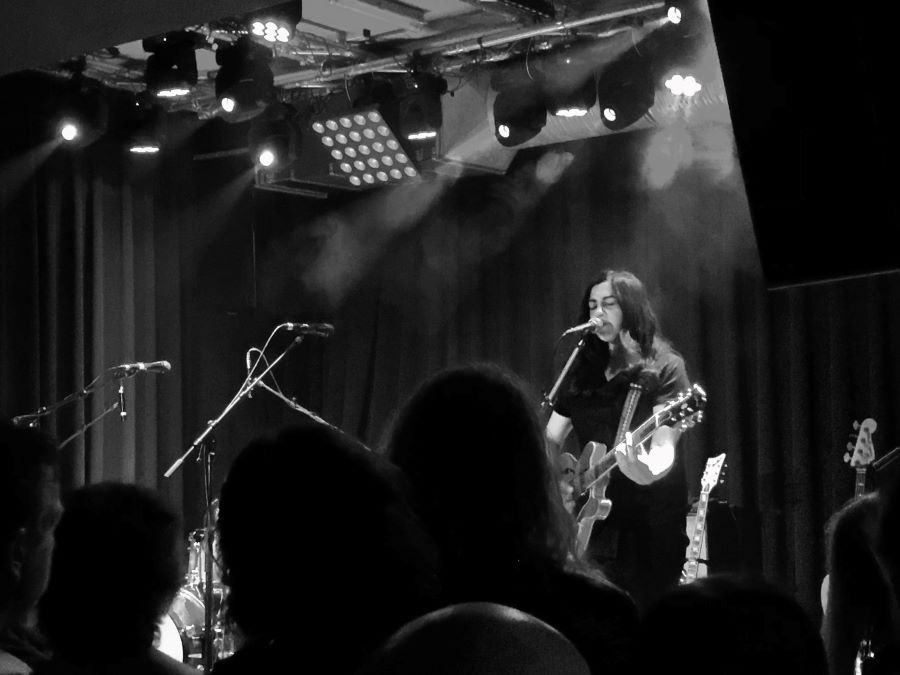
*

And so the Kurfürstendamm stretches out endlessly day and night. Also, it’s being renovated. These two facts need to be emphasised, because of the way it’s continually ceding patches of its true self to its designated cultural-historical role (…) it still feels as though it weren’t a means to an end but, in all its length, an end in itself.

Joseph Roth wrote those words 95 years ago, some four years before he left Berlin for the final time on the appointment of Hitler as Chancellor. It will become clear to you now that we are heading for a great catastrophe, he wrote to his good friend Stefan Zweig as he went. The barbarians have taken over. Do not deceive yourself. Hell reigns.

*

The demonstrations against the AfD continue to gather pace as their poll numbers drop slowly and ever-so-slightly. There are 150,000 souls gathered in the rain in front of the Reichstag. In the twenty-two years since I first arrived in Berlin it has never felt like a more dangerous time, and the tensions are apparent in the crowd that has been drawn to the Tiergarten.

‘Ceasefire now!’ is the call from one corner of the demonstration, against the bloody attack on Gaza by Israeli forces. Others in the crowd don’t think this is the time or the place. But when is? And which wars, crimes, displacements and threats do we give our attention to? Later, it is reported that national flags of all types – Israel, Palestine, Ukraine, Germany – were confiscated by stewards and police at the demonstration. 

Meanwhile, the Schwarz-Rot-Gold flies in front of the Reichstag building, home of the Bundestag and the very democracy we have all gathered in the rain to defend.

The Federal Ministry for Food and Agriculture releases new monitoring figures about the return of wolves to the German landscape. There are now 184 packs, 42 pairs and 22 lone wolves in the forests and woodlands of the country. 

In Wiesenburg, on the footpath that follows the Kunstwanderweg or Art Trail to Borne and on to Bad Belzig, there is a sculpture that stands just off the path. It is a small pack of wolves, always lingering among the fallen leaves of countless autumns. It was created by the Belgian artist Marion Burghouwt at a time when wolves had yet to return to Brandenburg. The last wolf was shot around 1850. Since this stationary pack took up residence in High Fläming, they have been joined by others.

A brief artist’s statement is included beside the sculpture:

The wolves represent the ghosts of the past, the search for new living space.

In the United Kingdom, the last wolf was killed in 1680. From the moment they become scarce or extinct in a particular place, they become the stuff of folklore and legend, mythical creatures like dragons and unicorns. They are the danger lurking in the forest, long after they are no more. Their return is not unanimously popular, despite those of us that find the return of any creatures to what was once their habitat a tiny glimmer of hope in these dark times. 

*

Reading From the Berlin Journal by Max Frisch. The Swiss writer began documenting his life in West Berlin (and his frequent visits to the East) when he moved into Sarrazinstraße in 1973; an apartment he would pass on to the Austrian poet Friedericke Mayröcker. In Frisch’s diaries he alternates between the details of everyday life and portraits of his fellow writers in the city, including Uwe Johnson (who later died on a flat, windswept English island), as well as Günter Grass, Christa Wolf and Wolf Biermann. Those wolves again. 

Summer is coming, Friedenau is green, making it even more petty bourgeois. Berlin without its Nordic sky and its lively cold, (is) a mild and leafy Berlin – which to me isn’t Berlin at all.

I met Berlin in wintertime. Today, I walk along the Holzmarktstraße, the Spree on the other side of the buildings and – eventually – the longest surviving stretch of the Berlin Wall. The sky is suitably Nordic for Frisch, above a collection of GDR Plattenbau and the architecturally incoherent collection of new builds that have been thrown up between Alexanderplatz and Warschauer Straße in the decades since the Wall came down. And still they are being built, with their pink pipes to pump out the groundwater of the Berlin swamp.

There are many who – if they can – try to escape the Berlin winter. Freelancers and hybrid office workers; those who shifted to remote contracts during the pandemic. Anecdotally, it seems like Portugal is the preferred destination, where Berliners are increasingly viewed like the New Yorkers of yesterday when they first landed in Berlin. By definition, Global Nomads have no home, and yet they still manage to raise the rent.

I wonder what his neighbours in Friedenau made of Max Frisch’s arrival. Or Günter Grass and Hertha Müller. Do Nobel Prize winners have an effect on house prices?

In Leipzig, the old factory is hosting an art market. Signs at the door list the clothing brands that are banned for their far right connotations. On the streets around, the graffiti is all in support of Regional League football team BSG Chemie Leipzig. There is not a Red Bull in sight. Welcome to Connewitz. 

It is grey and drizzling. Again. This is the third warmest winter since records began at the end of the 19th century, and one of the wettest. After the market, we walk through a soaked woodland on raised pathways that eventually lead to the river where the water is threatening to breach the banks. On the journey home through Saxony, Saxony-Anhalt and Brandenburg we catch glimpses of flooded fields and overflowing streams. There is water everywhere, and all at once.

*

A morning walk through Wedding, passing by the old factories and warehouses by the Panke river, where 1950s housing blocks fill the gaps created by the British and American bombing raids. Ghost signs advertise the things that were once made and fixed and distributed from here. A crematorium is hosting concerts and films. A physiotherapy practice is named for the swimming pool that has long since been replaced by a block of fancy flats. 

In the Humboldthain, crocuses are pushing up through the soil on the meadow in front of the open air swimming pool. 

On Nettelbeckplatz, a Hertha BSC flag is held aloft by a dancer that is part of a sculpture that adorns the fountain at the centre of the square. The fountain is shut off for the winter. On the low wall in front, someone is recording the deaths of women at the hands of their partners or other men in their lives by pasting a piece of orange paper with the details of each of the lives lost. It is part of a campaign to bring attention to the horrific number of women killed in Germany each year – currently one every three days – but also to rename the square itself.

Nettelbeck was a seafarer with ties to the slave trade. Good enough reason to find a new name. The Netzwerk Gegen Feminizide has identified the square as a place of resistance and the focal point for their campaign. 

In 2023, 114 women were killed by men in Germany. 

*

Rhiannon Giddens at Lido: ‘I’m a mixed baby. My children are mixed babies…’

With her band, she takes us on a journey through musical and cultural heritage; her own and those of the members of her band. It is a celebration and a dialogue and a reminder of what music can mean and what people from different spaces and places can create when they collaborate.

*

Magdeburg is a city I have only really encountered at a distance. From a train window. From the Autobahn. I visited once, as a new and sleep-deprived parent, and have memories of only a street scene that could easily have been Berlin and a schnitzel restaurant that could well have been in Schwerin. 
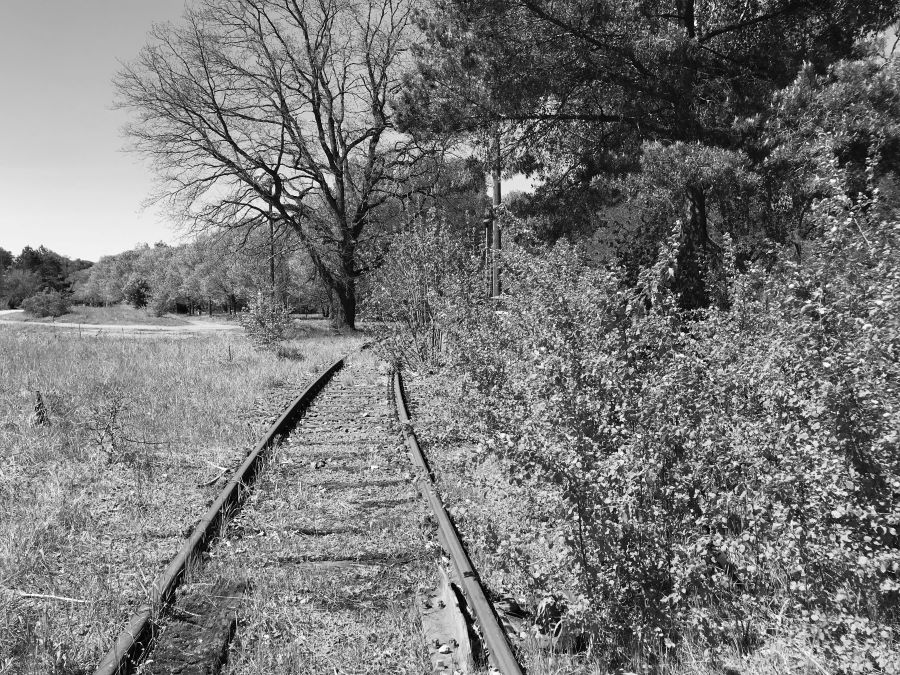
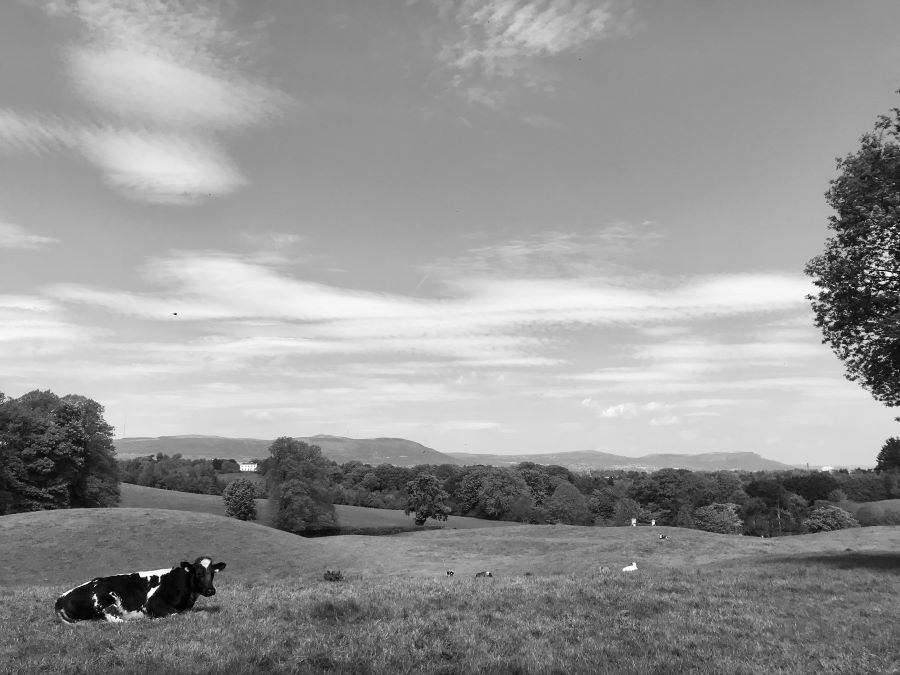
Today I walk through the Altstadt from the station to the banks of the Elbe. These first impressions are of a city that has had to be rebuilt. Aside from the churches and a couple of municipal buildings, there is nothing on this initial walk that is older than the 16th January 1945, when British and American bombs laid waste to much of the city centre. As a proportion of the city before the war, only Hamburg and Dresden suffered a greater level of destruction. 

It is a level of destruction that has been experienced in many places around the world, and can be seen on our nightly news – from Gaza especially – today. In Magdeburg, I walk through the specific architectural mix that speaks to the city’s geographic location and thus its social, political and economic history. Grandiose buildings of the 1950s and the brave new Stalinist world of the German Democratic Republic rising from the rubble. The more prosaic (and cheaper) Plattenbau of the 1970s and 1980s. The glass and steel structures that have filled in those gaps that remain. 

All of it, from whichever period, only makes me feel small and the space depopulated. I feel a bit lost, despite knowing exactly where I am.

*

At a few minutes to twelve, the bells of the Cathedral of Saints Maurice and Catherine – otherwise known as the Magdeburg Cathedral – sound out a call to fifteen minutes of peace and prayer that takes place each weekday at noon. Visitors are asked not to walk about during this time, and instead take a seat far beneath the impressive ceiling of the cathedral.

It is led by a layperson from the support foundation of the cathedral, and about fifteen of us are sitting before him as he begins by playing a piece by J.S. Bach over the loudspeakers. We then hear his reflections on peace, on the dangers of hate, with mentions of Ukraine and the Middle East. There is a reading from Psalms 19 and then the Lord’s Prayer. I find that seven years at Burscough Country Primary School have equipped me to mouth along the words, albeit in English and most probably an outdated version.

We are invited to sit again and listen to some more Bach. Suite No.1 in G major. It is a truly wonderful piece of music, and even played via CD or Spotify it gives a feel for how incredible the acoustics of this space truly are.

In the corner of the cathedral is a wooden sculpture by Ernst Barlach, a memorial to those who died in World War I, with an eternal flame for peace flickering in front of it. Eight thousand soldiers from Magdeburg perished in the trenches and no-man’s lands of what was then called the Great War.

As Bach plays, we can all see our breath mingling with the music in the cold air of the cathedral. In 1631, four thousand citizens sought sanctuary here as Catholic forces attacked and ransacked the city. As with the bombing raids at the end of WWII, almost the entire city was destroyed. The people in the cathedral were the only survivors of what became known as the Sack of Magdeburg in which 20,000 were killed in one of the worst massacres of the Thirty Years War – a conflict that claimed the lives of half the population of present-day Germany and the trauma of which still lingers almost four hundred years later.

It is a lot to think about, in this place, during fifteen minutes of peace on a weekday in February. Even for an atheist, in its understated and modest way, it is all very affecting. 

‘I love your country,’ the man who had been speaking says to me after I introduce myself. ‘I have been there so many times.’

I thank him for his words to all of us a few moments earlier and he thanks me for coming, before pulling on his bicycle helmet to continue on with the rest of his day.

*

In Wolfenbüttel, a half-timbered town famous for the Herzog August Library and being the global headquarters of Jägermeister, I give a reading in the former residence of Gotthold Ephraim Lessing, who was librarian from 1770 until his death, eleven years later, on a visit to his wine dealer at the age of 52.

I am reading from my book about the Harz mountains to an audience of people who have as much experience of those forested hills as I probably do, and the conversation which begins in the woods with the stories of Heine, Goethe, Anselm Kiefer and the impact of climate change and bark beetles, soon wanders off along diversions to the streets of Berlin and Magdeburg, the coastline of Wales, the moorlands of Scotland, a boat on the Rhine and the cliffs of Rügen, and explorations of Wolfenbüttel in the gloaming.

Can we separate the art from the artist (hello Wagner)? What about the artist celebrated by the worst of us (Casper David Friedrich)? How is the art of a place tied to its history, if not directly in the works or even the intentions of the artists themselves, but in how we as individuals respond to them due to the context in which they were created? These are all good questions, and I am sure I am not fully equipped to answer them, but it is the conversation that is important and I walk home through the deserted streets of the town inspired by the few hours we all spent in each other’s company. 

*

At the Delphi Filmpalast, Yoake No Subete – All the Long Nights, a film by Sho Miyake and part of the Berlinale film festival. No spoilers, but this is a beautiful film about disorder, trauma and grief, and how friendship among colleagues, respect and the act of caring, can create safe spaces where all are valued and the goal of the enterprise is not measured in how much money is made but how we all get through the day.

‘Perhaps it is not so normal in Japan,’ the filmmaker says on stage afterwards, ‘but in the end, it is also how I try to run my own projects.’

A film that, in its making, its story and its execution, is full of joy and hope.

In Yorkshire there are daffodils on the verges and the footpaths are muddy. We walk the canal into Leeds and along the river in Otley. We drink beers in a pub where the soundtrack is from our university days in Headingley before Berlin. Twenty three years ago we celebrated a birthday and then watched Liverpool win a cup in the living room of our student house on Raven Road. This weekend, we get to do it again. Geographically, it’s not that far. But we’ve come a long way baby. 

*

Two years since the Russian Army extended their war in Ukraine beyond the territories occupied in 2014. A year ago, there seemed some hope of a Ukraine counter-offensive. Now positions are entrenched and exhaustion in all its forms is taking its toll.  

Acknowledging this collective exhaustion may seem like admitting weakness, Nataliya Gumenyuk writes in The Guardian – as if our international audience expects Ukrainians to demonstrate their successes in their flawless fight against Goliath. Our country finds itself in an impossible position, where we are expected to show that we’re in control, while simultaneously making it clear how critical the situation is. Delays with weapons deliveries mean our armed forces are lacking ammunition. Foreign aid – financial, humanitarian, military – is essential right now.

*

In Berlin, freezing temperatures return, if only for a couple of nights. The rooftops are white with frost in the morning sunshine. On Nettelbeckplatz, where those pieces of paper had been added to the wall of the sculpture in memory of each of the women killed by men in 2024, someone has torn them all down. 

Words & Pictures: Paul Scraton