

I am in Wrocław to both explore the former sewage irrigation fields on the edge of the city for a literary project, but also to dig into the history of the city and all the many peoples that have called this settlement on the banks of the Odra river home. Aleksandra, who is walking the fields with me, tells me about the traces of settlers in these wetlands by the river, long before the river was controlled or the sewage fields were created.
We’ve shaped these places for longer than we’ve had a name for them, she says. The relics of the past lives of the fields can be found throughout. The houses were built on higher land, which is where those early settlers would surely have also lived. The line of old trees that follow what was once the Odra river, then an oxbow lake, now a reedbed. The cobblestoned street with its fruit trees, that linked the manor house with the rest of the world. The brick drainage channels from the 19th century and the concrete replacement from the 20th.
There are many ideas of what the future might hold for the fields. Cheap land for housing. Ponds for migrating birds. Wild horses on the meadows. A wacky scheme to turn it into a Wrocław savannah, complete with roaming beasts. A safari park on the edge of the city. After the rain, the only beasts we can see are deer in the distance and thousands of snails on the footpath that we try our best not to squash.
*
At the OP ENHEIM gallery in town, itself once the home of a number of Jewish families in what was then known as Breslau, an exhibition gathers together the belongings of people who once called the city home and were scattered to all corners of the earth. Their descendants have allowed the return of these Jewish Breslauers’ belongings to what was once their home city, if only for a while. Objects that have wandered the world, to the UK and Sweden, the United States and Israel. Objects that speak not only to the history of a place, but to families and their stories.
Watches and school reports. Notes for a Bar Mitzvah speech. Cigarillo boxes and apartment nameplates, paints and brushes, a travelling chess set. There is a family film from a holiday on the Baltic sea in the 1930s, the children playing in the sand as swastika flags flutter in the breeze. A postcard written by the painter Heinrich Tischler from Buchenwald.
I’m doing well here, I don’t need anything.
Tischler was released from Buchenwald but died a month later from illness contracted in the camp. His family fled to England.
On a television screen, his grandson Nick tells some of the story, of his father’s feelings about the city where he was born, and his own relationship to a place he knows as Breslau through his family history and Wrocław through his own experience.
‘I say I’m coming to my hometown, which I think tells you something … I put forward Wrocław as a beacon of hope … a beautiful, vibrant, international and welcoming city. So for me, it’s a beacon of hope and a model for everyone.’

From Wrocław I watch city centres burn in England, as mobs run rampage and terrorise communities. It can be hard, in moments like these, to find much hope. But it is there, in those who stand up to the far right and face them down. It is there, in those who come out to clean up and show defiance in the face of this aggression and intimidation. Meanwhile it is those, a long way from the streets where people of colour are intimidated, hotels burn and shops are looted, who continue to fan the flames.
*
On the final Sunday in Wrocław I walk along the Odra and then follow Oława, one of its tributaries, past the corner of the city known as the Bermuda Triangle, back when it was the owner of a somewhat unsavoury reputation, and then beyond, to the edgelands of factories and big box stores, allotment gardens and tram depots. The river trail leads me to the very edge of the city and the extent of the tram lines. It is a peaceful way to end my time in Wrocław, a place that I feel a connection to. As I catch the train to Berlin, it is with a sense of the end of a beginning – the end of a chapter in a story. There will be more to come.
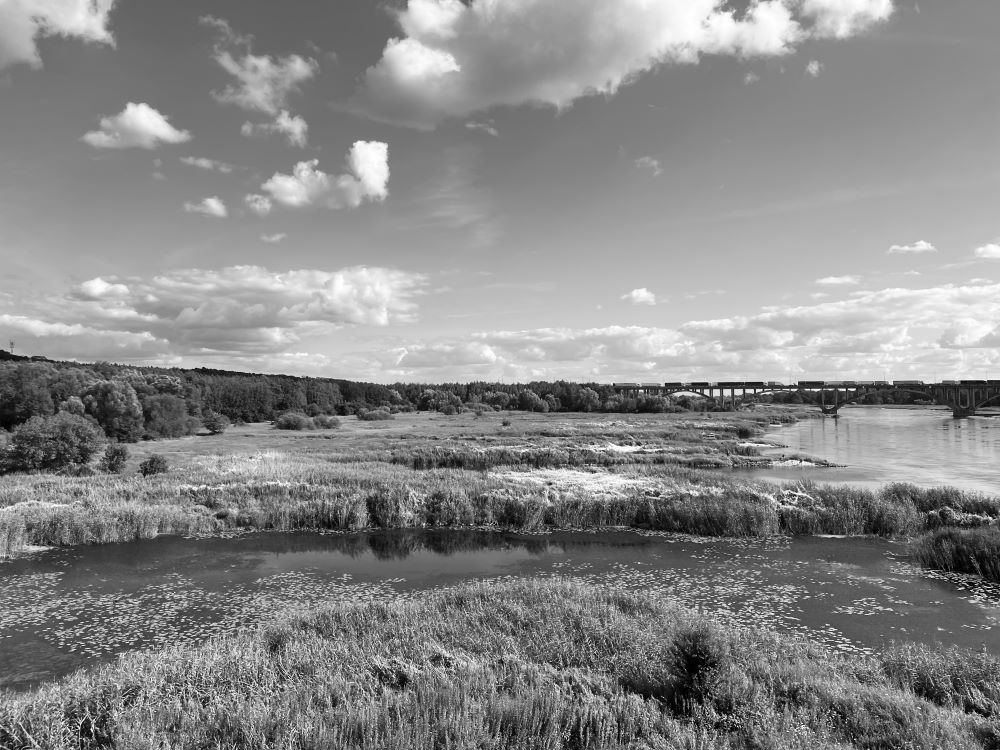
The Mitte Museum is located in Gesundbrunnen, in what was once Wedding, about half a kilometre from where we have lived for nearly fourteen years. Perhaps it is because of its proximity that I have only been once in all the years of living in the neighbourhood. Back then it was part of research into this corner of the city for a neighbourhood walking tour. Since then the museum has been renovated, and when friends ask if I want to join on a weekday lunchtime, it seems time for a revisit.
The museum is located in Pankstraße, in a building that once housed a school. The exhibition tells the story of the city as it grew, and especially the impact of industrialisation on Berlin. The old model, which shows the Gesundbrunnen spa as it was before the factories and the tenement blocks remains, along with the old maps, the sketches, the photographs. In this space built for learning, we are taught history through the layers that pile up on top of each other, and in the details of individual families and how they once lived.
*
After a damp spring and early summer, Berlin is hotting up. The first days of good weather lift the spirits of the city. A few days of thirty-plus temperatures and Berliners begin to become frazzled. Those who can escape to the lake or the coast will do so. Others find respite where they can. In the playground, children move with the sun, from one patch of shade to the next. Queues form outside the open air pools. Fans whirr and shoppers linger in the supermarkets with air conditioning. Evening brings cooler air. We open the windows wide with relief. But will we remember these days in the deepest of winter?
*
Outside the former Stasi headquarters in Lichtenberg, people begin to arrive about an hour before showtime. They get the first choice of the neat rows of white seats or the deckchairs on the grassy slope opposite the main entrance. They bring with them picnic baskets and coolers of drinks. Those – like us – who are a little less well-prepared, leave jackets on seats and make a quick run to the Späti.
This is an open-air cinema with a difference. Throughout the summer, the foundation in charge of activities in the former Ministry for State Security of the GDR are showing films somehow connected to the history of the building and the Stasi. They are in German and shown with English subtitles, and tonight it is time for Helden Wie Wir or ‘Heroes Like Us’, an absurd and sometimes fantastical comedy made in the late 1990s, when the events depicted were only a few years back.
The film is entertaining, and gets plenty of knowing nods of recognition and laughter from what appears to be a crowd with plenty of lived experience of East Germany. But it also begs some questions about the role of comedy in telling such stories. Is it always acceptable to play for laughs on subjects where the victims and their families are still living all around us? My instinct with these questions is that there should be no limits to where comedy and satire may go. It just needs to be good. And as we make our way back to the U5, to travel beneath Karl-Marx-Allee towards Alexanderplatz, I’m not entirely sure whether this particular film is good enough.

I first heard a personal memory of the night the Berlin Wall came down beneath the horse chestnut trees that have offered shade to the drinkers of the Prater Garten in Prenzlauer Berg for more than a hundred years. As it happened, K.’s story didn’t have much to it. A newly qualified teacher, living on the tiny strip of Sonnenallee that was on the eastern side of the Wall, she went to bed in one reality and woke up in a very different one.
Back when she told me the story, K. lived with her partner A. in a tiny flat on Bornholmer Straße, just a few hundred metres from where the first gate was opened at the checkpoint on the bridge while K. slept across the city at her parents’ place, on 9 November 1999. I was new in Berlin and they looked after me, taking me to their favourite falafel place on Danziger Straße, bowling the bowels of the SEZ on Landsburger Allee, and – of course – for drinks in the Prater. There are some that don’t like the beer garden any more. It’s got too expensive. Too full of tourists.
But for me it reminds me of nights like those, when K. would tell her stories of growing up in a country that no longer exists, before they left Berlin to start a family and a new life on the other side of the world. Adelaide is a long way from Sonnenallee in November 1989. But then again, so is the Berlin of today.
*
The Berlin Wall was begun to be built with the closing of the border on 13 August 1961, and every year on the closest weekend to the anniversary, runners from around the world make their way to the trail that now follows the route of the old dividing line, to take part in an ultra marathon. The Mauerweglauf is, like the Berlin Wall Trail itself, 160 kilometres through the city and around its edge. Some people take part in relay teams of two, four or even ten or more. Others complete the entire distance alone, out on the trail for a hundred miles, attempting to finish within the 30-hour cut-off.
A few years ago I ran as part of a relay team, and this year one of my teammates from back then (and one of the first people I ever met in Berlin) is running again. The start/finish line is in Gesundbrunnen, right by the Panke river and close to Wollankstraße station. I meet him at 7am, just before he is due to set off on the first leg for his four-person team. He is running the equivalent of a marathon, and I make plans to meet him again at a drinks station up in Frohnau, where the border ran between the West Berlin suburbs and the East German countryside, about halfway through his run.
In Frohnau, the sun is shining and the weekend strollers, joggers and dog walkers stop beside the path to applaud the runners who are strung out along the trail. We are about 22 kilometres into the total distance and there are about 138 to go. I spot a man in a yellow t-shirt, whose number indicates that he is a solo runner.
‘I are you going the whole way?’ I ask him as he passes and he gives me a wry smile.
‘I’m going to try,’ he replies, and moves on – slow and steady – with a small wave.
I hope he makes it. If he maintains the pace he has managed so far he will finish almost exactly 24 hours after he started. I cannot imagine what will be going through his head at the finish, let alone in the witching hour, deep in the night, with more than a hundred kilometres in his legs and more than a marathon still to go.
*
I spend the day with my nephew and family for his birthday, get a good night’s sleep, and wander back down the Panke to the start/finish line at around nine in the morning. I hope the man in the yellow t-shirt made it. I sit on a bench by the finish line and sip a coffee, watching the last of the solo runners arrive at their destination and then I go for a run of my own, tracing the Berlin Wall trail backwards until I reach the backmarker, flanked by two volunteers on bicycles, who look almost as tired as the runners they are accompanying.
It is hard to describe how inspiring these runners are. As Berlin wakes up, or makes its way home from a big Saturday night, the last of the solo runners have gone long beyond 24 hours on their feet, but they are still moving forwards and still offer smiles to my words of encouragement. Some are accompanied by a bike rider, who can carry water for them or offer other support.
‘He’s about to finish for the tenth time,’ one of these riders says, of his friend who is now about a mile from the finish line. He offers me a handshake and I run alongside him for a second.
‘It’s nothing special,’ he says. ‘I’m nothing special.’
I beg to differ.
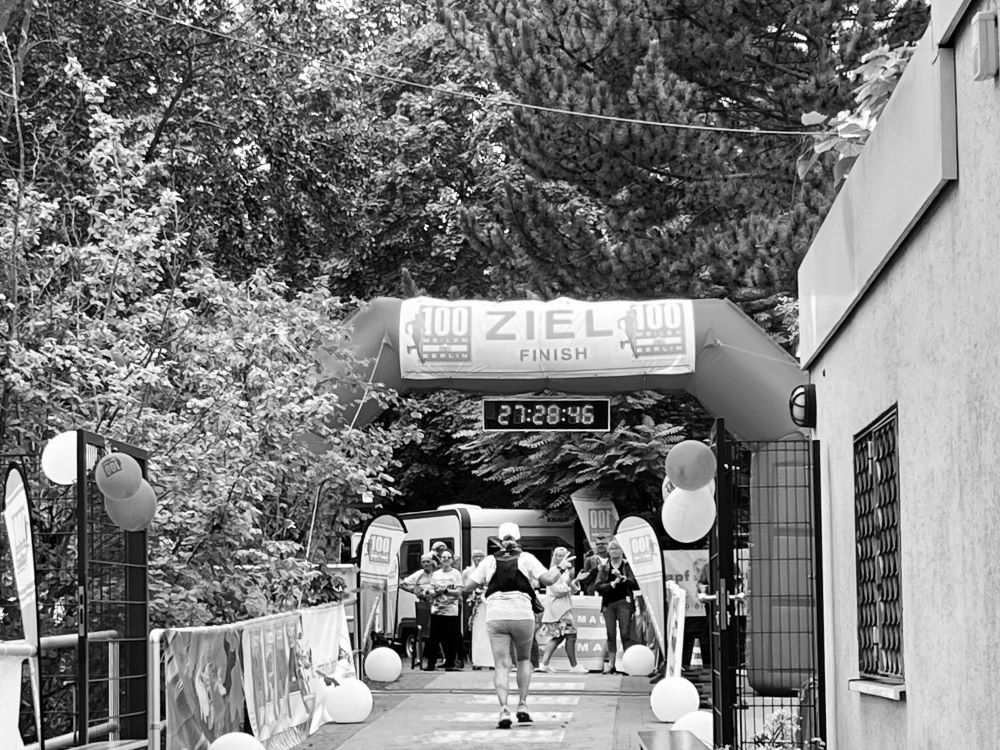
Each year, the Mauerweglauf is run in memory of one of the victims of the Berlin Wall. In 2024 they ran for Silvio Proksch. The Chronicle of the Berlin Wall tells his story:
25 December – 1983
On Christmas, the 21-year-old bricklayer Silvio Proksch is shot at while trying to escape over the Berlin Wall. He receives no medical assistance for quite a long time. Silvio Proksch bleeds to death in the “death strip”. The guard who delivered the fatal shot is awarded the Bronze Medal of the Border Troops.
The GDR State Security keeps the incident secret and spirits away the corpse of the dead man. In 1990/1991 two television journalists from German broadcaster WDR, Werner Filmer and Heribert Schwan, speak with Irene Agotz, the sister of Silvio Proksch, and document her memories of her brother’s escape attempt and the way the Stasi treated family members…
*
In Brandenburg, the election posters are being hung from the lamp posts ahead of the state election next month. There are also state elections to be held in Saxony and Thuringia. In all three former East German states, the polls suggest the AfD will emerge as the largest party, although all other parties have so far ruled out working with them, which means it remains unlikely that they will govern. Meanwhile, it appears that Germany is unable to impose a travel ban on Martin Sellner, a leading voice of the Identitarian Movement in Austria, who is travelling to Berlin, to speak to affiliates of the AfD on the subject of ‘remigration’.
In an interview with Deutsche Welle, Sellner says: ‘We’re not too radical. We’re just ahead of our times. In five to ten years, everyone in Europe will be calling for remigration.’
*
On Tempelhofer Feld, in the summer sunshine, Die Ärzte take to the stage for the first of three massive concerts in their home city. As well as band t-shirts there are plenty of anti-Nazi, anti-Fascist and FCK AFD merchandise on show. With the news of the day, the rise of the AfD, and the confidence of dangerous men like Martin Sellner, it is heartening to see such a public rejection of all that they stand for.
And we mustn’t forget, Bela B says, in between their songs that veer from the political to the absurd to the downright silly, that there are more of us than there are of them.
‘Wir sind mehr!’
The crowd responds.
I only hope he is right. That we are right.

In temperatures beyond thirty degrees, the footballers of 1.FC Union Berlin and Hamburg’s HSV kick off the new season of the women’s Bundesliga 2. It has been a while since Union played in the national league, and never in the main stadium. It is a record attendance for the second tier of German women’s football, and although the result is a draw, there is enough to suggest the Eiserne Ladies will have enough to compete at this level and – perhaps, perhaps – even beyond.
*
If you want to escape the heat there are a couple of options. You can go north, or you can go up. It is time to return, for the fourth time in six summers, to the valley just beyond the Germany-Austria border, south of Garmisch-Partenkirchen. It is a region of Austria known as Außerfern, and is for many simply a place to pass through on the way to the higher mountains or Italy beyond.
But for me it is a place to be. To climb the hills or walk the valleys. To cross back into Germany to swim in the lake. And to build memories upon memories of the previous visits, so that when we clamber atop a mountain and look across the valley, there are personal stories attached to the peaks that stand proud against the blue sky, and the towns down below. As always, the visit is too short, but then the Germans have a word that can be uttered in consolation (of course they do): Auf Wiedersehen.

 Under a Grey Sky