
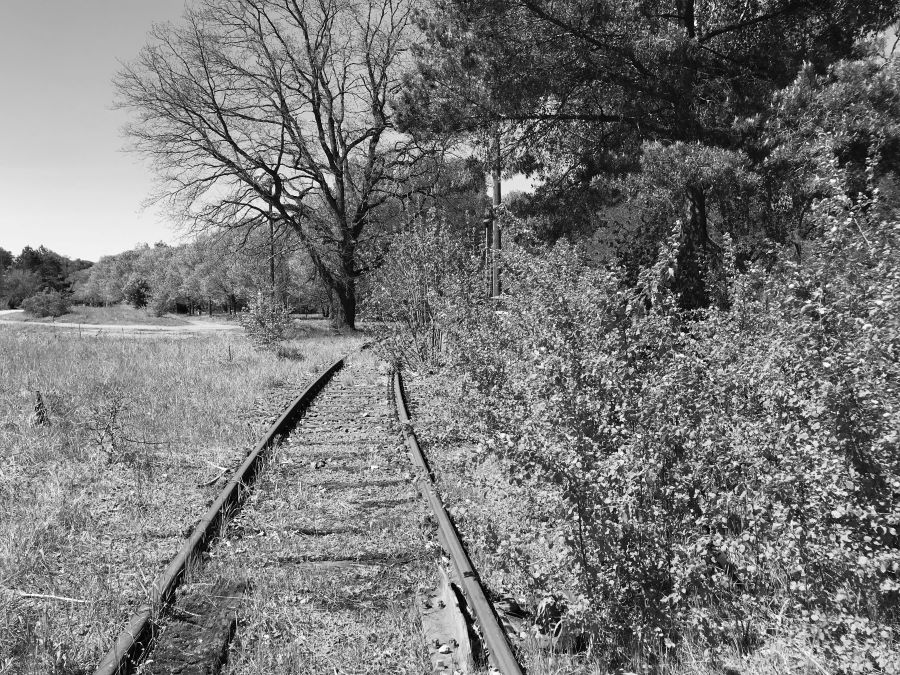
Waiting for an early May Day train back into the city, there is time to explore the old railway sidings and overgrown tracks beside Wiesenburg station. They once led to an industrial complex beside the station, where only a couple of buildings and the old gate remain. Part of the property is now a nature- and disc-golf course. The rest is being prepared for a new ‘co-living village’, the future set out in a weather-faded sign hanging from the outer fence. Progress, it seems, is slow. Another springtime brings new plants to grow up through the cracks. The only movement behind the fence comes from some heavy bees moving between the flowers. But it is May Day after all.
*
In the newly renamed English-language magazine The Berliner, the history of May Day in the city is told, from the first rally held at the Neue Welt in Hasenheide in 1890 to the present day. The piece quotes Rosa Luxemburg, writing 130 years ago:
As long as the struggle of the workers against the bourgeoisie and the ruling class continues, as long as all demands are not met, May Day will be the yearly expression of these demands. And, when better days dawn, when the working class of the world has won its deliverance then too humanity will probably celebrate May Day in honour of the bitter struggles and the many sufferings of the past.
*
The garden grows. There are birds everywhere. Wagtails and black redstarts. Blackbirds and housemartins. As dusk arrives, so do the bats. The first barbecue of the year turns into a campfire. We spend time together talking, while staring into the flames as they flicker in the half-light. Down by the town hall, someone has chopped the May Tree down. Pranksterism, it seems, is a tradition. But not one appreciated by all.
*
Down at Wannsee bathing beach, in the 1920s and early 1930s, bathers would stake out their territory according to political allegiance. Flags in the sand would declare this stretch for the Communist, another for the Social Democrats, and another for the National Socialists. Symbols sewn into the swimming trunks allowed everyone to know where you stood, even when in line for a portion of fries. Sunshine and beer would lead to territorial encroachment. Fights in the late afternoon. The police would come in along the alley through the woods. Berlin street violence transplanted via the S-Bahn lines to the lakeshore.
*
Today, the flags in the sands advertise outdoor brands. There are campervans and a climbing wall. Spin the wheel to win a rucksack or a sleeping bag. Try out a new kayak or a stand-up paddleboard. In the May sunshine we stand by the water’s edge and dream of the mountains and the coast.
The wonderful things in life are the things you do, not the things you have.
*
At BER airport, approaching midnight, things are settling down. The last of the flights have departed. The bakeries and cafes are closing. Security guards and police stroll the halls while those waiting for the very early morning flights are trying to make themselves comfortable on hard benches. In the corner, next to the lift for the railway platforms, there is a collection of sleeping compartments. They come with a bed, a dusk, air conditioning and a variety of lighting options.
Inside, the sounds of the airport are masked by the low hum of white noise. It feels somehow both futuristic and retro at the same time. Japan in the 1990s? To emerge from this cocoon at 4am, into an airport well on its way to waking up, is a strange and discombobulating experience.
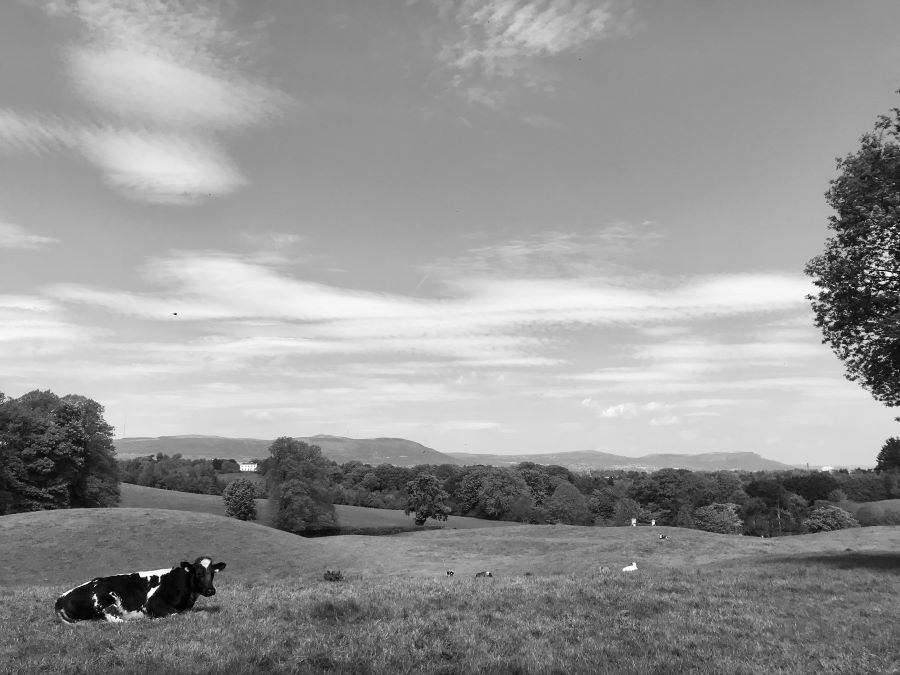
The sun falls beyond the Belfast hills. All day the city has been alive to what is about to happen. The further we walked down the Lisburn Road, the percentage of people wearing fan shirts increased until, outside the Bowery pub, it seemed like everyone had bought into the day’s unofficial uniform. Every tour since Springsteen first crossed the Atlantic appears in the in evidence, the backs of all those shirts a collection of many thousands of hours on stage and many thousands of memories.
We all share something, on this playing field sandwiched between the motorway and the railway lines, and conversation comes easy.
‘I saw him in Cardiff. Brilliant…’
‘I’ve tickets for Wembley too…’
‘Did you go last year? I didn’t make it… My mum was having an operation and…’
There is relief and excitement. When your heroes are in their mid-70s, you wonder if this is the last time the E Street Band will come to town. Make it a night to remember, then. It surely is. From No Surrender to See You In My Dreams. The band play. Oh, can they play. Bruce apologises for his voice. No one cares. The sun sets beyond the hills. Tramps like us…
Darkness, but no one is ready to go home. Not yet. And so the band plays on…
*
We walk by the Lagan. Belfast’s river. Like all rivers, it has stories to tell. It links the countryside to the city. One community to another. Amy-Jane Beer, in a book picked up from the wonderful No Alibis bookshop in town:
Rivers are life, health, history, story, reflection, transmission, awe. They can be barriers and obstacles and boundaries, but more often they are corridors, portals, thin places or confluences. Like water itself, a river can be giver and taker of life…
From the river bank we climb up to the Giants Ring. What’s the story here? Nobody knows for sure. Lost to time. In the distance we can see those hills again. The outline of a face that inspired another story. Between us and there lies the city, but we cannot see it. It is hidden by the trees, by the grassy hillocks and thick bushes coming into bloom.
*
Cross the Irish Sea. In Manchester, between the showers, we walk through the city to the Castlefield Viaduct, part of a network of bridges that criss-cross the canals close to the oldest passenger railway station in the world. Liverpool Road station wasn’t used for long, and hasn’t even seen a goods train for about sixty years, but there are still plenty of trains passing this way and that, as we inspect the barges moored in the shadows beneath.
But not on the Castlefield Viaduct. This no longer carries trains. For years it was left to the elements and the seeds carried in on the Lancashire winds. Not so much rewilded as wilded-in-the-first-place, there grew a soft green carpet where the tracks once ran. One section is now managed by the National Trust, a Mancunian High Line with raised beds and space for classes and workshops, and other spots to simply take a break. On the day we visit they are making birdhouses as the tram rubbles by across the bridge next door.
Quotes from Octavia Hill, co-founder of the National Trust, remind us of the need for air and the sight of sky, while an artwork cast in iron speaks to the history of a place that was at the very epicentre of the Industrial Revolution.
Once a place of noise, industry and commerce, Castlefield is now a place of community, culture and recreation. Castlefield is authentic and it doesn’t stand still. It showcases what has gone before whilst opening its arms to the future.

Elbow in the new arena. A place of noise and community and culture. A night of joy. A perfect waste of time.
*
The People’s History Museum, right on the river, tells the story of the struggle for democracy and representation, from the Tin Plate Workers Oath and the Peterloo Massacre, to the International Brigades of the Spanish Civil War, the Clarion cyclists and fight for the women’s right to vote.
There is a small exhibit next to the story of the Co-operative movement that explores how music has played a role in many democratic struggles over the years. There is a poster for Nelson Mandela’s 70th Birthday Party at Wembley Stadium, when he was still locked in a South African prison cell. It was the first concert I can remember attending. But on this day, and in this place, the song that most quickly comes to mind is not from Dire Straits or Little Steven, but from Ewan MacColl:
I’m a rambler, I’m a rambler from Manchester way
I get all my pleasure the hard moorland way
I may be a wage slave on Monday
But I am a free man on Sunday
*
‘Welcome to the Manchester of Poland,’ Maciej says as we drive along the wide streets of Łódź, passing new office buildings, shopping centres and the crumbling remnants of the textile industry that built this city. Like Castlefield, plants have found their way into cracks in the brickwork, rooted in the legacies of the Industrial Revolution.
At midnight we walk through a crowded city centre to the old power station, now re-imagined as a film museum. Since the film school opened in Łódź in 1948, it is cinema as well as textiles that have put the city on the map. The two strands of history come together in The Promised Land, a film by Andrzej Wajda based on the novel by Władysław Reymont, set in the world of 19th-century Łódź. The past and the present came together during filming in the 1970s:
When Wajda began filming The Promised Land (1974), Łódź was still teeming with textile life, and some of the factories used equipment dating back to the 19th century. Today there is not much left of this Łódź…
Still, a wander through the north of the city centre between thunderstorm showers offers traces and reminders. Łódź feels like a city that once knew exactly what it was for and is not trying to find itself again, now that the mills and factories and power stations have fallen silent.

At the Łódź Literary House I talk with Maciej in front of a friendly festival crowd about Ghosts on the Shore. It was my first full-length book, written between 2015 and 2016, and published in English seven years ago this June. It has just been published in Polish translation. As I speak with Maciej, I try to remember the context in which I took those journeys to the Baltic coast and wrote the book. What has changed and what stayed the same. It was the time of a million refugees from Syria. There were anti-immigrant marches while a third of the population volunteered to help. I finished the book a few weeks before the Brexit vote in the UK. A Donald Trump Presidency seemed unimaginable.
A lot has changed. Some things have stayed the same.
After the reading we make a late night pilgrimage to the Hotel Savoy. It closed during the pandemic and is yet to re-open, but we were there to look at the plaque on the wall. It tells us, in Polish and in German, that Joseph Roth once stayed here in 1924. A hundred years after his visit – during which he was working on the novel titled Hotel Savoy – someone has stolen the sculpture of his face. So we are left with an incomplete memorial fixed to the wall of a shuttered hotel.
What next for the Hotel Savoy? What next for Łódź?
*
The joyful anticipation before a journey is always outweighed by the irritation of actually going… – Joseph Roth, writing for the Frankfurter Zeitung, June 1926.
*
In Warsaw… but not really. Not yet. From arriving on the train from Łódź, I travel with Kasia from the publishing house to their bookshop/office not far from the Jewish museum in what was once part of the Warsaw Ghetto. I spend the day between the books and on the Baltic shore, talking to journalists and readers about my memories of those coastline explorations. It is interesting what different readers focus on: the family stories or the parallels to Poland. The notion of borders, both political and geographic. What the sea holds and what the sea hides. The books written and the songs sung. Caspar David Friedrich’s Monk on a clifftop and how two people sharing a low stage in a Warsaw basement can have had such differing experiences of Greifswald.
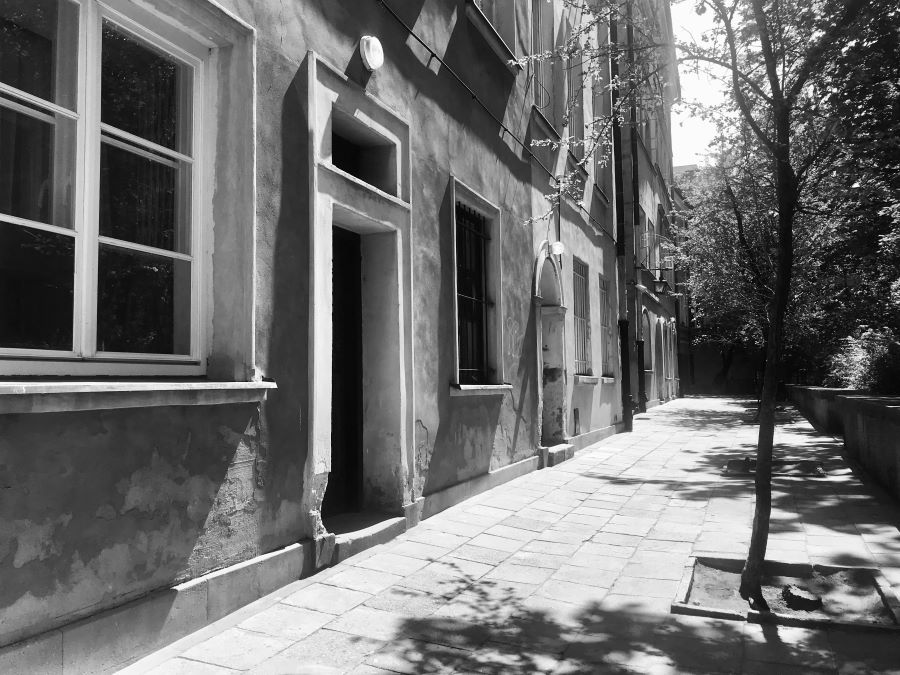
The Old Town is thronged with people, most of whom seem to be a member of some kind of group. Adults with lanyards. School children with matching caps. Like much of Warsaw’s city centre, the Old Town was almost completely destroyed during the Second World War, and its reconstruction was one of the first ever attempts to resurrect a historic city core.
Elsewhere in the city, Warsaw seems to reach for the sky in a way that no other European capital, except maybe London, has gone in for. Huge steel and glass towers rise up as if trying to block the view of the Palace of Culture, itself a monumental wedding-cake of a building that refuses to be overshadowed. Indeed, it somehow seems to be all the more striking now surrounded by these taller neighbours.
At street level there are still gaps. I meet Ewa in a small bar tucked into the corner of the Palace of Culture, next to the theatre. It is the eclectic nature of Warsaw that makes it so special, she says. To get to her, I walked beside empty plots covered in gravel and what some people might call weeds, used as car parks for shiny Audis and BMWs. There were communist-era apartment blocks and 21st-century condos. The odd pre-war building that somehow survived the devastation comes as a shock, held together with green netting and wooden supports; the last standing clues as to what once stood on this particular street corner.
*
What was lost. At POLIN, the museum of Jewish life in Poland, history is told in an almost overwhelming exhibition. It starts in the dark forest that covered much of the Polish lands more than a thousand years ago. The museum’s name comes from the legend of the Jewish arrival in this forest; in these lands. Po-lin. Rest here. But the museum’s ceiling, fragmented and fractured, speaks to the rupture of what was to come. The rupture of the Holocaust.
From the moment I got off the tram from the station with Kasia, I have spent almost my entire time in the city within the boundaries of the Warsaw Ghetto. Almost half a million Jewish people were held within its walls until they were taken to the trains and the extermination camps. The central deportation point was called Umschlagplatz, and a memorial marks the spot.
Along this path of suffering and death over 300,000 Jews were driven in 1942-43 from the Warsaw Ghetto to the gas chambers of the Nazi extermination camps.
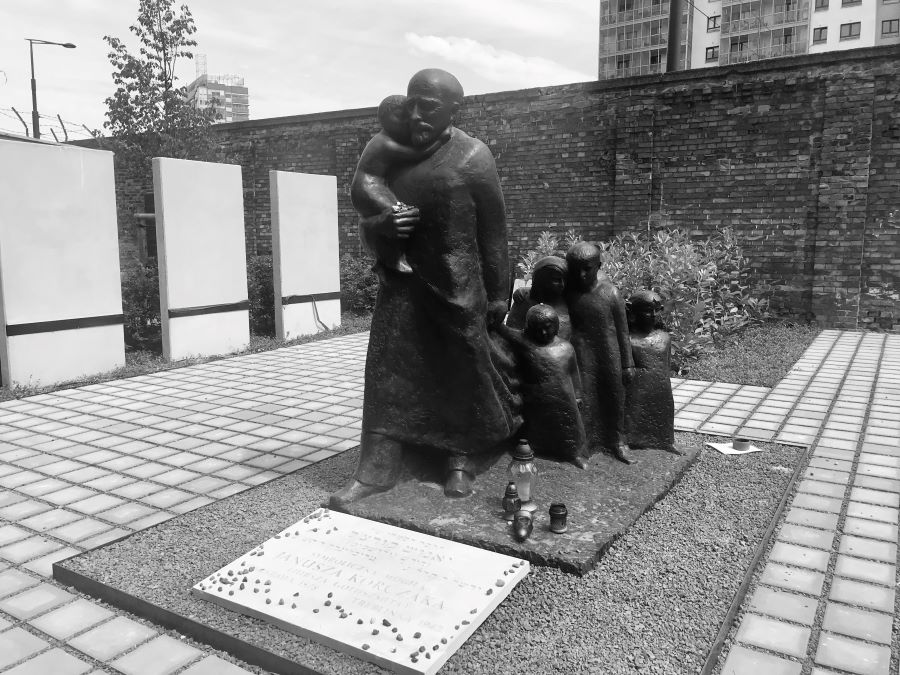
From the memorial I follow the road around to the Jewish cemetery, one of the largest in Europe. The dates on the headstones speak aloud the long story of Jewish life in the city. But the deepest wounds are reflected in the memorials. The mass grave of those who died in the Warsaw Ghetto. The orphans led hand-in-hand to the cattle trucks that would deliver them to Treblinka. To Jack Eisner, who survived, and to all those that didn’t.
*
Grandma Masha
had twenty
grandchildren.
Grandma Hana
had eleven
only I survived.
– Jack Eisner
*
On the Berlin-Warsaw Express, I eat schnitzel in the dining car as Poland passes by the window outside. I am reading Wojciech Nowicki:
“Rebuilding” is a key word in my part of the world, similar to other words like “war”, “besieged”, “murder”, like “liberation”, “exile”, “escape”, like “cemetery” and “displacement”, like “Regained Territories” and “post-German houses”. Here, if you dig a little deeper, it turns out to be fake, not original, a couple dozen years old at most.
On the train I sip my beer, the book face down now on the table as I watch the fields and forests, villages and towns, and I think of Gdańsk and Wrocław. Of Berlin and Dresden. Of Warsaw.
Home again.
‘What does home mean to you?’ they asked me in Poland.
Not Germany. Not England. Both Germany and England. Maybe: the North. Whatever that means. Most probably: Berlin.
Wherever Katrin is.
*
At the Lobe House, a short walk from our apartment in Berlin-Gesundbrunnen, I watch a friend launch her book while the S-Bahn rubbles past, chickens peck at the soil and a fat rat makes an appearance through the open doors behind the stage. Jessica J. Lee writes about place and nature, borders and belonging, better than anyone I know. I treasure the chance to listen to her talk and carry her new book Dispersals home with me like precious cargo.
These are essays, she writes in a note to the reader, written for a world in motion. Plants that, in dispersal, might teach us what it means to live in the wake of change.
*
We sit on the central reservation of Unter den Linden and drink a beer, across the street from the Aeroflot building and a few steps away from the memorial outside the Russian Embassy to all those killed following the invasion of Ukraine. Each time we come this way, more photographs have been added. More stories of those who have been lost to Russian aggression.
There are stories from Ukraine told too in the foyer of the Instytut Pileckiego on Pariser Platz.
The Pilecki Institute is simultaneously a research institute, a digital archive, a historical museum and an educational institution. Our work seeks to help defend the values of democracy and freedom from historical oblivion, as well as unveil a new perspective on the history of Europe by including the Polish experience of the 20th century in international discourse.
We are there to listen to Marcel Krueger talk about his Great Uncle, about how he was a soldier in the German Army and a spy for Poland. How the story of a family from Olsztyn/Allenstein can show us how complex notions of nation, identity and home have always been, and why the world is rarely easily explained.
At the end of Marcel’s talk he is asked about his Great Uncle and what he might say to us today, if he could.
‘Somehow,’ Marcel replies, ‘“never again” has become “no war” for many in Germany and I find it difficult to understand why. It seems the historical experience of a necessary military struggle for a just cause, the experience that violent resistance against a criminal opponent is not only morally imperative but can also be successful – a thing my Great Uncle Franz understood early on – is missing from the current debate. The legacy of the resistance fighters and partisans who defeated National Socialism after a long and difficult struggle is regularly commemorated in Poland, Ukraine and many other countries in central and eastern Europe, but not in Germany.’
*
Caspar David Friedrich turns 250 years old this year. A collection of his works are being shown in Dresden, Hamburg and Berlin to mark the anniversary of his birth. Right now it is Berlin’s turn, with Unendliche Landschaften or Infinite Landscapes at the Old National Gallery on the Museum Island.
Together with what feels like half of Berlin we walk through the halls and try to catch a glimpse of these landscapes; the coastlines and mountain ranges, the scenes lit by moonlight or at dawn and dusk. The small figures almost swallowed by the world around them. The contours of a country covered in mist and fog.
Friedrich, the exhibition tells us, saw the forest as a symbol of belonging, its evergreen trees expressing hope and consolation.
Today, the evergreen trees of the Harz Mountains, and the ranges along the German, Czech and Polish borders that were the main places of the artist’s wanderings and his inspiration, are ravaged by bark beetles and threatened by forest fires. The forest of Caspar David Friedrich’s imagination tells us a story not so much of hope and consolation but of the climate crisis.
*
The exhibition leaves me with more questions than answers, one of which is posed at the very start:
Where does the human being stand in relation to the world?
And if we cannot find the answer in these infinite landscapes, where might we find it?

Words & Pictures: Paul Scraton
 Under a Grey Sky