
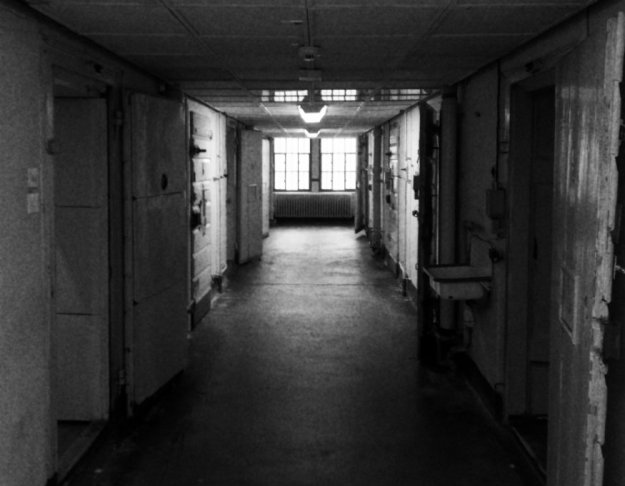
On the top floor of the exhibition, arrows guided visitors from the lift and through a heavy metal door. To the right: the guard’s office, still fitted with a small desk, a telephone and a seat. To the left: a corridor, floor polished by the footsteps of countless guards, remand prisoners, democracy protestors and today, visitors to the exhibition. It had been left as was. Exposed pipes and padded cell doors. Bars on the windows. Strip lights and a sink. The cell doors were open, but otherwise this was the view the guards would have had from their command post. Weak winter light shined in from the opposite end of the hall.
From the founding of the German Democratic Republic in 1949 to the dramatic events surrounding the fall of the Berlin Wall just over forty years later, the remand prison of the Ministry of State Security (Stasi) stood on Andreasstraße in Erfurt, within sight of the main cathedral square and the gingerbread half-timbered houses of the picturesque Old Town. Over those years some five thousand people were held there, awaiting trial for crimes that for the most part amounted to little more than political opposition to the GDR regime. A banner, requesting that the government abide by the human rights agreements of Helsinki. A satirical slogan, spray-painted on the wall. That was enough to land you in these cells. Men upstairs. Women downstairs.
After trials, prisoners would be transferred to the main prisons. For his Helsinki human rights banner, Gerd-Peter Leube was sentenced to three years and six months for “anti-government incitement”. For their slogan painted on the wall, six teenagers (Grit Ferber, Ulrich Jadke, Holm Kirsten, Jörn Luther, Thomas Onißeit and Andreas Tillmans) spent up to six months in prison for the crime of “hooliganism”. Continue reading
 Under a Grey Sky