Monthly Archives: February 2016

City of Memory, Prague

Memory1

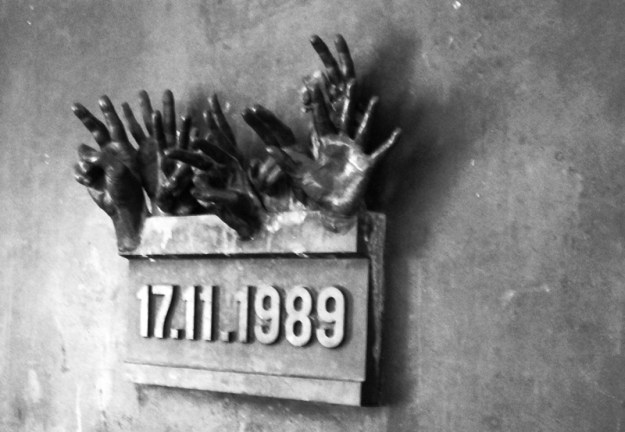
On the 17 November 1989 a group of students set out on a candlelit procession through the streets of Prague, following the funeral route of Jan Opletal, a medical student killed by the Nazis in 1939. Fifty years later, with central and eastern Europe revolting against Communist rule, the students of 1989 were in no mood to follow the agreed route. Instead they made their way along the river bank to the National Theatre and turned right onto Národní třída, heading for Wenceslas Square. Met by riot police they held out flowers, put their candles on the road in front of them, and held out their bare hands to show their non-violent intentions. The response was brutal, and truncheon blows rained down on the students and the other men, women and children that had joined the peaceful demonstration. It was, in the words of Timothy Garton Ash, “the spark that set Czechoslovakia alight”.

The memorial to mark this momentous first step in the Velvet Revolution that would end Communist rule in just a couple of weeks, is pretty difficult to find. It is on Národní třída, hidden in a small passageway at the point on the street where the students met the riot police. It is close to the Cafe Louvre, where Kafka and Einstein once hung out, and the Reduta Jazz Club where President Havel took President Clinton during a visit that seemed to take in more basement watering holes that palace reception rooms. The simple memorial shows a set of hands. “We have bare hands,” the students told the police, and regardless of the violent response, the protests would remain peaceful. That, and the speed of change, is one of the remarkable achievements of the events of November and December 1989. Continue reading

Finding Havel, Prague

Havel

Today we walked down a side street, not far from Tescos, and at a fairly anonymous wooden door rang a doorbell. A woman answered. “Is this the place for the exhibition?” I asked and she smiled and held the door open, apologising for not speaking English. No matter, she spoke German, and so she led us through an empty room with bookshelves at one end and piles of folding chairs beneath the windows. “This is where we hold our events,” she said, before taking us into a small room underneath those typical Prague Old Town arches. The room housed an exhibition titled “Václav Havel in a Nutshell”, his life story told on touchscreens with quotes and photographs filling all the space on the walls.

Prague’s celebration of the playwright, dissident President is modest, and you would only find the exhibition if you know about it and have the confidence to ring the doorbell. At first you think it is a shame that this is not more accessible, in the “Top Ten of Prague” to lead off every guidebook, but in the end it does not matter. He was one of the best, and in 15 sqm it was all there. Truth and love must triumph over lies and hatred, he said on Wenceslas Square on the 10th December 1989. He was right then, and he would be right today. They charged us nothing to visit the exhibition, and so I bought a couple of postcards. A tiny contribution. And so Václav Havel will look down on me as I work at my desk… one of the good guys.

Anyone who takes himself too seriously always runs the risk of looking ridiculous; anyone who can consistently laugh at himself does not.

Words: Paul Scraton
Picture: Katrin Schönig

Fragments from Rügen, Germany

TitlePicBlog

Binz

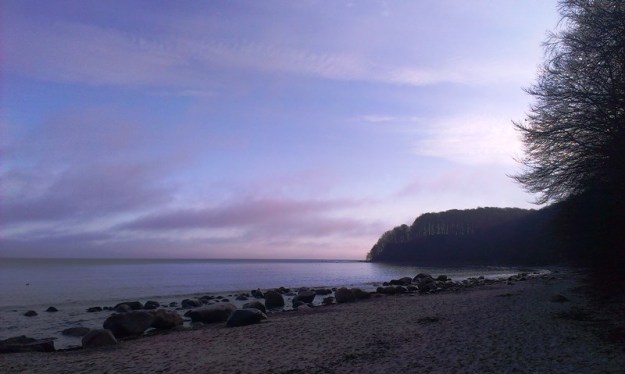
The weekend crowds, even in winter, patrol the boutiques of Binz’s main shopping street, aiming for the pier and its walkway out above the waters of Prora Wiek bay. Follow the beach away from the pier and, once past the last house, the cliffs begin to rise and the gentle sands turn to uneven pebbles and rock. The crowds thin. It is not easy walking, around the headland beneath the cliffs, and so it is left to the fishermen and the beachcombers, picking their way across the stones and the rock-pools in search of amber. Or perhaps “chicken gods”. These stones with holes were once seen as good luck charms, warding off evil spirits. Now they are used for necklaces or candle-holders. At the promontory we pause and luck across the bay, just about able to make out the chalk cliffs of the Stubbenkammer in the distance, topped with the beech trees of Jasmund. Casper David Friedrich found stirring landscapes upon which to build a romantic mythology. Theodor Fontane simply found it melancholy. Perhaps both are true, especially under January’s grey skies.  Continue reading

Through the Granitz Forest, Rügen

Granitz1

From the resort of Binz, on the coast of Rügen island, the path into the Granitz forest starts at the point where the promenade runs out, the neat paving stones giving way to a sandy track of dirt that skirts the beach until it plunges inland and up towards the high cliff-top trail. Germany’s Baltic coast can in general be pretty flat – a landscape of big skies, dykes and dunes, where the only things reaching up towards the clouds are electricity pylons or windfarms. But Granitz is a bit different, formed as it was during the ice age; an undulating moraine landscape that marks the furthest extent of a glaciers journey, like rubble pushed across a wasteland by a mechanical digger.

Continue reading