In Search of Rixdorf on Slow Travel Berlin

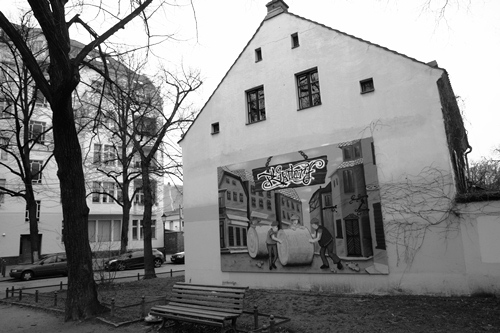
A while ago I published a photo collection from a walk in Rixdorf, an old village long swallowed by the city of Berlin. A longer piece was submitted to Slow Travel Berlin and they published it today. Here is the beginning:

It is a grey day in Berlin, which makes the Sonnenallee feel all the more gloomy. I am meeting my friend and Neukölln resident Julia at her apartment so she can show me the way to Rixdorf, an old village that still – just about – exists within the confines of the S-Bahn ring despite being swallowed by the city over a hundred years ago.

As we walk south, away from Hermannplatz, there is not much in our surroundings that suggests village life. This corner of the city is one of traffic and noise, takeaways and internet cafes, the electronic stores offering up second hand gadgets and tobacconists selling calling cards to five different continents.

People often comment that Berlin, for the most part, does not have the feel of such a big city. It’s quite spread out, with plenty of green spaces. Its fractured nature means there is no real centre, and people tend to orientate themselves around their neighbourhoods. It never really feels as hectic as London, New York or Paris.

Still, there are places, such as the Müllerstraße in Wedding, or the Potsdamer Straße in Tiergarten, where you get that big city feeling, and Sonnenallee has it too. And so it makes the contrast all the more striking when you turn down the Richardstraße and find yourself walking amongst half-timbered farmhouses, old stables that have been renovated but still betray signs of their original function, and cobbled alleyways that are lit, on this gloomy day, by what appear to be gas lamps.
Read the rest on Slow Travel Berlin

The Ted Hughes Poetry Trail at Stover Country Park

By Tim Halpin:

I sat on a rustic bench – a sawn section of trunk mounted onto two stumps – beside The Warm and the Cold, point two on the Poetry Trail. Twenty metres behind me was my car. I could have heard it ticking as it cooled down, but the sound was drowned out by wave after wave of cars on the A382, just the other side of the car park. Equally incessant was the birdsong. A robin sat halfway up a young oak growing beside The Young and the Cold, furiously exchanging trembling phrases with another robin in the trees shading the car park. The South West of England was blanketed by a warm trough of air in a stable high pressure system whose centre covered the whole of the Bay of Biscay. It was a warm Spring day, and Ted Hughes’ similes seemed strangely out of place.

Moonlight freezes the shaggy world
Like a mammoth of ice.

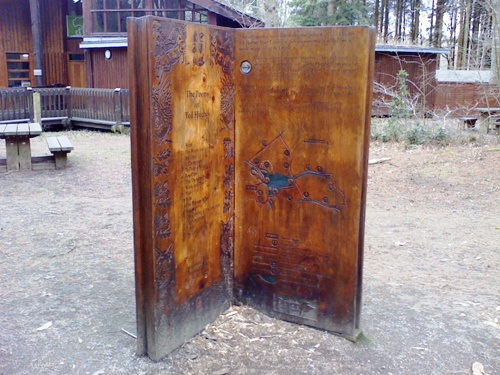
Of course, they were out of place. The trail began at a giant book carved out of wood, engraved with a map of the park and a short introduction to Ted Hughes. The poems themselves had escaped from the book, to be written on granite tablets along the Poetry Trail. The Stover Country Park had done what I do, and taken the writing outdoors. But it seemed that they’d gone further than me, taking the poems so far out of their literary context that they do not even mention which poetry collection they are from. The idea was that the poems would add to the visitors’ enjoyment of the park. I was more interested in what the park does to the poems. Continue reading

Twice around the Schäfersee, Berlin

A weekend morning at the Schäfersee, a small body of water just inside the Reinickendorf border, a few hundred metres from the local chapter of the Hell’s Angels, in the north of Berlin. It is only a few kilometres from our apartment, but apart from perhaps on the bus up to Tegel, this is a corner of the city I have barely touched in the ten years I have been living here. The buildings around a typical for the neighbourhood – old worker’s apartment blocks from before the war, when Wedding and Reinickendorf were centres of industry in the city, plus a few post-war blocks of flats that look more peeling and crumbling than their older neighbours. An then there are the open spaces, perhaps planned or where, maybe, stray bombs fell. During the Second World War a nearby flak tower shot down a Soviet plane which then landed in the lake and, as yet, it has never been recovered from the depths. Continue reading

This Ain’t California


Skateboarding back in the DDR…

This looks interesting, and thanks to Slow Travel Berlin for putting it on our radar… Winner of a prize at this year’s Berlinale International Film Festival, This Ain’t California is a documentary about skateboarding in the GDR, a.k.a East Germany. Like with the surfers in Cuba, just the choice of activity and its origins in the west of the United States would have been seen as a subversive act of rebellion under the Socialist regime, and that is before the riders took their “wheel-boards” across the so-called public space that was the 1980s Alexanderplatz.

From the film website:

“In 90 minutes, we see the GDR more sharply, more clearly: the skater subculture shows that not all was grey-on-grey and drab clouds of Trabant fumes. This Wildfremd production (Ronald Vietz & Michael Schöbel) by director Martin Persiel takes original clips of the “wheel-board-riders” – straight out of the East German scene in the 80s – and mixes it with animations and reencounters with the protagonists today. It is not just a well thought out story on its own – this film also raises the aesthetic bar.”

According to the Facebook page, This Ain’t California will be hitting cinema screens (in Germany we presume) in August 2012, and is doing the round of the film festivals, and is an official selection for the Atlanta Film Festival 2012.

Battle of the Nations – the Völkerschlachtdenkmal in Leipzig

A photo diary by Katrin Schönig:

Between the 16th and the 19th October 1813 the allied armies of Prussia, Russia and Austria convened on the battlefields just outside Leipzig to defeat Napoleon’s army in what was the biggest mass battle of the century. There were over half a million soldiers fighting on those days, and one in five never made it home. The villages and the landscape were left in ruin, but the Battle of the Nations would prove to be decisive. A year later and the coalition forces invaded France. Napoleon was forced to abdicate, and though he would return to power, it proved to be only in order to suffer a final defeat at Waterloo and exile for the remainder of his life on St Helena. Continue reading

An Uig Journal

By Sharon Blackie:

March is a month that hangs in the balance. Sometimes held on the side of winter, sometimes swinging forward to spring. Mostly undecided. Or, as my great-aunt from County Durham used to say, ‘neither nowt nor summat’. There are buds on the willow and rugosa; the sparse winter carpet of waterlogged grass slowly thickens in the paddock. But beware of taking too much for granted: just one salt-laden south-westerly gale and March can turn on you, leaving devastation in its wake. Sometimes, March kills its own babies. Continue reading

Walking the Berlin Wall Trail

Berlin’s Mauerweg – The Berlin Wall Trail:

Borders are always interesting places. As someone who grew up on an island where a land border meant waiting for the first signs of ARAF painted on the tarmac as we left Cheshire for North Wales, the idea of crossing from one country to another by car or, even better, by foot remains a fascinating proposition. For the urban wanderer borders are also the location for much that is worth discovering, whether it is the border between neighbourhoods, between the inner city and suburbia, or the edgelands that mark the often muddled and blurred boundary between the urban and its hinterland.

In Berlin of course we have a structure – or for the most part the memory of a structure – that if you follow its 160 kilometre length will offer up all of the above, as well as the reminder that once where Wedding becomes Prenzlauer Berg or Mitte becomes Kreuzberg was not just the matter of crossing a street from one neighbourhood to the next, but an international border guarded by concrete slabs, barbed wire, and guards with guns. Continue reading

Skies over Margate

Turner Skies week 1 from Turner Contemporary on Vimeo.

Thanks to David Salmon for the link to this lovely video from the roof of the Turner Contemporary in Margate:

To celebrate our current exhibition Turner and the Elements, we’ve put a camera on the top of the gallery’s roof and will be filming the elements as they happen each week. Watch this film to see the dramatic skies over Margate that JMW Turner described as ‘the loveliest in all Europe’.

Turner Contemporary Website

Winter walking in Austria

By Chris Hughes:

The vast majority of people who choose winter holidays in Austria do so for the skiing – great downhill and spectacular cross-country skiing exists in many villages all easily accessible from the UK after a short flight and coach transfer. If you prefer to make your own travel arrangements then many villages are on the railway line out of Innsbruck. Seefeld and the next valley of Leutascsh are especially good for cross-country skiing having hosted the winter Olympics events, there are kilometres of prepared ‘loipertrails’ of all levels of difficulty.

But best of all, from the point of view of the walker, there are equally large amounts of cleared winter walking paths. The paths are well signposted, set out on maps available from the Tourist Information office and offer flat or slightly hilly walking through beautiful countryside, woodland and riverside locations. The snow conditions do vary from year to year and month to month but December to march is a pretty reliable time from good winter walking conditions. Continue reading

A Slow Travel Day in Berlin

A little plug for our friends at Slow Travel Berlin. On the 22nd April they will be holding their next event in Kreuzberg. Last year there was a similar event at The Circus, with talks, films, books, cakes and much more, and this time around it looks like it will be even better. They haven’t announced the complete details yet, but for those of you reading within striking distance of the Markthalle here in Berlin, then we will keep you posted as and when they are announced.

Oh, and if you are looking for a special, urban exploration of Berlin with a literary twist, check out the Slow Travel Berlin review of the Christopher Isherwood Walking Tour, which comes highly recommended:

“Every so often, Nash pulls aside the curtain on a familiar street and reveals to you the city of Isherwood’s Berlin Stories or the 1970s movie version of the hit musical Cabaret. Remember Liza Minelli in the role of Sally Bowles?”

Read more