Author Archives: Paul

Fragments: A Berlin Journal – January ’24

The S-Bahn is empty mid-morning. The streets are piled high with the debris of an explosive night before. It’s a day where even the weather seems to be having a lie-in. It is not yet time, it seems, for the new year to begin.

Perhaps the city is waiting for the countdown. At the Brandenburg Gate we pin the year to our chests and line up behind “pacers” whose job it is to slow us down and who have – we are told through a crackly speaker system – have an average age of 81. The countdown commences and then we run; down Unter den Linden, past the Russian Embassy and the vigil outside for those killed in Ukraine. At Bebelplatz they are dismantling the Christmas Market but ahead of us, in front of the City Hall, the big wheel turns still. 

‘Wir schaffen das!’

The mum encourages her daughter at the halfway point. Dad echoes the sentiment, but it is easy for him to say as he tolls along on a bicycle. The runners are stretched out now, from the Museum Island to the Brandenburg Gate and the finish line. As we arrive the weather finally wakes up. It begins to rain. The new year can finally begin.

*

In Pankow the drizzle has set in. Only dog walkers and joggers are braving the early year conditions, but the lights are on at the beer garden in the park so we walk over more in hope than expectation.

‘I had some things to do so I thought I’d open the hatch and see who turned up…’

The man is cheerful as he warms our apple punch and Glühwein. It seems likely that we might be his only business of the day. But then again – with his strung-out lights shing against the dull, deadened colours of a Berlin winter’s day – you never know.

*

The first election posters for the rerun vote are spotted. Free Palestine is scrawled on a wall. A Ukraine flag hangs limply from a balcony. Its colours are faded by the sunshine of two summers. We are approaching the second anniversary of the Russian invasion. 

*

Reading Train Dreams by Denis Johnson. A “whole life” story of changing times in the American West and a short novel that manages to tell a story of epic scale in its 116 pages. It would make a good companion to A Whole Life by Robert Seethaler in its depiction of an individual experiencing the world shifting during a self-contained lifetime, even if the books themselves are as different as an American railyard is to an Alpine valley. 

God needs the hermit in the woods as much as He needs the man in the pulpit. Did you ever think about that?

They are books about lives on the borderland. That ragged space where nature meets what we call civilisation, and the recognition that here there is no line at all; that one is part of the other, and the idea that we can hold nature at arms length – from the safety of our “civilisation” – is as illusory as the dreams that haunt us like memories in the night. 

*

Behind the Soviet War Memorial in Tiergarten, sleet falls between the photos that show Berlin in 1945. The brick skeletons of the buildings. Tiny figures picking their way through the rubble. The Tiergarten completely devoid of trees.

We walk on through the park, where every tree and bush is younger than those photographs, with the knowledge that if they can be stripped away once, they can be stripped away again. 

Outside Wittenberge in Brandenburg, the Elbe has broken its banks and flooded fields on either side of the motorway. South of Berlin, wind turbines stand in a foot of water. The mildness of the past few weeks is about to give way to a freeze, and the waters will not recede in time. The frost won’t be able to break up the soil, and the fields will not be able to absorb as much water in springtime. This will be bad for the crops.

Meanwhile the farmers are blocking the roads and making their feelings known, taking headlines from Sahra Wagenknecht, who launches a party named after herself. Ukraine. Gaza. The climate crisis. Recession. A Deutsche Welle survey finds that only half of respondents in Germany are confident that 2024 will be a good year. Meanwhile, the AfD are polling at 22%

I cannot avoid the impression, Vaclav Havel wrote in 1984, that many people in the West still understand little about what is actually at stake in our time

Overnight, the temperature drops. We walk along frozen tracks between waterlogged fields in the mist, before it is time to make our way back to the city.

*

The closest thing we have to a daily walk takes us along Bellermannstraße to the Millionenbrücke, crossing the tracks to Swinemünder Straße and on to where Gesundbrunnen gives way to Mitte by crossing the little line of cobblestones that mark the route of the Berlin Wall. For seven years we lived at one end of Swinemünder Straße, close to Arkonaplatz. For the last thirteen we have lived at the other. 

Many of the stories of this walk are personal. A first kiss. A first bike ride. Helping a friend move apartments. A marathon viewing of Buffy the Vampire Slayer and summer beers by the riverbank. Sunday runs and walks to work. Flea markets and meeting friends at the playground, some of whom have left Berlin, others who have passed away. 

Later I am with a group of people as we cross Swinemünder Straße. We are following the route of the Berlin Wall now, and our group contains people from Australia, Romania, Japan, Cameroon, the Netherlands and Germany. None of them were even born when the Wall was standing, and they have come to hear stories from the divided city and beyond. On Bernauer Straße, some of the gaps created by the fortifications have yet to be filled in, even though this has been a memorial site longer than it was a no-man’s land.

The group are interested in the stories of the Wall and the city at a time that is increasingly hard to imagine. But they are also interested in the personal stories of a place. Of those first kisses and a child learning to ride their bike. Stay long enough in a place and your own memories become stories of the city, to be taken away by those who visit, shaping their own ideas of what Berlin is and how it once was, at a time when they were children in places far away. 

Secret meetings in a villa outside Potsdam. The discussion is about “Remigration” – meaning: mass deportations.

With under two years till the general elections, Musa Okwonga writes, it’s time that a lot more people started paying attention.

*

A run along the river crosses the old border into Pankow. The lights are shining once more at the beer garden, but it is not the time to stop. On the edge of the park, close to where the trams rubble by, the memorial to the Czechoslovak journalist, communist and member of the anti-Nazi resistance Julius Fučík stands solid beside the footpath.

MENSCHEN, ICH HATTE EUCH LIEB. SEID WACHSAM!

Be vigilant. Fučík worked for the underground Communist Party after the Nazi occupation of Czechoslovakia, moving between his parents’ house and other locations in the countryside before finally being captured by the Gestapo in 1942. In 1943 he was brought to Berlin, charged with high treason, and executed at Plötzensee prison, not far from our apartment and close to the lake where we sometimes go swimming in the summer. 

*

A friend travels in from Brandenburg and we walk together to Pariser Platz.

NIE WIEDER IST JETZT!

The demo was called in a hurry. Many of the placards are homemade. The crowd is mixed in age. There are 25,000 here in Berlin and another 10,000 in Potsdam. Is it enough?

In an interview for NDR, the writer Florian Schroeder talks about the role of the Identitarian Movement – whose ideologue Martin Sellner was present at a meeting in Potsdam with members of the AfD – within the populist right as a whole. They operate, Schroeder argues, in a “pre-political space”, changing the terms of reference. From deportation, for example, to remigration…

This is a classic populist tactic. Someone from the fringe says the “unsayable”. Everything shifts in response, including the discussion of the so-called “middle”.

It’s wrong to say that history repeats itself. Each time and era has its own unique set of circumstances and challenges. But even if the context shifts, as in the quote so often attributed to Mark Twain, history may not repeat itself – but it does rhyme.

The only thing we learn from history is that we learn nothing from history, wrote Hegel, but we know that this is also not true. People learn from history all the time. But those doing the learning might not always be on our side… 

As the tractor horns sound outside, four thousand Faroese fans (approximately 8% of the entire population) belt out the national anthem before a European Championship handball match against Poland. The game is played in a cacophony of boos and whistles, shouts and cheers, mostly on the side of the tiny island nation from the North Atlantic. The game is cagey and tense, with no side getting more than two goals ahead at any time.

While the athletes and the fans give their all, an announcer called Kevin does his best to get the rest of us going. In between plays and bursts of Europop, John Denver and Neil Diamond, Kevin tells us what is going on in a beautiful Euro-English accent that has its origin somewhere near a service station close to the French-German-Luxembourg border. Naturally, whether the players are Faroese or Polish – or later Norwegian or Slovenian – he pronounces each and every one of their names with precision, from Elias Ellefsen á Skipagøtu to Przemysław Urbaniak.

Poland wins but both teams go out. The Faroe Island fans retire to the bar to drown their sorrows, but most return to their seats to watch Norway and Slovenia battle it out for the group win. The latter win the tightest of victories, before we all head out into a dark, cold night, that echoes with the sound of the Faroese songs and those tractor horns, all soon to be muffled by the thinnest of blankets of overnight snow.

*

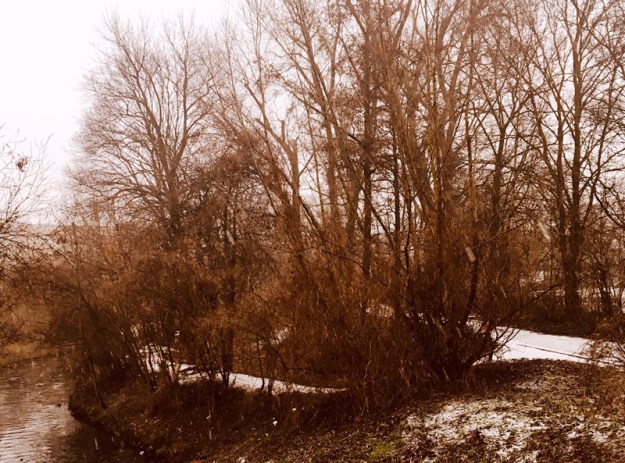
In the city, snow and ice brings chaos wherever it meets stone or concrete. A walk to the shops becomes a dangerous undertaking with the threat of injury. Bridges become ice rinks, with nothing solid beneath them, only freezing air. The snow piles up by the kerb, dirty orange and speckled with grit.

In Brandenburg and Sachsen-Anhalt, the effect is no doubt the same in the towns and cities, but moving between them and something about the snow creates a shift of perspective. Here, it serves to muffle and disguise, hide and cover. A village, viewed across a white blanketed field beside a fairytale forest, is a collection of neat white triangles around a church tower, the snow resting on slates, plastic tiles or solar panels, covering plastic toy and garden furniture, water butts and gas tanks.

Under a grey sky, with everything else seemingly black and white, the scene becomes impossible to date. Viewed through a car window it is as if we are taken out of the here and now, if only for a moment. 

It’s a little uncanny. Or perhaps, as an old Aimee Mann song gives way to the hourly news bulletin, it is just a short moment of wishful thinking.

*

A short walk to the Elbe in Wittenberg, with snow on the cobblestones of the old river harbour, where some brick factories are still operating, others have been turned into gyms and training colleges, furniture showrooms and DIY stores and others still have been left to collapse into snow-dusted ruins.

Scrawled slogans insult others for slights the casual reader can never possibly know. A swastika against the red brick triggers an almost physical reaction. You try to imagine the person as they spray it. What are they thinking? What are they trying to say?

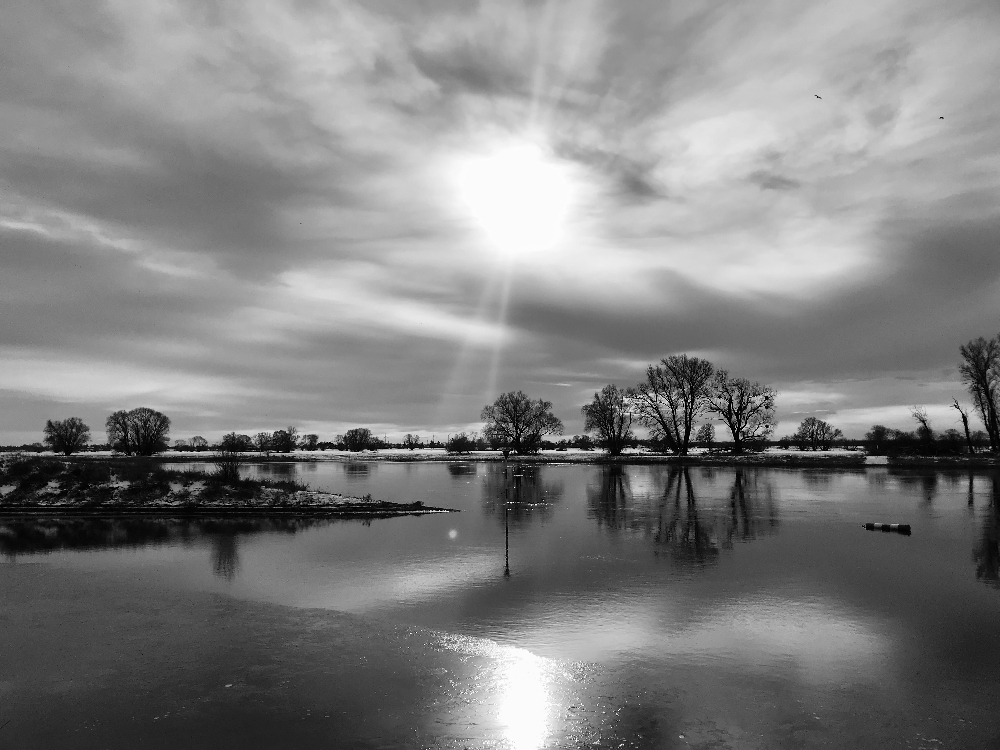
At the river, the sounds and the symbols of the city, its past and its present, recede. Geese fly in formation overhead. Deer stand in the field on the opposite bank, dark against the snow. Dogs bark in a distant village. Church bells sing. And the river rushes on by, no time to pause in its long journey from the Bohemian hills to the North Sea. 
The numbers offer a glimmer of hope. Organisers say 350,000. The police say 100,000. No matter the demo, no matter the country, it’s always the same. But if the truth lies somewhere in the middle, it remains – as do all the demos across the country – a powerful symbol. As does the vote on dual citizenship laws in the Bundestag.

Ignoring the protests against them, the AfD put “Dexit” on the table. Meanwhile, train drivers announce a six-day strike. Recession grows ever more likely. And the temperature rises by ten degrees and the snow melts.

*

News from Liverpool reaches the Berlin U-Bahn. Football is unimportant, especially when compared to what is happening in the world, and yet it is the sense of escape that it gives that keeps us following and tuning in, despite the money, the corruption and the sportswashing that are an inescapable part of the sport. As for Jürgen Klopp: for anyone who fell in love with footy as a kid, you’ll understand how Liverpool fans are feeling. He made us feel like it was then… again. 

Escape on a Friday night is to be found at the Velodrom, just off Landsberger Allee. Groups of young people gather inside the track, clutching their plastic glasses of beer. Lights flash and music blares. The two commentators do their best to explain what is going on to those of us for whom the Berlin Six-Day races are the only indoor cycling event they ever go to watch. Older men, slim in their jeans with a cycling cap perched on their heads follow the events on the track. They don’t need any explanations.

The Six-Day Races have been going for more than a hundred years, although the pandemic shut the Berlin edition down for a while and now the racing only takes place over two days.

“We’re working on it…’ one of the commentators says, about the possibility of returning the event to its former glory. Those who have come to the Velodrom on this cold, January Friday evening seem to be having a lot of fun. The racing will continue to midnight, in a dizzying array of disciplines. Not everyone – audience or competitor – will make it to the end.

A slow morning stroll through streets I have known for more than two decades. A cafe where we drank 2.50 DM beers while the proprietor told inappropriate jokes about 9/11. A square where we met friends in the playground when our children were still small enough to go on the swings and climbing frames. The house where an old, mostly lost friend lived, surrounded by walls that we helped to paint. Her name is still on the doorbell.

More squares, more playgrounds. Which shops are the same? Which cafes have changed their name? By the Gethsemanekirche – where the Peaceful Revolution first arrived in Berlin – notices on the railings bring to the attention of the neighbourhood human rights abuses at different places around the world. Another message kindly asks the person who keeps tearing the notices down to come and talk instead. A time and a place is offered.

Let us talk! But this is a time for slogans. Shouted by a multitude. Affixed to the front of a tractor. Delivered while glued to the floor or aiming foodstuff at a piece of artwork.

*

A sign above a kindergarten exclaims:

NEVER AGAIN WAR

A painted piece of cardboard leaning against a balcony balustrade insists:

NEVER AGAIN IS NOW

The sun shines. The air is chill. In the centre of the square, an old artist contemplates an empty playground in the place where she used to live and which now carries her name.

NIE WIEDER KRIEG

Käthe Kollwitz’s placard is a hundred years old this summer, created to mark the tenth anniversary of a war that was supposed to end all wars and took with it 40 million souls, including Kollwitz’s son Peter, who died on the battlefield in October 1914.

A hundred years. Never again… No more wars. But you count them off, and there are so many in the century that has passed. Even then, you realise, do not know of them all.

Don’t forget Sudan.

The sticker on the lamppost is small. For “Never again” to mean anything, it requires the memory of what went before. But instead we do our best to forget what is happening, even as it happens. 
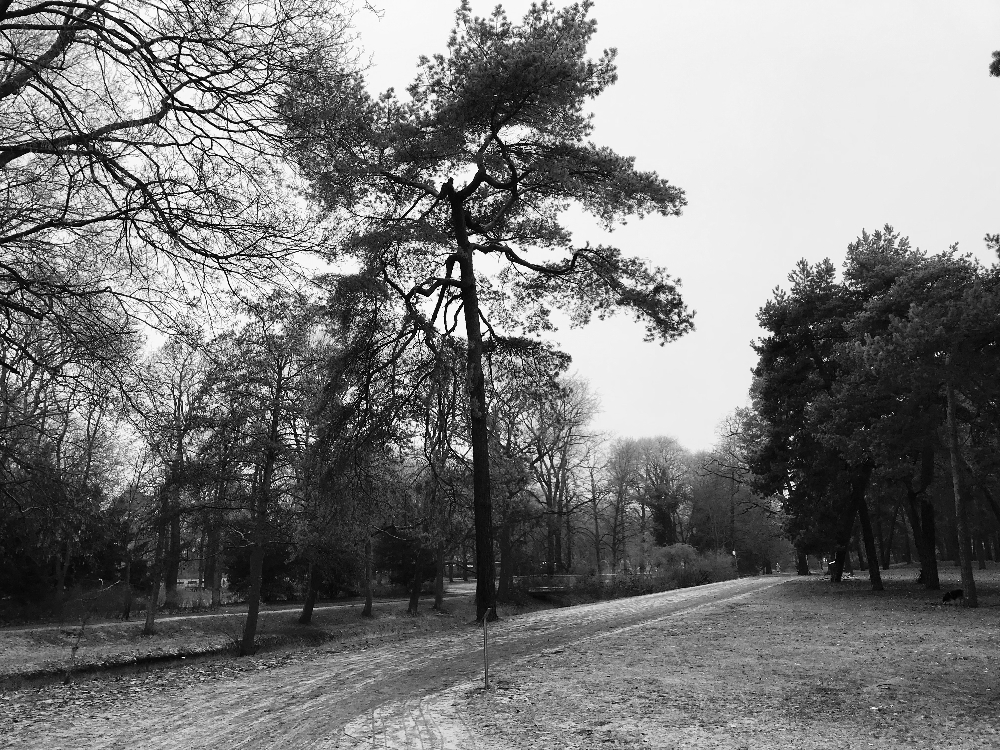
Words & Pictures: Paul Scraton
Publications and round-up of 2022

It is already springtime as I write these words, trying to get the energy to put together the round-up of last year’s activities seems to have been more difficult than usual. Not quite sure why. In any case, the biggest news of 2022 was the start of a new project – The Winding Trail. This is a blog created together with my partner Katrin devoted to ‘adventures beyond the front door’… a little like Under a Grey Sky was once upon a time. We have published lots of words and pictures on the site since we launched last year, so go and take a look and an explore.

Also in 2022, we continued to keep Elsewhere: A Journal of Place ticking over. This project now enters its ninth year and I remain incredibly proud of everything we publish there, and especially the fact that we are increasingly a place where writers get there first piece of published work out into the world. It is something we will continue to work on in 2023, along with some new Elsewhere-adjacent projects that begin with a Joseph Roth evening in Berlin a few weeks ago – you can follow along on Elsewhere as we take the next steps.

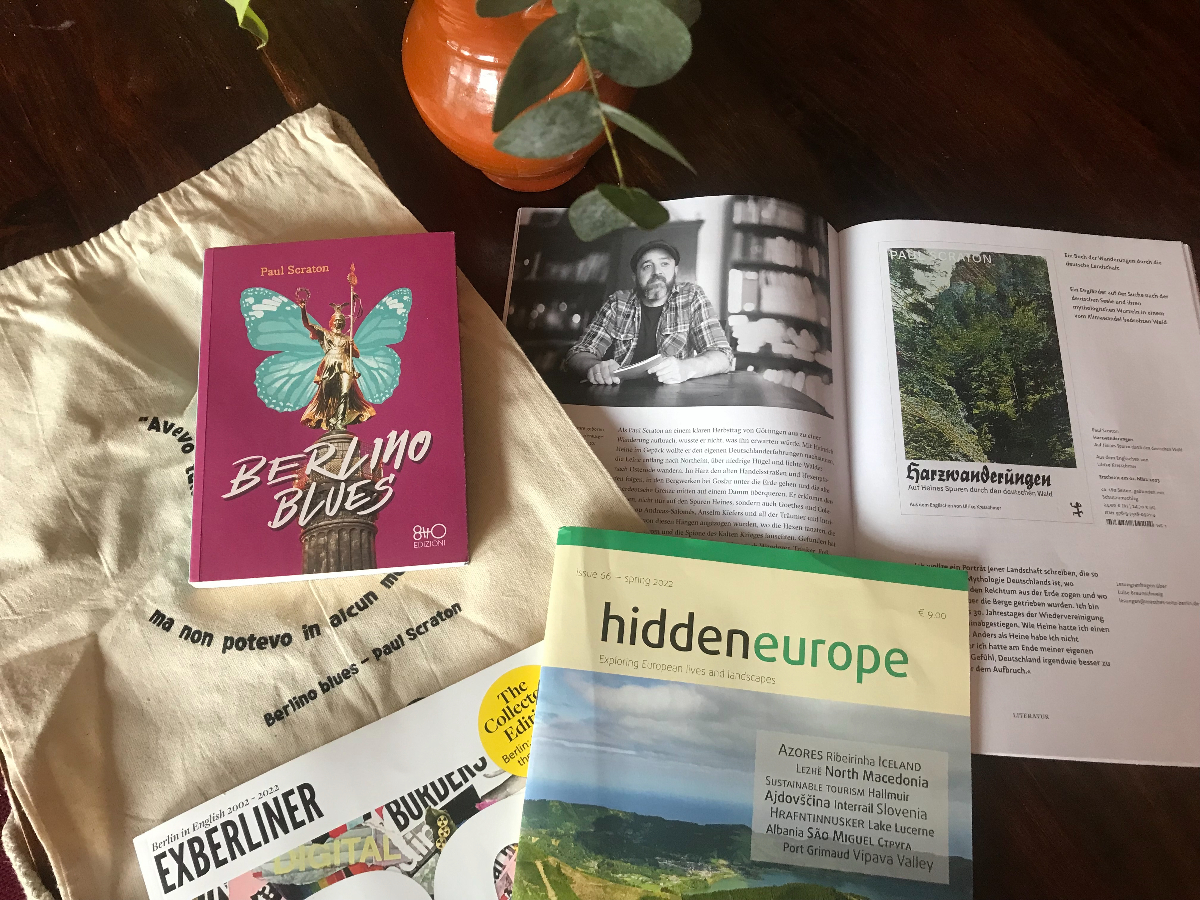
But let’s not get ahead of ourselves. We’re still in 2022… so what else happened over the year? There was the excitement of my novel Built on Sand (published in 2019 by Influx Press) getting an Italian release, published by 8tto Edizioni as Berlino Blues – including a tote bag with my words in Italian printed on it. Although no new books were published in 2022, I finished two. Harzwanderungen, for my German publishers Matthes & Seitz about a walk in the Harz Mountains following Heinrich Heine will be published in April 2023, and my next novel A Dream of White Horses will be published by the incredible Bluemoose Books in 2024.

So there was not much time for other writing, but I did have a few pieces published during the year:

For Slow Travel Berlin (essay): The Peace Race – Socialism’s Grand Cycling Tour
For ExBerliner (essay): The Panke
For hidden europe (essay): A Tale of Two Hearts: Emigration and the Azroean Spirit
For hidden europe (book review): In search of Joseph Roth
For Visual Verse (short story): Edgelandia
For Elsewhere: A Journal of Place (essay): Between the Years

What else? There were a few events over the course of 2022, including the chance to read and appear alongside wonderful writers such as Musa Okwonga, Kirsty Bell and Adam Scovell. I was also invited to Switzerland to read at Books Books Books, which has led to me becoming a judge on the Swiss Writing Prize for high school students, which should be a great experience.

There are quite a few events already in the calendar for 2023 and hopefully more will be announced soon. And I really need to crack on with the next book. I know what it is supposed to be… now’s the bit where I have to get on with it!

If you’ve read to the end, thanks for coming with me on this incredibly self-indulgent post, and I hope 2023 has started well for you and will continue throughout the rest of the year.

Paul

Publications and round-up of 2021

In attempt to keep track of things that have happened, and more importantly WHEN they have happened in these strange times, I’m once again putting together a round-up of what I’ve been up to over the past 12 months. The biggest news of 2021 was undoubtedly the publication of IN THE PINES, my novella of the forest, by Influx Press. My third book for Influx was also a collaboration, as it featured the haunting and beautiful collodion wet plate photography of Eymelt Sehmer. You can also read an interview with me about the book, from the ExBerliner, and an article and interview I wrote for Elsewhere about Eymelt and her photography. You can also read an extract from the book on Caught by the River: Ruinenlust.

Here’s what else I’ve been up to:

For Slow Travel Berlin (essay): Springsteen and The Wall, about the Boss’ famous 1988 GDR concert in East Berlin.
For The Guardian (essay): The paintings that take me back to Snowdonia, about the artwork of Rob Piercy.
For The Times Literary Supplement (review): Not all stories are for sharing, ‘The Fig Tree’ by Goran Vojnović
For Europe by Rail (essays): Reading on the Rails and A Hole in the Wall. The latter is about an opening in the north face of the Eiger, that has become part of mountaineering folklore in the Alps.
For hidden Europe (essay): Heathland: Exploring the Lüneburger Heide
For Caught by the River: Shadows and Reflections, about walking in Germany and the music of Gillian Welch.

We continued our work on Elsewhere: A Journal of Place, where I am the editor in chief, and although I wrote less for the journal this year than normal, I did contribute a couple of pieces including this review of the Adventure Podcast and an essay from Weimar about the town, Buchenwald, and how we remember the events of the past: Bearing Witness.

What else? In 2020 I attended the incredible ‘eleven songs‘ sound installation at Halle am Berghain by tamtam (Sam Auinger and Hannes Stobl). For their documentation of the project, published in 2021, I wrote the essay ‘Memory Songs’. I also worked with the wonderful people at Marmota Maps on the English translation of their Book of the Alps – which is out now!

If you’ve read this far, thanks for reaching the end of this – by its very nature – self-indulgent post, and I hope you have a wonderful 2022.

Paul

In the Pines is out now!

I’m extremely pleased to be writing that my latest book, In the Pines, has been published by Influx Press. In the Pines is a novella, which tells the story of the narrator’s lifelong relationship with the forest through a series of fragmented sketches and short stories. It is also a collaboration, with the photographer (and my good friend) Eymelt Sehmer. The book includes a series of her collodion wet plate photographs, using a 170-year old technique which required her to take a mobile dark room into the forest to develop the images on site.

The stories and the photographs contained in the book are linked. Sometimes, Eymelt went into the forest with one of my stories in mind, and came back with an image inspired by it. Other times she came out of the forest with a series of pictures that triggered something in my imagination and out came another story for the book. We will be launching the book on the 20 November at Eymelt’s gallery in Berlin, where she will also be exhibiting the photographs. If you are in or around Berlin next week then we would love to see you.

Otherwise, if the book is of interest then you can get your copy via Influx Press or through your local bookshop. If you are not close to a bookshop or are being careful with shopping right now, Bookshop.org is a website where you can both order online but also support a local or independent bookshop. You can find all my books, including In the Pines, here.

A Little Over Halfway There – #30for30 Half Marathon Challenge

The Pahar Trust Nepal team along with teachers and pupils at Sita Ram school in Nepal, where they’ve already been undertaking a number of #30for30 activities since January.

I wanted to write this last week, between my 15th and 16th half marathons for the Pahar Trust Nepal’s #30for30 fundraising campaign, but events got the better of me. So here we are, with sixteen runs down and another fourteen to go and I have to say that – for the most part – I’ve been really enjoying these weekly long runs. 

One of the main reasons has been the company. On most of the runs I have been joined by my good friend Jim for at least some of the way, and I’ve also run a half marathon with Neil and Charlotte. Unfortunately, the restrictions here in Berlin have limited me to only being able to run with one person per week, but I am hopeful that by the time we get into the twenties it might be possible to run with a slightly larger gang. 

But the support I’ve had over the past sixteen weeks has not only been from these three out on the streets with me, but also from everyone who has donated via my Justgiving page and sent me words of encouragement and support, and especially Alan and Tim from the Pahar Trust Nepal who have sent me supportive emails and a lovely fundraisers medal to mark the halfway point of the campaign. I have medals from running that include a full marathon in the forests of Brandenburg, the Mauerweglauf along the Berlin Wall Trail, and numerous half marathons and 10km runs in Berlin, Liverpool, Dresden and Leipzig, but I think this is the one that I will treasure the most.

Right now the Pahar Trust Nepal is well on the way to their #30for30 target of £50,000 and our little community that has supported me in my half marathon efforts have already donated (at the time of writing) £1,785. When I started the fundraising back in December I set an aim of £200 – my target now is ten times that (and secretly I’m aiming for more – see below). Thanks so much to everyone who has supported so far, and if you feel like encouraging me for the runs to come, you can do so here on my Justgiving page.

The Important Bit:

But what’s the money going to be used for? I thought I would use the halfway report to go into a little more detail on the Pahar Trust Nepal’s work and in particular their early years education projects, as this is the main focus of the #30for30 campaign. On their website, there is an overview of the importance of early years education by Sue Green, the Pahar Trust Nepal President:

“A child’s brain develops more than at any other time during the first five years of life and the experiences that a child has during this time shapes their brain development. The basis of a child’s social behaviour, capacity to learn, ability to problem solve, communication skills and motivation skills develop during these early years. Without appropriate age related stimuli and loving care development will be inhibited…” (Read the rest of Sue’s post here)

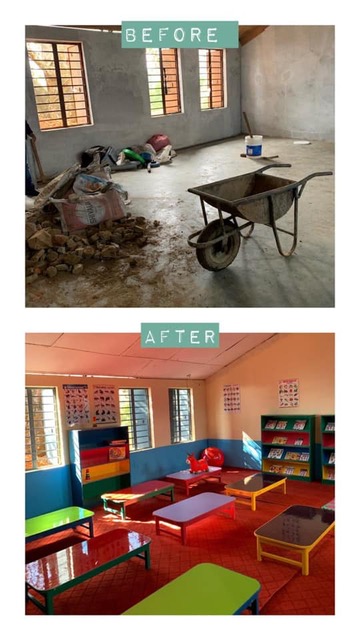
On the website they also present a couple of case studies, to give anyone who supports the Pahar Trust Nepal the chance to understand how the funds raised via the #30for30 campaign and through their other activities will be used. This includes a story from the Thaprek School in Tanahun, where volunteers visited in 2019 to support the refurbishment of the school to provide an improved Early Childhood Development classroom, a new kitchen and dining area, and a safe, reliable water supply.

The team repainted the classroom to make it brighter and more engaging, installed new furniture and learning resources, and constructed a new toilet so that children did not need to go outside – especially beneficial during the monsoon season. The improvement works cost around £4,200, and the impact for the children was clear to the teacher, Muniraj Gurung, who said: 

“The new room has provided much more space for the children to play and they have lots of learning materials to use now. We are also able to provide snacks to the children which is good.  We have seen an increase in attendance and we are almost full which is good for the children. They can play with each other and learn many things while playing. They are improving their habit of helping each other also. I would like to thank the donors for their support because before there was a very narrow room; there weren’t many things to read and play with. Now we have a room and resources which makes the children happy and their learning becomes even more meaningful.”

Each penny that we raise for the #30for30 campaign will go towards projects like the Thrapek School, and even modest amounts make a massive difference. For example…

£20 could provide a bag and educational materials for a student
£100 could repaint a classroom
£500 could provide new resources such as stationery & toys
£1,200 could provide new flooring, a whiteboard & furniture
£3,000 could provide the complete refurbishment of an existing room

I don’t know how realistic it is, but if by the end of the thirty weeks and the thirty half marathons we can get close to the £3,000 needed to complete refurbish an Early Child Development classroom then it would certainly make every one of 632.7 kilometres worth it, and all the aching muscles that come with them!

One more for luck: 30 Half Marathons in 30 Weeks Fundraising Page

You can find out more about the Pahar Trust Nepal, sign up for regular newsletter updates and discover more details about the various projects they’ve undertaken and supported over the last thirty years on their website: Pahar Trust Nepal.

#30For30 – Half Marathon Challenge for the Pahar Trust Nepal

I’ve never been one for New Year’s resolutions, but as we approached the end of 2020 – possibly the most strange and anxious year many of us will have ever experienced – I decided to set myself a running challenge that would be doable regardless of lockdowns and other restrictions that might be in place. My idea was to do something for the Pahar Trust Nepal, an organisation that I’ve long known about thanks to the involvement of good friends of ours. It turned out that, as I thought about what it was I might do, they were in the process of announcing a fundraising campaign to mark 30 years since the first school funded and built by what became the Pahar Trust Nepal was opened.

And so, with #30For30 as their campaign slogan, it seemed only right to come up with a challenge that fit this theme and so the idea of running thirty half marathons in thirty weeks was born. At the time of writing I have completed the first four – you can read about them on my fundraising page, or follow me on Instagram – and despite Berlin’s cold winter they have been going well, although I am beginning to get used to having nearly permanently tired legs. I’m hoping this will get better the longer the challenge goes on.

About the #30For30 Campaign

From the first school opened in Pokharithok, a tiny village in the Himalayas, the Pahar Trust Nepal has completed more than 200 projects, including building and renovating 159 schools, 51 libraries and 38 other essential projects such as health centres and toilets. For the #30For30 campaign throughout the whole of 2021, the PTN is aiming to raise £50,000 to help 30 schools in Nepal improve their teaching provision and facilities for pre-primary school children aged 1-5 years old.

This might include the total refurbishment of a classroom, or more resources such as stationery, toys and other educational materials. From the PTN website:

When children attend pre-primary education, they are more likely to stay in school and attain minimum reading and mathematics competencies. It also supports economic growth, as it enables mothers and other caregivers the opportunity to work and increase their earnings.

Research also shows that children who receive safe, quality education at this age are significantly more likely to have more successful outcomes as adults.

The campaign supports the UN’s Sustainable Development Goal to ensure all children have access to quality early childhood development (ECD) so that they are ready for primary education.

I have set my own fundraising goal to £800 and as of today thanks to some generous support I am already at 81% of the target. To get an idea how the fundraising can help, here is an overview of how the money collected can be used:

£20 could provide a bag and educational materials for a student
£100 could repaint a classroom
£500 could provide new resources such as stationery & toys
£1,200 could provide new flooring, a whiteboard & furniture
£3,000 could provide the complete refurbishment of an existing room

I’ll add some updates here on the blog as the campaign continues, both about my runs but also the projects in Nepal that the campaign will help, and once the weather improves and I can strike out a bit from running only from home, I’ll also post some route ideas for anyone planning to come to Berlin and would like to explore by running a half marathon through the city. And if you feel like supporting me in this 30-week challenge, then please visit my Justgiving page. I know that things are tough financially for many people right now, but anything you can donate will make a very real difference and is greatly appreciated. And if anyone fancies keeping me company on a long run between now and July, just let me know.

Paul

Publications and round-up of 2020

At the end of this strange and anxious year, I’m once more looking back at the last 12 months to create a round up of some of the things I’ve been up to. In March, my first book in German (translated by Ulrike Kretschmer) was published – AM RAND: UM GANZ BERLIN. In December, we launched STORIES FROM THE SQUARE, a series of short stories commissioned by The Circus in Berlin and which you can listen to me read if you follow the link.

Here is what else I have been up to:

For Lit Hub (essay): ‘What can the artist do in dark times‘, on the life and legacy of Käthe Kollwitz.
For Metamorphosen 27 (short story): ‘Walking to remember‘.
For Stadio (essay): ‘Six weeks in Springtime‘.
For hidden europe magazine (essay): ‘Carried on the wind: Walking with Rilke in Duino‘.
For Caught by the River (obituary): ‘Caught by the Reaper: Jan Morris‘.
For the exhibition BERLIN.LOKAL-ZEIT (essay): ‘Berlin Springtime‘ (audio version).
For Lit Hub (essay): ‘Can the German Path to Truth and Reconciliation Work in America?‘.
For Caught by the River (essay): ‘Shadows and Reflections‘, on the artwork of Rob Piercy.
For hidden europe magazine (essay): ‘The 21.48 from Aachen‘.

For Europe by Rail I wrote a monthly short essay from March to December. You can see the archive of pieces here, but I wanted to  flag up the August essay ‘A Little Train in the Mountains‘, a tribute to Tony Judt on the tenth anniversary of his death.

We continued our work on Elsewhere: A Journal of Place, and I was privileged to work with wonderful writers throughout the year. My own pieces for the journal are here and a couple of my favourites are:
Irreplaceable – An interview with Julian Hoffman‘.
Jenny Sturgeon, Nan Shepherd and The Living Mountain‘.
At Grunewald station: Memory and the danger of forgetting‘.

There are a couple of videos of events we managed to do during this strange year, including this one (in German) about my book AM RAND, and this one (in English) about Wanderlust and Memories of Elsewhere. I was also very honoured to be invited to Dortmund to take part in a panel discussion as part of the ‘The Other Side‘ exhibition at the Dortmunder U. 

What of next year? I’m currently in the middle of writing a book about Germany’s Harz mountains and Heinrich Heine, tentatively to appear in 2022, and October 2021 will see the publication of my novella IN THE PINES, accompanied by photography from Eymelt Sehmer. It’s being published by Influx Press and all the details are here.

Finally, and in connection to Influx. Early in the first lockdown we made some short films featuring readings from our books. Here’s mine for my Berlin novel BUILT ON SAND, which was published by Influx in 2019.

Publications and round-up of 2019

As we reach the end of 2019 I wanted to bring all the different things I have been up to over the past twelve months into one place. It has been a busy, exciting and exhausting year, not least because it saw the publication of my debut novel BUILT ON SAND (Influx Press) as well as a number of other short stories and essays that have found their way out into the world:

For the New Statesman (essay): ‘How Joseph Roth saw Europe’s future’.
For Lit Hub (essay): ‘How Berlin Reckons with Its Past Each and Every Day’.
For SAND Journal (short story & interview): ‘Trans Europa Express’.
For hidden europe (essay): ‘A Walk in Grumsin: The Forest and the German Imagination’.
For BLA Bokvennen Litteraer Avis (essay): ‘Against forgetting’.
For The Lonely Crowd (short story): ‘The Haunted Land’.
For Caught by the River (essays): ‘Field Notes from High Fläming’ and ‘Shadows & Reflections’.

We also continued with Elsewhere: A Journal of Place, which is now an online journal and for which I wrote the following articles and essays:
‘On Potsdamer Straße (to see an old friend)’.
‘Postcard from Rüdenhof, Moritzburg’.
‘Between the villages’.

As the editor in chief of Elsewhere, I also previewed the fine album ‘Chalk Hill Blue’ by Will Burns & Hannah Peel, and had the privilege to edit and publish far more fine writing than I have space for here. One particularly proud moment was to publish a series of literary tributes to writers at risk around the world, in collaboration with English PEN – archive here.

Earlier in the year I was interviewed by Nothing But The Rulebook about my writing, while in November, I was interviewed for the Monocle podcast ‘The Urbanist’ about borders, memory and the anniversary of the fall of the Berlin Wall. There were also readings in Germany, the UK and Ireland, all of which were a lot of fun and are listed here.

The end of the year also saw the first time my work has appeared in German. Ulrike Kretschmer translated my essay about a night walk in Berlin for the anthology PSYCHOGEOGRAFIE, edited by Anneke Lubkowitz and published by Matthes & Seitz.

So that was my 2019 in writing. Let’s see what 2020 brings…

Joseph Roth and the Schiller Park in spring

The parks of a city reflect their surroundings, not so much in how they look but in who can be found wandering their pathways or lounging on their green spaces. In Berlin, many of the parks were created with the expansion of the city – ‘People’s Parks’ intended as a patch of nature, a communal garden, for those who lived in cramped tenement blocks and worked the red-brick factories of the industrial age. With their trees, lawns and gravel paths, the parks of Friedrichshain, Wedding, Mitte and even the grand old Tiergarten in the heart of the city, have always shared much in common, but since the beginning they got their local character from their local characters.

In 1923 the writer Joseph Roth visited the Schiller Park in Wedding for an article published in the Berliner Börsen-Courier. It was autumn, and he reflected on the falling leaves and the poetry in the sound of their rustling, that symbolised a spirit of ‘mournfulness and a sense of transience’ that fitted the time of the year. Or at least, it did in the Tiergarten, preserve of the promenading well-to-do of Charlottenburg. In the Schiller Park, things were different:

‘…the locals from the working-class district of Wedding gather up the leaves every evening, and dry them, and use them for winter fuel. Rustling is strictly a luxury, as if poetry without central heating were a luxury.’ (from What I Saw, translated by Michael Hofmann, Granta)

On a Saturday morning in spring I run from my flat in Gesundbrunnen (once part of Wedding) through the backstreets of my neighbourhood until the Schiller Park opens out in front of me. There are no leaves on the ground of course, and even if there were, most of Wedding’s apartments now have central heating. But in the people on the benches and playing football on the open space, the neighbourhood is still reflected, as it was when Roth was here. This scene is Wedding. The park is rooted in its community.

The football pitches are both makeshift and yet impressively organised, with thin ropes and plastic training cones to mark the sidelines. Each team has a different coloured bib, and there is a referee, identifiable as the only person on the pitch without a day-glo vest and by the whistle hanging around his neck. There is a small crowd off the the side watching on at the halfway line, and I stop with them for a moment as I catch my breath. Encouragement is shouted in a number of different languages. A young child plays in the piles of discarded jackets and tracksuit tops of the players. I chat with a man doing keepy-uppies, waiting for his substitute appearance. We speak in English. He was born on another continent. He lives around the corner. He asks me where I am from. I tell him I was born on an island that seems to wish it was another continent. And that I also live around the corner. He laughs.

I am tempted to stay in the Schiller Park, to watch the rest of the game and wait for the time that the beers are opened from the crates that mark the halfway line. The sun is warm and music plays, a rhythm from portable speakers that mingles in the spring air with the sound of shouts, the referee’s whistle and the thud of a hoofed clearance out from the back. Elsewhere in the park, morning drinkers occupy the benches that line the path around the edge. I re-join the stream of joggers circling the park. Away from the football pitches, a family have arrived to set up for a picnic, laying out blankets between the coolboxes. It is the first warm Saturday of the year and you can feel the happiness in the air. The Schiller Park is still the neighbourhood’s backyard. It was a mild winter, but a winter nevertheless, and we all survived it. Now it’s time to play.

Words & Picture: Paul Scraton

By the river

It is a cold morning down by the river, on one of those days when it doesn’t really get light. If there is activity here, it is to be found inside. In the red-brick workshop where, behind high windows, a blonde woman with paint beneath her fingernails hammers at a lump of stone. In the library where, among the shelves, staff move with soft footsteps as tandem partners trade languages in low voices across circular tables and children search for stories they can read, listen to or play. In the apartments that look down on the river, the library and the workshop, and the spaces in between.

Outside, the football pitch is empty. The playground too, and the benches where drinkers gather on warmer days than this. They are part of the strange community down by the river, with their dogs and their brown bottles, and the arguments which can be heard over the laughter of kids on the playground or the shouted appeals to fair play in the direction of non-existent referees. They are all someplace else today. As are the young people who follow desire paths down the embankment to smoke and drink in the sanctuary of the bushes.

But there is life and movement beneath the sullen skies. A grey heron stalks the shallows, stepping elegantly over the latest shopping trolley to have been dumped from the embankment. A woodpecker scurries around the truck of one of the older trees. Wait until dusk, and a family of foxes can be spotted trotting along the embankment where, last summer, tents were pitched, tucked beneath overhanging branches of trees. The encampment moved on when the winter winds began to blow. A presence by the river for months, they left no trace when they departed, except a sodden blanket, curled at the water’s edge, waiting to be swallowed by the brambles in spring.

At the window she
stands, staring at the river
and recalls his face

Words & Picture: Paul Scraton