Monthly Archives: June 2016

In and out of Europe

Bonn, Juli 1991 Europa-Flagge Die zwölf gelben Sterne auf blauem Grund stehen sinnbildlich für die Mitgliedstaaten der europäischen Gemeinschaft (EG).  Der EG gehören an: Belgien, Bundesrepublik Deutschland, Dänemark, Griechenland, Großbritannien, Frankreich, Italien, Irland, Luxemburg, die Niederlande, Portugal und Spanien.

“What happens now?”

It is a question I have heard a lot in the past couple of days, ever since the United Kingdom and the rest of Europe woke to the news that the seemingly impossible had happened and the voters had – just – decided for LEAVE, for Brexit and for the end of a 43-year relationship with the rest of Europe. The question means different things, depending on who is asking it. What happens now for the UK, in England and Wales, in Scotland and Northern Ireland? What happens now in Germany, or France, or the Netherlands, where the far-right and Eurosceptic politicians spent Friday celebrating as the rest of the continent looked on in horror and disbelief. And what happens now to me, still an EU-citizen living in Berlin thanks to my British passport, and to my daughter and others of her generation for whom the world, all of a sudden, seems a little smaller?

“Are you going to get German citizenship?”

This is another question I have heard over the past couple of days, to which the only answer possible when no one seems to have any clue what is going on or what is going to happen next is: Maybe. And maybe, having lived in Germany for fifteen years, I should have got my German citizenship already. After all, having committed to living in this country, I should have made the next logical step. But until now it was not, for me at least, a logical step. I did not want to get German citizenship because I did not – I do not – feel German. My own sense of identity is as mixed up as many peoples, I imagine. Part northern English. Part British. And yes, part European. And it was always that third part, the European part, which allowed me to feel there was no contradiction in living in one part of this Union of ours while maintaining citizenship in another.
Continue reading

In Brandenburg

Brandenburg

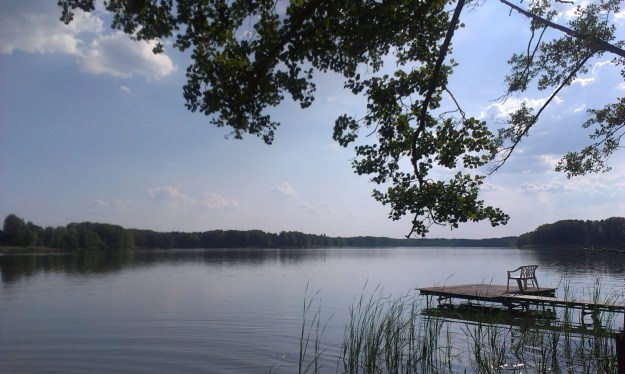
We travelled north, out from Berlin along the bumpy autobahn that exits the city via Pankow and which is presumably too important a commuter road into and out of the city for it ever to be closed to fix its legendarily uneven surface. From the Berliner Ring – the German capital’s M25 – we left the motorway and continued our journey on overland roads that made their way through forests, villages and between fields. Even outside of the large patches of forest that cover much of the state, many of the roads through farmland are lined with a single row of trees; avenue streets through the countryside. Trees, woods and forests. Add about a thousand lakes and that, to my mind at least, is Brandenburg.

Sometimes, when you drive, ride or walk through the state that completely surrounds Berlin, it feels as if there is no one there; as if there is some kind of force at the heart of the city – the TV Tower perhaps – that sucks people towards it to leave behind a depopulated, forgotten hinterland where wolves and wild boar roam the forests and black kites share the skies with white tailed eagles. There are people of course, some 2.4 million who call Brandenburg home, but that number has fallen by about 8% since 1989 and German reunification a year later and it is predicted to fall further still. And when I think about Brandenburg, this land beyond Berlin’s borders, I don’t think of Potsdam or Cottbus or the old one-industry towns lined up along the Oder and the Polish border, but empty villages, empty lakes and empty lanes. The word that first comes to mind is sleepy. Spring, summer, autumn or winter; it doesn’t matter. There will be space in the market square, on the forest trail, at the beach on the lakeshore.

Continue reading