

Easter Monday and the Berlin streets are quiet as we move around the back of the university from Friedrichstraße station to the Gorki Theater for Heinrich Mann’s Der Untertan. The English-language translation of the novel was called Man of Straw; the tale of Diederich Hessling, whose snivelling and unswerving loyalty to authority, when combined with his hypocrisy and general unpleasantness, stands as a satire of Wilhelmine Germany and the type of patriotism that led the country to the ruinous battlefields of World War I. Mann completed the novel in 1914, on the eve of a war that he would become a vocal critic of, but it would only be published four years later as a very different Germany emerged from the trenches.
In the decades that followed publication, Der Untertan would be seen as almost a premonition. The attitudes embodied in the character of Hessling were those that enabled the rise of the National Socialists. And today, it feels like those behind the production at the Gorki Theater have something to say about the current situation. Hessling’s story is told through twelve morality tales. There is humour and a bit of slapstick. Breaking of the fourth wall. It is funny and clever, but throughout you are forced to ask the question: just because the protagonist is laughable, doesn’t mean the place we get to is necessarily amusing.
The play has English sur-titles and at least a couple of the translations – “drain the swamp” being the most on the nose – seem to be offering up a vision of Donald Trump as a 21st-century Hessling character. It seemed clear, even in 1918, that what Mann was offering was not just a portrait of the recent past but a warning for the future. In Berlin in 2024, there remain lessons worth heeding.
*
The Trans-Pennine Express. Never has there been such a gap between the evocativeness of a train service’s name and the reality of the passenger experience. But today everything seems to be going smoothly between Manchester and Liverpool.
As we move through the suburbs we can look down on the gardens of semi-detached houses. There is a view through a window to a kitchen sink or a wooden table. Blinds pulled down in the middle of the day. A man smoking a cigarette out of an upstairs window. The gardens offer clues as to the personalities of those who maintain them. Neat lawns and tended flowerbeds. Is the overgrown tangle next door the result of laziness or an attempt at creating an insect-friendly garden? All are better than the plastic grass surrounded by white pebbles a few doors down. A single pot of basil outside the back door is the only growing thing between the tall wooden fences.
It is this vision of suburbia that I think of when I imagine myself on a train in the north of England. If I imagine a similar scene on a German train, I am looking down on the allotment gardens on the edges of Berlin. The divided plots with their sheds, lawns and beds for growing vegetables or flowers. Depending on the authority of each colony, some are almost regimented in their neatness.
Here the gardens speak less of the personality of those who maintain them, and more of the people with the clipboards who move along the neat paths to judge them. Are you keeping up to standards? Has the hedge been trimmed? Is the compost pile out of control? It is a job for Diederich Hessling, for even in the Kleingartenkolonie there needs to be order and respect for the authority of those wielding the clipboards.

In Germany, I am still sometimes relieved to be able to use English, especially in doctor’s surgeries or in any dealing with officialdom. When in the UK, I enjoy the opportunity to use German on those who are not expecting it. Across the aisle at Anfield, a couple of men are enjoying the build-up to the Sheffield United match. When I offer to take their picture for them, I see the moment of brief worry cross their faces. Have they said something they shouldn’t, in this place where they thought no-one understands them? But they haven’t. They are just excited, like we are, to watch our beloved red men in these last matches of the Jürgen Klopp era.
I have been to Anfield in recent years – to visit the museum and to be part of the Hillsborough Memorial – but it has been a long time since I was in the ground for a match. That was 2007, and the stadium is almost 50% larger now and, of course, no players from back then remain. But the magic of catching a glimpse of the green of the pitch at the end of the concourse tunnel remains as electrifying as it was as a kid, as is the chance to join in with You’ll Never Walk Alone as kick-off approaches.
It would be nice to say that it is enough to just be here. To soak up the atmosphere, regardless of what transpires on the pitch. But at this moment in time, there is still a chance of a title, so there are a lot of nerves in the ground and a real feeling of relief as Liverpool win 3-1. We don’t know what will happen next but we walk out into the dark and stormy night with hope in our hearts, if only for the time being.
*
I have written about Rhoscolyn many times before, and of all the things I have committed to paper about places that mean something to me, it is those that I am the least happy with. It feels like I cannot do justice to the place and what it means to me. A gentle failure, then, of trying to write about the most important place in the world.
I have never lived here. Never called it home. If you add up all the time I have spent at Cerrig-yr-Adar since I was born it would come, at most, to about 40-50 weeks of my 45 years. Not nothing, but nothing compared to my Uncle and Aunty, and my cousins and their children, who have lived and worked here. And yet, it is the only place I have constantly returned to in my life. The only place that has a presence in all the different chapters I have lived so far.
Perhaps that is enough. The one place I hope I shall always be able to return to. And to try, and try again, to find the right words.

On Unter den Linden the half marathon runners turn the corner by the Aeroflot building and catch a glimpse of the Brandenburg Gate. Their race is nearly run, and for most it gives them the boost they need to run the last of the 21.1 kilometres. I have run this race a number of times and I know how they are feeling. Those who are finding it easy. Those who are suffering. Those who are elated, and those who want nothing in life at this moment in time than the possibility to stop. We clap and cheer and shout our encouragement in the springtime sunshine, and try to resist the temptation to think that maybe next year would be a good time to do it again.
*
In Wiesenburg our local red kite – who we have named Charlie – hovers over the gardens in the early morning. I am reading Kathleen Jamie’s Findings:
If you’ve seen the hawk, be sure, the hawk has seen you.
*
There is blossom on the cherry tree at the heart of our garden. The grass is getting long. The bats are dancing at dusk and the bees soundtrack the morning. Spring.
*
It is the anniversary of the death, in April 1945, of Dietrich Bonhoeffer. He was hanged by the Nazis in the dying days of their ‘Thousand Year Reich’, which would last a little more than twelve. At the Zionskirche in Berlin, where we walk numerous times in a week, there is a sculpture in his memory. Bonhoeffer was active at the church on Zionskirchplatz from 1931 until 1933, when Hitler was appointed Chancellor. There was already a schism in the protestant church over National Socialism, but Bonhoeffer was clear where he stood.
The church, he wrote, has an unconditional obligation to the victims of every social order, even if they do not belong to the Christian community.
This was April 1933, only a few months after the Nazis came to power. The church has a responsibility to resist, Bonhoeffer argued, to not simply bandage the victims under the wheel, but jam a spoke in the wheel itself.
*
Wiesenburg is alive to the sound of birds. In the garden, we hear the bicycle-pump call of the great tit. Blackbirds. Sparrows. Wood pigeons. There are wagtails on the wood pile next door and a black redstart on the compost heap. Walking out across the fields we spy a kestrel, a buzzard and crows pacing between the ploughed furrows. There are less birds outside of the village than in. Horatio Clare called the crows, on his own walk across Germany, the Emperors of Emptiness, their domain the monoculture of the countryside.

On Saturday morning the village wakes slowly, a tale told through a series of sounds. The birds with the coming of first light. A cockrell. People with early shifts back their cars out of the driveway. One dog a few doors down catches a glimpse of an early morning jogger and his barks wake up all the rest. The first of the motorbikes from the city change down the gears as they enter the 50 zone. The click-whir of a lycra-clad peloton riding three abreast. Lawnmowers and wood saws. Tractors pulling loads. Saturday shoppers from outlying hamlets. The sound of the Bundesliga Konferenz, drifting out of an open window.
We walk out from the village to the low hills – little more than lumps in the landscape – that separate it from its neighbour to the north. The paths follow the “rummels”, dry valleys created at the end of the last Ice Age that are not dissimilar to holloways, especially as they became paths from the moment humans began to move through this space. One is named for the pastor. Another for the brewer. Now they belong to the hikers, following the symbols painted neatly on the trees, the hiking maps available for free at each train station with routes to suit every level of fitness and time schedule.
*
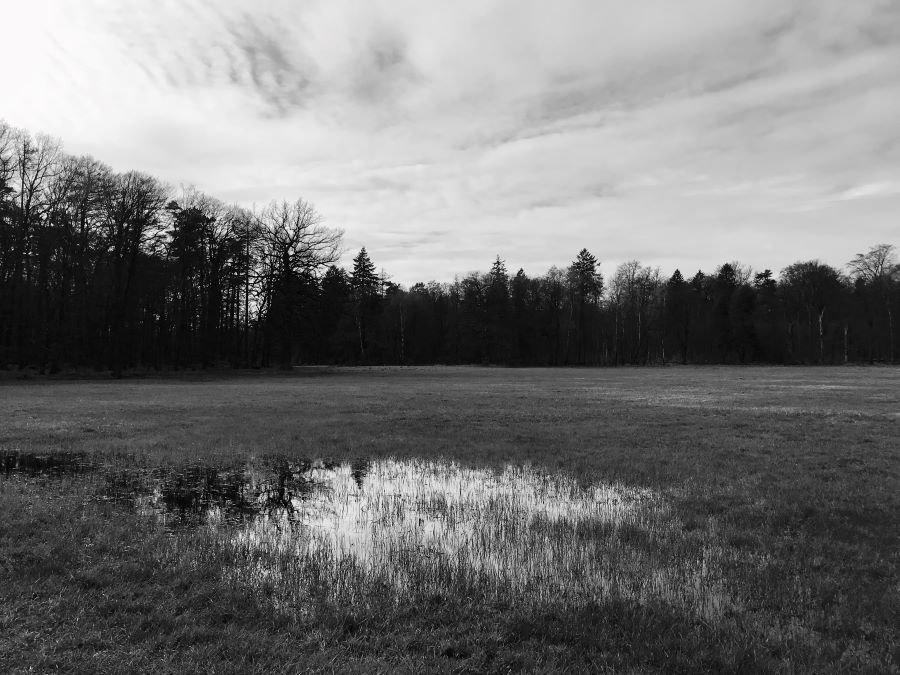
Another day, another walk. This one leads us out of our end of Wiesenburg and across the fields on a path that takes us to the historic heart of the village, a cluster of low-slung houses around a church built from the stones that were cleared from the fields (and are still being disturbed by the plough to this day).
On the corner, where the path dog-legs to follow a ditch that has become a running stream this year, there is an old oak tree with a bench beneath it. The tree has been pollarded numerous times, and it has a strange, almost uneasy shape. Which is not to say that it is not beautiful, and more than anything it is a reminder that even the most familiar walks can offer up something new. We have encountered the old oak tree in all seasons of the year, at all times of the day and in all types of weather. Each time, it seems to offer up something different.

The early morning bus links the villages with the town, with the high school and the train to the city. Frost returned last night and there are patches of white in the shade, even as the rapeseed flowers shine a bright yellow against the blue sky. A low mist hangs over some of the fields, a reminder of being on night trains approaching Berlin as the long journey through the darkness approaches its end with the first light of morning.
Today, the commuter ticks off the stations like a mantra. She dozes at one end of the carriage, in what she likes to think of as her regular seat, and although her eyes are closed and she travels in that place between sleeping and waking, she always knows where she is. As we approach Charlottenburg she gathers her things, ready for her stop even before the announcement comes.
*
In Weißensee we read pieces inspired by the White Lake City. It is the second salon at Galerie Arnarson & Sehmer, almost a year to the day after the first. Last year we spoke about rivers, today it is Weißensee itself, from the lake to the old racetrack, the memories of film studios and the Jewish cemetery.
In another country the baseball season is in its infancy. On the Rennbahnstraße, the schedule has yet to be fixed. All that lingers are the triumphs and tragedies of summers past.
A swing. A metallic thunk. The white ball against a blue sky. Her teammates cheer as she touches them all. Glory Days.
*
In Grunewald we walk from the station of the same name, where Jews were loaded onto trains at Platform 17 and taken to the camps. Grunewald is a neighbourhood of big houses erected beneath what Isherwood called the gloomy pines, but our path takes us away from the villas and the memorial to those taken and never to return, into the forest.
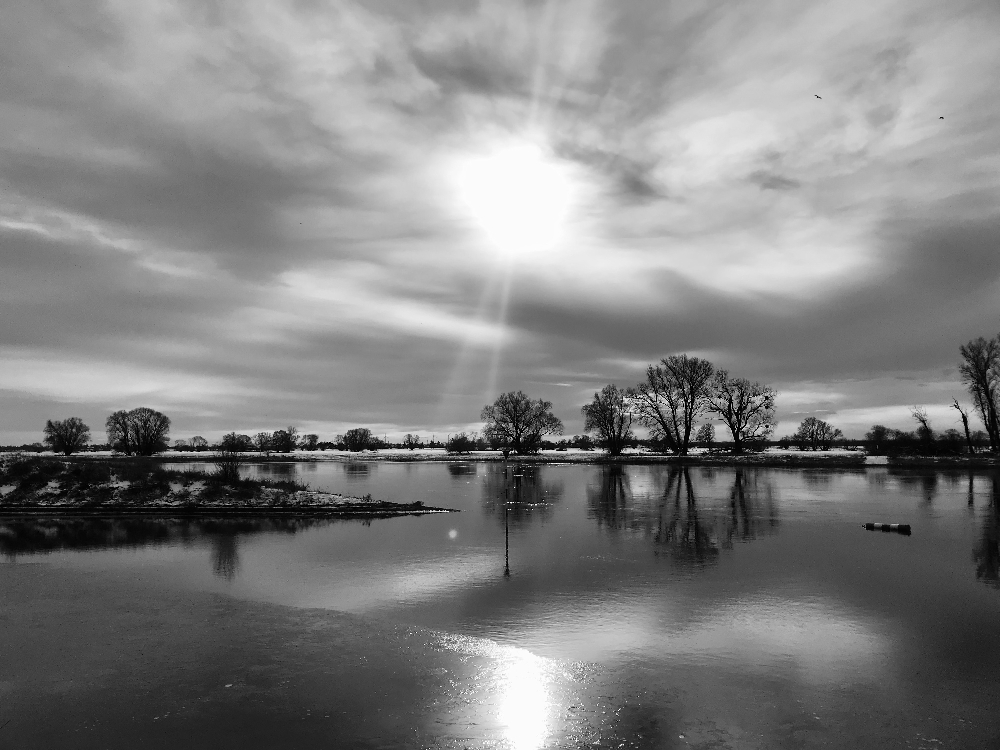
We pass by the sand dunes and the Devil’s Lake. The old listening station stands on a rubble mountain, no longer spying but still observing the scene. We reach the Havel at Schildhord, named for a Slavic Prince and a death-defying escape across the choppy waters. We can see the villa where the British Commander lived during the Cold War. From Slavic Princes to British Commanders, via Hessling’s beloved Kaiser, the list of those who have called the shots in Berlin is long and varied.
Our journey takes us through the suburb where British officers once lived to Le Courbusier’s massive apartment block, just across the railway tracks from another monumental architectural statement: the Olympic Stadium. This is an ambivalent place, depending on what you choose to remember. Hitler or Jesse Owens? I’ve played football on its pitch and run around its track. I’ve watched Liverpool play a friendly and Usain Bolt break a world record. I’ve heard Bruce Springsteen sing about summer in New Jersey and sheltered from a Berlin summer thunderstorm.
It feels like this is a place that has spent its existence trying to erase the stain of its earliest years. The World Cup in 2006 was probably its most successful moment. This summer, we’re trying to do it all again.

In Deutsche Welle, a report that pessimistic young Germans are turning to the far right. That 22% of those aged 14-29 would vote for the AfD if there was an election tomorrow, a number that has doubled in two years. Their main concerns are inflation, expensive housing, poverty in old age, the division of society and migration.
*
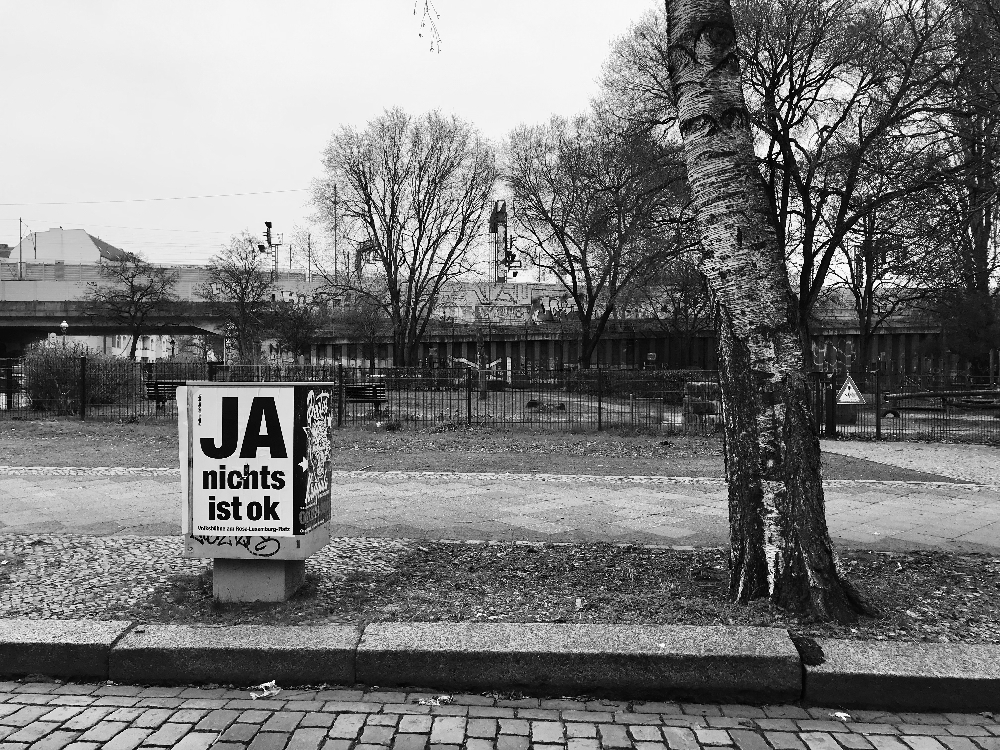
Posters for the European elections have begun to appear. A parade of placards along the central reservation of Osloer Straße.
We must vote for those who think justly, not dictatorially, Heinrich Mann wrote in 1930. We must work, be patient and show ourselves far too proud to allow ourselves or our state to be “saved” by anyone. That is something only we ourselves can do.
*
In Köpenick we join the crowds, mostly in red and white (but with patches of blue and white here and there) as we walk along the path through the trees to the Alte Försterei. Anyone who has been to a home match of 1.FC Union Berlin will know this walk, along the railway to the Plattenbau clubhouse bar and then through the trees to the ground. But this day is different. Today it is the women’s team who are playing in the forest stadium, in a local derby against Hertha BSC. They may only play in the third tier of women’s football, but more than 12,500 turn out to cheer them on.
From both sides. Indeed, the Hertha fans are arguably making the larger racket during much of the match, but they have little going for them on the pitch. Union take a 5-0 lead into half-time and then seem to decide the job is done. The game finishes with the same score as both sets of fans trade their favourite songs, and insults, throughout the second half. The Hertha fans’ loyalty is almost rewarded when they hit the post, but it is not to be. Despite the one-sided scoreline, it is a hopeful and joyful lunchtime kick-off.

Words & Pictures: Paul Scraton









 Under a Grey Sky