

State elections are held in Thuringia and Saxony, with depressing success for the AfD and a strong showing for the brand new “Left-Conservative” or “Left-Populist” party that has formed around Sahra Wagenknecht. Possibly the most concerning aspect of the results are that the AfD are the number one party for voters under the age of 35. That they are winning the youth vote speaks to the atmosphere of disillusionment and economic fear held by many young people, and not only in Germany. What will happen in next year’s federal election is anyone’s guess, but the dangers are very real indeed.
*
Katja Hoyer, writing in The Guardian, warns against the simple explanations and knee-jerk responses to the election votes. It must surely be possible to condemn the AfD for what they are, while also trying to understand where their vote – and indeed, that of the BSW – is coming from.
But easterners are far from anti-democratic. There were lively public debates everywhere in the buildup to the elections. People discussed politics at workplaces and at the kitchen table. Turnout was at a record high, with three-quarters of people casting their vote. East Germans are neither fed up with politics nor with democracy. They are fed up with not being taken seriously…
*
It is hard to be optimistic in times like these, but there remains something about September, and autumn in general, that suggests something of a new start. I have always felt that this is the actual time for resolutions. The football season is starting. The academic year too. A summer break to find inspiration for new ideas or new starts. Time to clear the desk. Get to work.
*
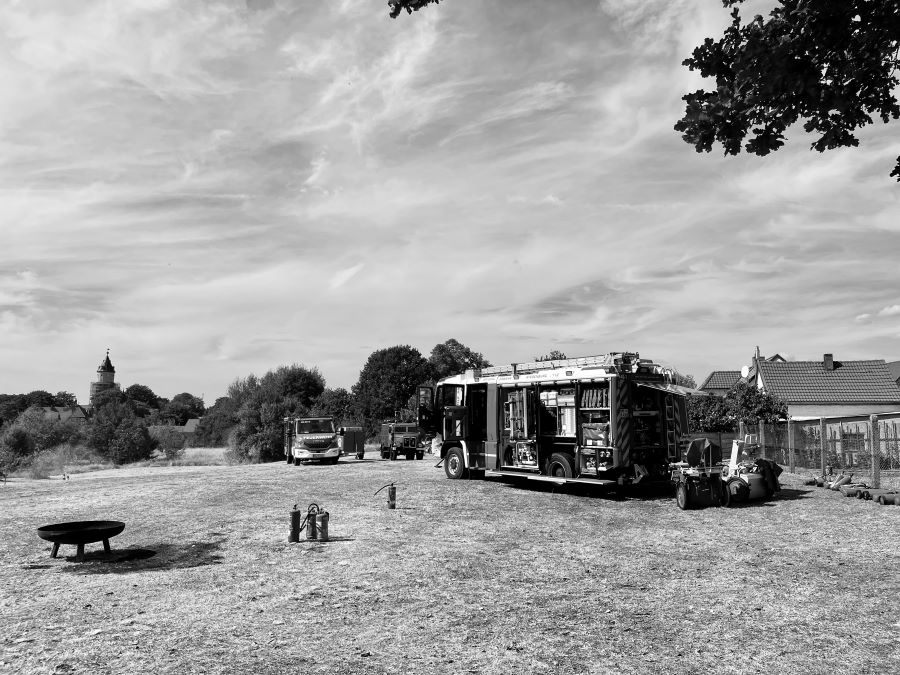
In Wiesenburg, it is the annual open day for the volunteer fire brigade. We grill sausages in front of the garage, where chairs are sent out for the older folks in the village to enjoy their coffee and cake, and biergarten tables and benches for everyone else. Kids clamber in and out of the fire engines and the bouncy castle, while the pea soup cooks in the bright red field kitchen. Throughout the day people come down from their houses with their pots, to buy a number of portions for the week ahead. ‘No need to cook for the next few days,’ one of the women says, as she carefully holds her pot full of soup with two hands. ‘Like being on holiday…’
My route to the airport starts on the Bellermannstraße before catching the Airport Express from Gesundbrunnen station to BER. We like to complain about airports, especially Berlin’s no-longer-so-new one. But familiarity at least breeds some understanding of how to mitigate its many faults. Pass through security in Terminal 2. Bring some food. Don’t trust that the pub on the other side of the passport control will be open.
It seems to obey no logical timetable, and I wonder if the woman who always seems to be working there when it is open, lives somewhere in the non-Schengen end of the terminal, in that strange in-between place where you have officially left Germany without leaving the building, and that she opens and closes her pub simply when the mood suits her.
*
As I travel once more to the UK, leaving Germany at that end of the terminal but not yet on the plane, let alone admitted to what I sometimes still call home, I am reading Ryszard Kapuściński. The Polish journalist and travel writer is describing a moment early in his career, when working in a small town on the very edge of Poland, close to what was then Czechoslovakia:
This mystery and quiet intrigued me. I was tempted to see what lay beyond, on the other side. I wondered what one experiences when one crosses the border. What does one feel? What does one think? (…) It must certainly be different. But what does “different” mean?
On a couple of occasions I have been asked to lead creative writing workshops, usually with a friend, on the subject of place writing, whether travel writing, essays or simply writing place in creative nonfiction. I’m not sure it is possible to actually teach writing, or even if the things that might work for me are of any use to the people sitting around the table. But it does make me think, especially when picking texts to share by writers far greater than I will ever be, about what tools you might need.
Most of all I think you need curiosity. The desire to see what is on the other side. The interest to ask questions of people and places. The need to collect stories from the past and the present, to help you understand. To see what’s different and to find out what different means…
*
In a pub in Guiseley we arrive for the weekly quiz with about two minutes to spare. Thanks to our combined knowledge of musical theatre, European capital cities (and where they are located), an ability to differentiate between titles of country music songs and headlines in Take a Break magazine, we win by a solitary point. A four-pack of craft beer each and we will walk home in triumphant spirits.
During the quiz I have one of those moments when I wonder, as we sit at the table in the corner, waiting for the next round (of the quiz or the drinks), what it would have been like if I hadn’t agreed to that job in a hostel cafe more than two decades ago. If Berlin had stayed an extended stopover on a long journey to Sarajevo. But there is not much time to ponder. There is a sheet of paper with Drag Queen Celebrity Lookalikes, and they are not going to identify themselves.

‘The thing is, there is only so much water on the planet, right?
‘Right.’
‘So how can it be that there seems to be more rainfall now? They call these floods “once-in-a-century” events but they are happening more and more frequently. Or am I wrong?’
The two German guys are waiting to be called to board at Manchester Airport and are discussing the floods that are happening in Poland, Czech Republic and Germany.
‘It’s that it all comes at once. And the land is dry and can’t it soak it up… not at that volume.’
He switches to English.
‘Extreme Weather Events.’
‘Thing is, you can’t get insurance any more. Not if you live in a flood risk area. And loads of places are now flood risk areas that never used to be before.’
‘At least you don’t have a basement.’
‘True.’
‘And we live on the fifth floor…’
*
Every story on the Wrocław News website is about the rising waters in the Odra river and its tributaries. The city is bracing itself, but it looks like they might get away with this one. Other places are not so lucky. Meanwhile, changes to the monsoon in Nepal are causing major problems, from flooded rivers to landslides wiping out the roads that are often the only access to remote villages in the hills. We’re in the same storm, but we are not all in the same type of boat.
*
I’m invited to Osterode, a small town on the edge of the Harz mountains, to take part in a series of events linked to the 200th anniversary of Heinrich Heine’s Harz Journey, a walk which I followed for my own book that was published last year in Germany as Harzwanderungen. It is nice to be back in the town, with its half-timbered houses and views to the hills around. I walk some of the route and marvel at how much more of the forest has been ravaged by the bark beetles – another result of the climate crisis – since I walked these trails for the book four years ago.
‘The thing is,’ my host Lutz says, as I mention how different the landscape looks. ‘There is a new forest growing. And we might get away from these monoculture plantations and have a mixed forest like it was even before Heine was walking here. Anyway, you have to have hope. Otherwise, what else is there?’

I walk up the old postal road between Osterode and Clausthal-Zellerfeld. I came this way following Heine and now I am following myself.
Here the mountains grew steeper; beneath me the pine forests were swaying like a green ocean, and above me the white clouds were sailing through the blue sky. The wild landscape was tamed, so to speak, by its unity and simplicity.
Heine wouldn’t recognise the forest today. But even as he walked, two hundred years ago, the forest was already business; the Harz mountains cultivated land, like the fields of cabbages and sugar beet in the plains north of Göttingen where we both started our walks. Like Lutz said, maybe out of catastrophe there is a chance for something better to grow.
*
In Brandenburg, where the forest has been eaten by bark beetles and destroyed by fires that can be seen from Berlin, the AfD – who have their own thoughts on the climate crisis and the measures we might need to implement to mitigate the impact of what is to come – come second by a percentage point or two. A sigh of relief? At least it was only second? Can we find hope in results like these?
*
The plane leaves Helsinki and flies north, ever north until we’re passing through the gap between Russia and Alaska and now we’re flying south. In Tokyo the first few days are filled with reminders of ten years before; the things that have changed, and those that appear the same in this wonderful, overwhelming and bewildering city.
We emerge from the subway in Akasaka to torrential rain. The post-work crowds fill the corner Izakaya, leaving no space for us until we are rescued from the downpour by a friendly man outside his pub. He finds us a table and we drip on the floor while drinking beers and lemon sour, nibbling on skewers and soy beans.
Tokyo is a rush. Tokyo is a blur. Tokyo is understandable. Tokyo is unfathomable. It feels nostalgic – the nostalgia for an imagined future that never came true. A vision of what might have been and now feels a bit scuffed around the edges. A bit 1980s. A bit 1990s. A bit like us, really. Under heavy heavy skies, with the air warm and humid, there is a feeling of melancholy in this city, despite the cars and trucks and people, people and more people.

We meet Daisuke in Shibuya and go for sushi in a tiny restaurant where they somehow squeeze is until a table in the corner, in front of the miniature kitchen where the rice is made and in front of the saki shelf, so that every time someone orders a drink I have to move to one side. And then we go to Golden Gai, where Daisuke drinks at a bar that is only accessible to those who ‘Mama’ – the third generation of women to run the establishment – determines are trustworthy. The bar was built in 1948, when Shibuya was still a barren field destroyed by the bombs of World War II.
Mama must trust us, must count us now as one of the ‘believers’, as she takes our photo for her special album and carefully writes down our names so that she gets the spelling right. On the wall there are pictures of her grandfather and grandmother from when they started serving drinks in 1948. Each bottle on the shelf has the name of the regular it belongs to. It is everything you’d want a Japanese drinking den to be…
‘We are totally outdated but we cherish something that existed in the past but that is invisible nowadays…’
*
The runners gather at different meeting points, the part of the trail around the grounds of the Imperial Palace that is nearest to where they are coming from. Some leave bags and water bottles. They park their bicycles beside the water fountain. Others, in bigger groups, carry urns of something refreshing to be doled out afterwards. And then: we run.
The loop around the palace is about five kilometres, with each hundred metres marked by stone flowers laid in the pavement. On a Sunday morning there are so many of us that it is a surprise not to see numbers pinned to shirts. But no-one has organised this, except for whoever it was, years ago, that decided to mark the route and make it a thing at the very heart of the city.
There is an unspoken solidarity on the trail. Fast and slow. Japanese and foreign. Some will do one loop, staggering to a grateful halt after half an hour in this damp, muggy morning. Others will complete laps, counting up (or down) the kilometres until they reach their goal. 10k. A half marathon. A full marathon. More… But nobody except us runners are counting. It matters only to each person who puts one foot in front of the other and then does it again. Those who keep going.
*
In Omote-sando, between the boutiques that line the neat streets of low buildings, the crowd dressed in identical robes, beer cans tucked down the front for safekeeping, carry floats through the narrow streets while children bang drums and blow whistles and everyone, from participants to onlookers, record it all on their phones. Harvest time.

The day begins at the Tsukiji Outer Market, all that now remains of what was once the greatest fish market in the world. A tourist trap? Undoubtedly so, but in the inside halls Tokyo residents still buy their fish that lies resting on mountains of ice, and the restaurant and other buyers have priority before the rest of us are admitted and the chefs come to buy their knives or get them sharpened at the workshops they have always used. Fresh, raw fish, eaten from styrofoam plates with disposable chopsticks has never tasted so good.
*
In Asakusa, a kind of bazaar leads from the gate to the Buddhist temple, and amidst the throngs of people shopping for all manner of tat, the first thing to notice are how many people are wearing traditional Japanese dress. It is only at the second glance that you realise that they are almost exclusively foreign, predominantly Chinese, and that they are being followed as they make their tiny footsteps through the crowds by a photographer who will document it all as part of the service.
Now we notice the number of shops that spell out KIMONO RENTAL in a variety of different languages and scripts. It is a chance for all of us to have a bit of old-fashioned Japanese cosplay in front of a real, and important Buddhist temple, while the odd, actual Buddhist might be there for reasons other than a guidebook checklist or a spot of dressing up.
We try to imagine the equivalent. Lederhosen or a dirndl to visit the Frauenkirche in Munich? A kilt before stepping into St Giles’ Cathedral in Edinburgh? It seems unlikely.
*
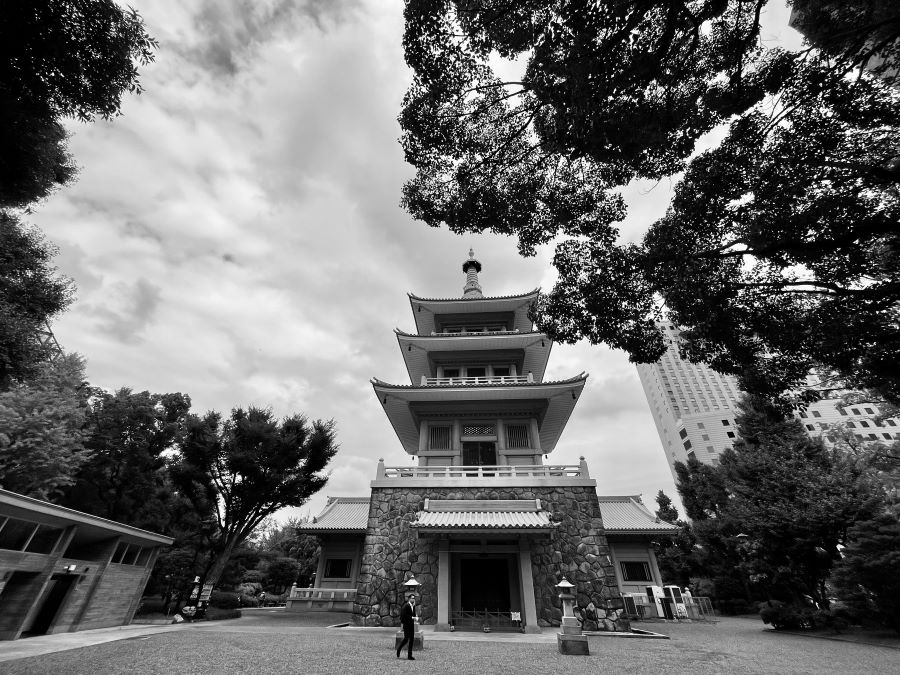
On 1 September 1923 the Great Kantō Earthquake led to a fire that claimed more than a hundred thousand lives. On 9 March 1945 the Great Tokyo Air Raid saw the US airforce drop 180,000 firebombs on the city in one night. It was the single most destructive bombing raid in human history, killing a hundred thousand people and leaving more than a million homeless. At Yokoamichō Park the Tokyo Memorial Hall remembers all those who were lost to the fires that raged during both events, and graphic images show the piles upon piles of charred bodies in the streets.
‘It was often impossible to tell if they belonged to men or women,’ the commentary on the information film bluntly explained, while outside it was possible to hear the sound of kids at break in the primary school on the other side of the fence while we contemplated the memorial to all the children lost to both events, little more than twenty years apart.
Japan has a new Prime Minister. It looks like he will call an election. Meanwhile bombs rain down on Beirut and floods rip apart the Kathmandu Valley. To travel is to build connections in places. In a business hotel room in Tokyo, it all feels a long way away, as we try to make contact with those we care about and make sure everyone is safe.
*
In Ueno Park the city seems to retreat as we walk up the stairs. A moment or so earlier, we were sitting at a bar under the tracks, watching the crowds in the Ameyayokocho market, listening to the music, the calls of the vendors and the scream of the pachinko machines as the sliding door periodically opened across the street. And now it is as close to silence as it is possible to get in this city.
The wind blows the trees. Birds sing. The water runs from a fountain so that we can wash our hands before approaching the shrine. The gravel crunches beneath our feet. Across the pond filled with Japanese Lotus leaves we can see the apartment blocks, the hotels and the office towers, but on a bench by the water it is possible for a person to once again hear themselves think. What kind of witchcraft is this?

Words & Pictures: Paul Scraton
 Under a Grey Sky