
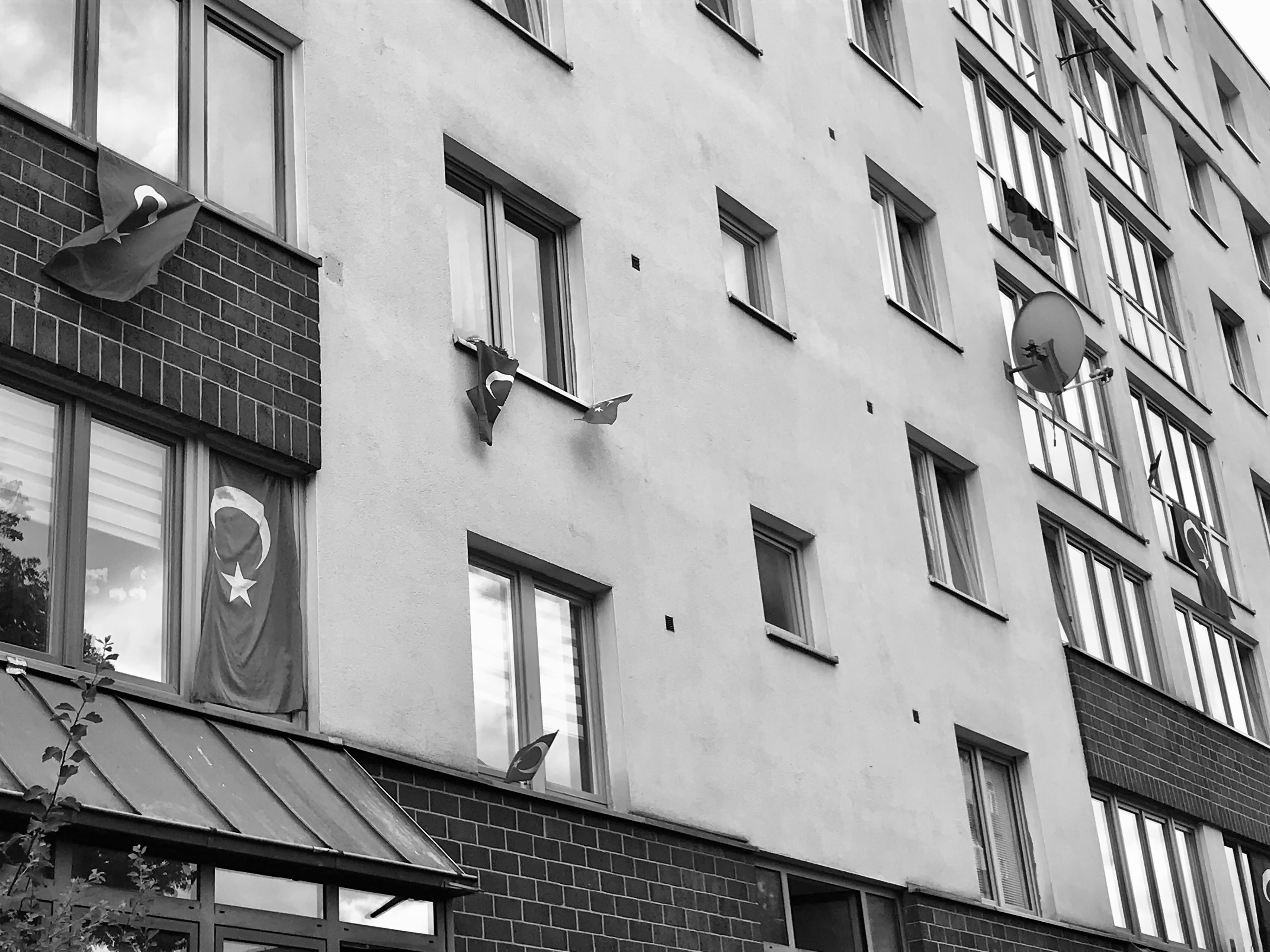
When the goal goes in it feels like our neighbourhood is going to explode. Even more so at the final whistle. Throughout the day I’ve seen flags everywhere. Outside the cafes and hanging out of car windows. Three young women on their way home from school or college all have their team kits on, hours before kick-off. When Germany plays, we can hear the goals go in by the delayed cheers of neighbours, the speed to which they see the ball hit the net depending on their cable or internet connection. But when it is Turkey, the noise is something else.
If Gesundbrunnen is celebrating, it has to be said that it took some time. Maybe no-one expected them to get this far, but most of the flags and the knock-off merchandise for sale on Badstraße came after the first couple of good results.
*
Another day. Another sport. Mark Cavendish rolls back the years to win his record-breaking 35th stage on the Tour de France. A few years ago he thought he would have to retire because he couldn’t find a team willing to give him a contract. What happened next is now cycling history.
Ten years ago we were on the side of the road in Otley and then up on the moors for the stages of the Tour de France in Yorkshire. The pubs in town changed their names. People dug out their old bicycles from the shed to spray-paint them yellow or white with red polka dots. One of the greatest things about what might be the greatest of all sporting events is its accessibility. You just have to look at a map of the stage and find your spot by the side of the road, and you can be a part of it.
Hopefully one day I’ll get to see it in France. Despite everything, it is perhaps my favourite sporting event. Or maybe not even because of the bad parts of the race’s history. Maybe that is all just a part of it. The triumphs and the disasters. The incredible performances and the all-too-flawed heroes. It’s all about the stories.
*
The third Salon Weißensee at Galerie Arnarson & Sehmer, this time with Marcel Krueger, Jessica J Lee and Dasom Yang. I read a work-in-progress, something that is part of the preparation for my residency in Wrocław later in the month. It is about the Karow Ponds.
These are all the stories of the edgelands. The gravel pits and drainage channels, places that once filtered the waste of four million souls that became an unplanned gift from the past to the present. Neither urban or rural, the ponds and their footpaths offer respite from a city they are part of and owe their existence to, and yet somehow feels so very far away when surrounded by the thick, heavy air of summer and the persistent buzz of insects.
If you follow the path beyond the last of the ponds, along the edge of the fields, you reach a small stream. You can follow that through a tunnel under the road and then another beneath the Autobahn. Now the old sewage fields stretch out towards the horizon. The last notes are scrawled at the top of an otherwise blank page.
Clusters of trees and huge electricity pylons. Gravel tracks and worn down desire paths. A red kite against a bleached blue sky.
This is Berlin.
I wrote.
But not quite.
In the hotel in Dömitz, overlooking the Elbe, the German team line up on the television screen ahead of their match with Spain. The first bars of the national anthem sound and the room falls quiet. It is a little awkward. One man stands up. He is about sixty, with white hair tied back into a tight ponytail. He wears a Germany shirt, but not one produced by Adidas or any kit supplier. His wife stays sitting next to him. He puts his hand on his chest and sings gently. His voice is soft, almost tender. The rest of the room watches the screen while listening to him.
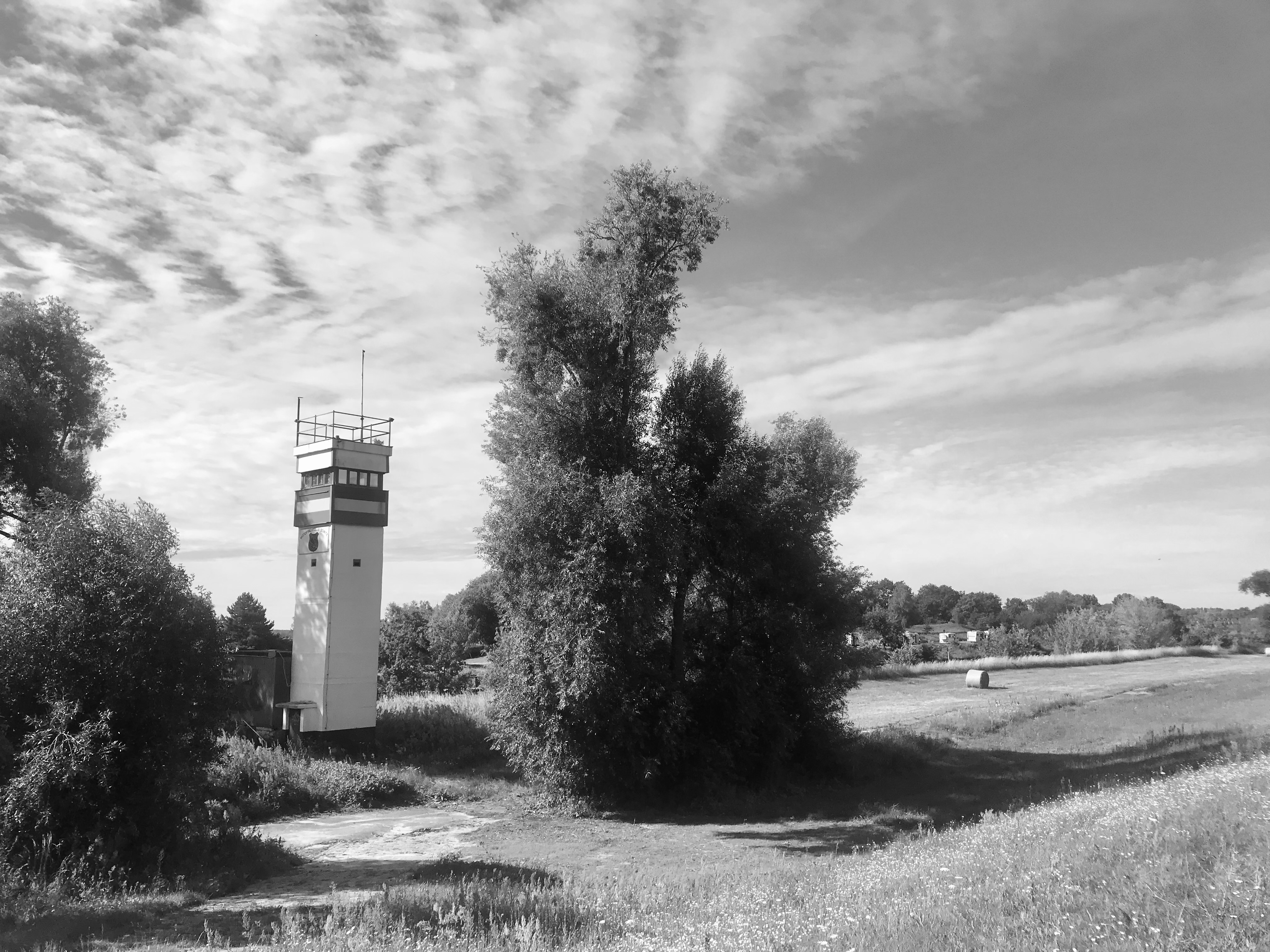
Beyond the television, through the window, we can see the Elbe. This stretch of the river was once the inner-German border, our hotel a grain-storage silo in a restricted zone, West Germany on the opposite bank. Across the harbour is a watchtower. It is the only real remnant of the border in sight. Later, I will meet a woman who lived in the town when it was hard against the border.
‘You didn’t really think about it,’ she said, about the fence at the bottom of her garden. ‘I felt sorry for the guard’s dogs. But otherwise it was just normal. We didn’t know any different.’
Back then, if she wanted to see the river she would have had to travel south, into Brandenburg and on towards Magdeburg, where the GDR controlled both banks and access to the dykes and paths no longer reserved to the men in the watchtowers and their dogs.
The anthem finishes. The man sits down. Conversation starts again. Germany give a good account of themselves, but in the end Spain are too strong. And so, despite their early performances, it looks like hope now rests with England.
*
Reading Kairos by Jenny Erpenbeck. In it, two characters in East Berlin discuss the national anthems of the two Germanys.
– Odd, really, the anthem of a socialist country starting with the most Christian word there is: Resurrected.
– I don’t think it’s odd. It’s just the way it is. You can only make something new after some thoroughgoing destruction.
*
We take a boat trip along the river. The guy sitting next to us has just come from the hospital. He had come here with his elderly father, taking the place of his mother who died a few months ago. His father fell sick and is now on a ward, although the man is hopeful that he will get better.
‘I didn’t know what else to do?’ he says, as if trying to justify his presence on the boat. ‘I visited this morning, but otherwise I just have to wait. And I always wanted to take a boat trip on the Elbe.’
He will get no judgement from me. We move out from the harbour and onto the river, the captain giving us snippets from time to time as most of his passengers try to decide what cake to have with their coffee. Overhead a white-tailed eagle soars. It is an incredible sight. We share the binoculars. Our waitress, delivering the cake, looks up and smiles, as if recognising an old friend.
*
What can you see in the shallows? An oystercatcher on the sandbank. An abandoned bucket from a long-ago fishing trip. Cattle at rest in the shade of a silver willow.

On the wall of Goethestraße 25 is a plaque dedicated to Anna Wolffenstein. She was the last Jewish resident of the town, before she was deported to the camps. I try to work out what her journey would have been. Most likely she would have been taken first to Schwerin and then to Berlin. From there it would have been a cattle truck from Anhalter Bahnhof to Theresienstadt, the fortress concentration camp on the Elbe. The same river that used to flow a hundred metres or so from Anna’s house.
The Jewish population of the town had been decreasing long before the Holocaust, but it was under the Nazis that the Jewish cemetery was finally cleared. I wander around for a while, trying to find it. A few steps lead up to an overgrown path between two fences, and then a green gate with a Star of David. A cluster of trees and a single memorial at the centre. All the remains.
One of the Jewish families of the town left for the United Kingdom. The father would return after the war, to East Germany and the restricted zone, to periodically tend to the grave sites of the family who had remained in the earth long after their descendants had fled or been murdered.
*
I already know that this month I will only spend seven nights in Berlin. From Dömitz, on the Elbe, we have a pit stop in the city before heading out to Wiesenburg. We walk through the dry valleys of the High Fläming Heath, known as Rummel, where legends linger in a place where folklore seems mostly to have been lost in the shifting of the sandy soil and the movements of people caused by war, disease, regime change and the shifting of borders.
*
Back to the Elbe and the modern engineering wonder of the ship canal bridge, crossing the river and transporting boats, barges and ships high above the river. In our corner of Germany it is rare to have a view, but climbing up the embankment to the level of the bridge seems to open up the sky. It reminds me of something Dorthe Nors writes in A Line In The World about her yearning for the west coast during her time in Copenhagen:
I want to wake beneath a sky that is grey and miserable, but which creates a space of colossal dimensions in a second, when the light comes ashore. A horizon is what I want, and I want solitude.
The sky is anything but grey and miserable today, but as we stand on the bridge, the swallows ducking and diving beneath us, we have a horizon and we have the place pretty much to ourselves.

I take the train to Wrocław for my residency, funded by Culture Moves Europe and supported by the BWA Galleries of Contemporary Art. I am there to make connections and start work on a project titled The Fields, all about the former sewage irrigation fields of the city, that share a history with similar spaces in the edgelands of Berlin. But I am also travelling to learn more about Wrocław itself, the culture and the history of a city that has had many names over the years.
As with most Central European cities, Norman Davies writes in his book about Wrocław, the problem of nomenclature is a thorny one. When a city has a different name for every nationality that lays claim to it, to prefer one version over another is to make a political statement and to risk causing offence. Nonetheless, a ready solution comes to hand when one realises the choice does not lie between two stark alternatives – Breslau or Wrocław – but rather between the scores of variants which the historical sources contain.
Davies decided to title each period of the city’s history with the name most appropriate for that era, based on the historical sources. It is something I have wrestled with before, especially in relation to Germany and Poland. My solution was always similar: to name the place based on the period I am writing about. And so, in 1945, the Allied bombs fell on Swinemünde. In 2015, I visited Świnoujście to tell that story among many others about the Baltic shore.
*
Going backwards in time:
Wrocław
Breslau
Bresslau
Presslaw
Vretslav
Wrotizla
But what do you call the place when no-one knows that the city’s name actually was? Davies goes for ‘Island City’.
And when he is not sure?
Whenever we are in a quandary we use the name that was first introduced by literate Latin-speaking clergy more than a thousand years ago and which is still with us: VRATISLAVIA.
*
I explore the fields with Katarzyna from the BWA and Piotr, a musician and sound artist from Gdańsk. We discover traces of the infrastructure among the reeds and long grass, pick our way through the riparian forest that stands between the old sewage treatment fields and the Odra river, and peer through the fence at the pump house.
Piotr collects the sounds of the fields, from the calls of the finches and the yellowhammers, our footsteps on the path and distant sounds of the trains heading out from Wrocław. The pulpits are empty of their hunters and the sky is quiet, except for the beating wings of a marsh harrier and the occasional buzz of the light aircrafts that have quite possibly the best view of all.
*
How do you experience the stories of a city? In Wrocław I walk from where I am staying in the southern suburbs and into the city centre, getting a feel for the neighbourhoods I would otherwise only pass through by choosing to move on foot. I read books about the city and novels by Polish writers. I meet artists and curators and people working for literary and cultural foundations, and I have conversations with my new friends and all manner of Vratislavians. And as the days pass by, I make some stories of my own. I find my corners, my places. Ones that I will return to and look for when I come back to this city in the months and years to come.
The reedbeds and desire paths along the Ślęża river. The shaded trails of what was once a cemetery and is now the Grabiszyński park. The shelves and cosy corners of the Tajne Komplety bookstore. The alleyway outside, and the tables of the Proza bar. The preposterous train station. The galleries of the BWA. The cafes, bars and restaurants under the railway tracks, where I sit and chat and share ideas with Katrin, with Kasia and Aleksandra, and with Berenika.
And of course: the fields.
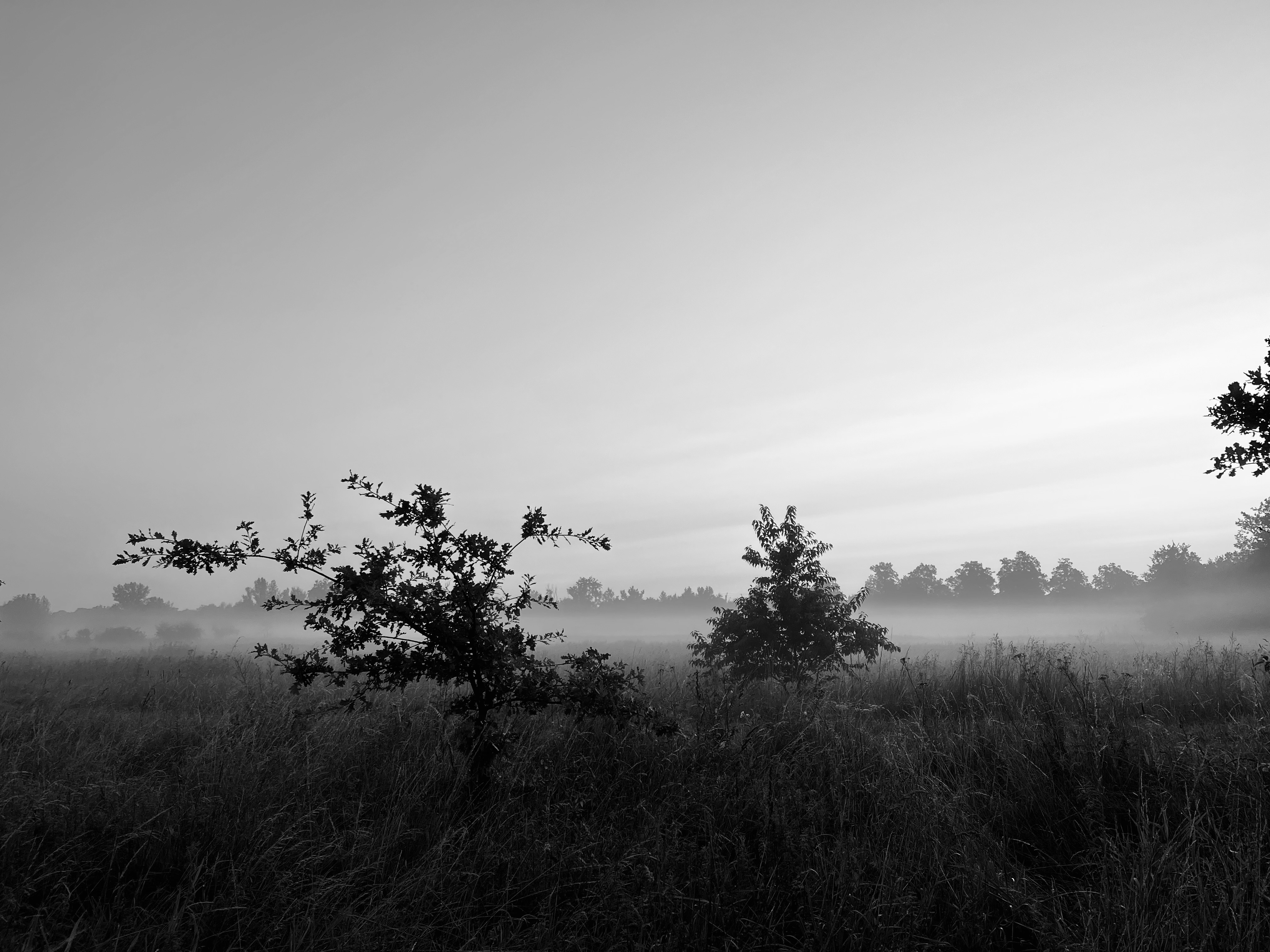
We travel to the fields at first light, Kasia collecting me from outside the house at 4.30am. We arrive as the sun is just pushing up above the trees of the forest in the distance. Mist hangs above the fields as we follow old cobblestone roads and make our own paths through the long grass to find a place to simply sit and be for a while. We see deer grazing in the distance. We hear moorhens, goldfinches, golden orioles and the sound of the train to Poznań. I am about to write that we have the place to ourselves but of course we don’t. We might be the only humans though.
*
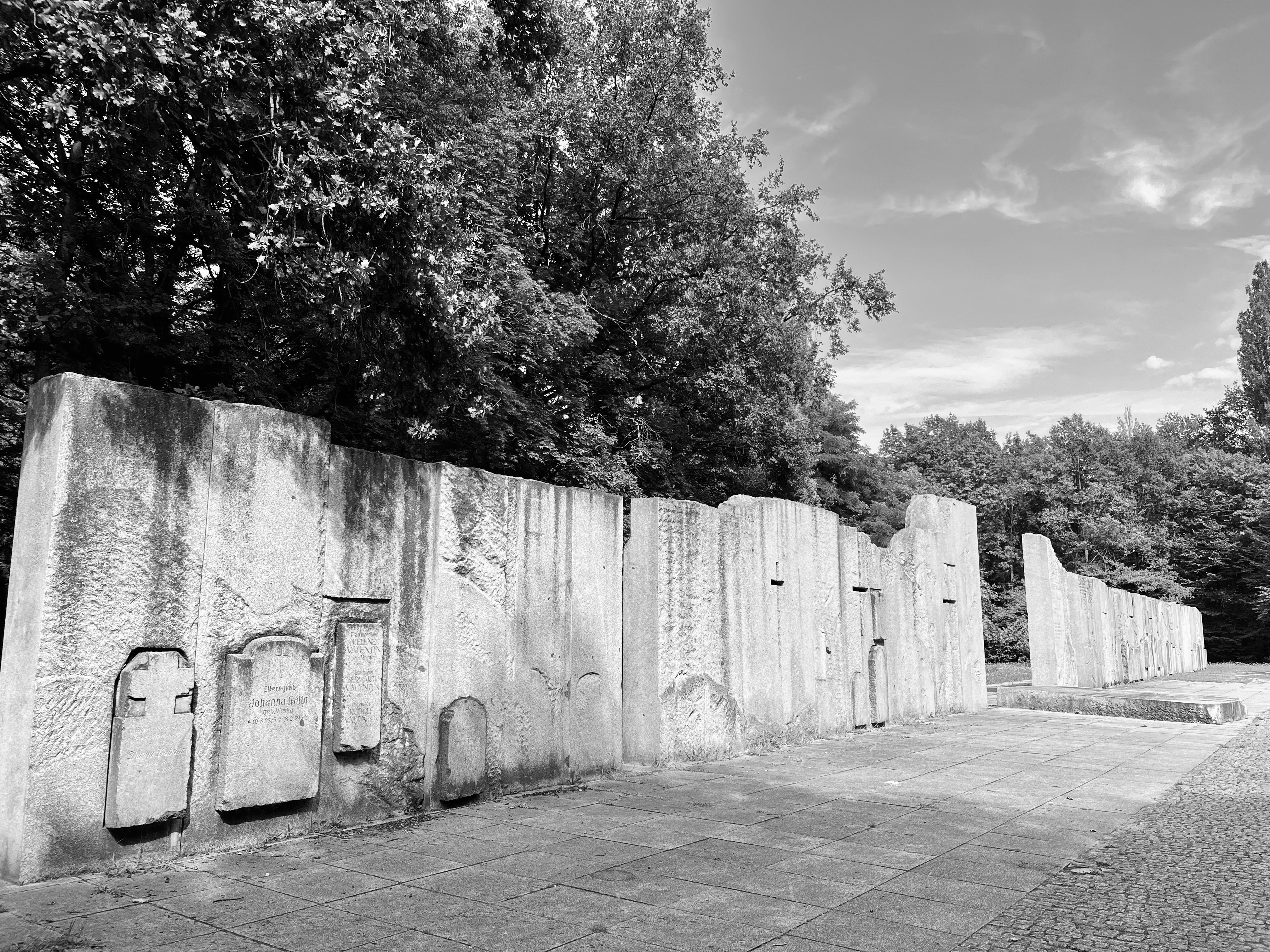
In Grabiszyński park you’ll find the Monument to Common Memory, a recognition – created in 2008 – of the more than forty cemeteries that were destroyed in the transition from German Breslau to Polish Wrocław after the redrawing of Europe’s borders at the end of the Second World War. It is, I think, an important recognition of the history of the place. We can only find belonging if we build relationships, and we can only build the relationships through recognition of what has gone before.
The memorial has been created using surviving headstones of graves from the old cemeteries, including inscriptions in both German and Hebrew. The dedication is in both Polish and German and is to the memory of the former residents of our city buried in cemeteries that no longer exist.
It reminds me of the Cemetery of Lost Cemeteries in Gdańsk, a place I wrote about in the novel BUILT ON SAND and which has a similar function in that city. There, the fragments of shattered headstones, with inscriptions in German, Polish and Hebrew and which represent the city’s former residents of all faiths, whose resting places were destroyed during the Second World War or in the years after.
How do we remember, when memory is painful? How do we remember, when memory is contested? How do we remember, when there is no longer anyone around who can recall the times before?
We built relationships to places by writing our own stories too. Katrin arrives for the weekend and we spend the day walking the city. The Island City still has islands, even if the Cathedral Island is no longer an island (and Museum Square doesn’t have a museum in it). The exhibition at BWA Studio is called KROKI or STEPS is all about walking:
When we walk, the horizon of our experience is defined by the distance we are able to cover on our own feet. The collective exhibition KROKI / STEPS refers to the conceptual and performative foundations of the contemporary reflection on walking in art – from the motif of pilgrimage, through political steps, to walking in the aspect of the migration crisis.
*
The month ends but my time in Wrocław is not over yet. Still, I am asked to give a presentation about my residency for the team at the BWA. I make it about memory and the importance of stories, two things that speak as strongly in this city.
In thinking about how we create, how we write, and how we tell stories, it is in the power of those who have gone before that I take solace. In the words of Sebald or Drndić. In the journalism of Joseph Roth or the drawings, sculptures and woodcuts of Käthe Kollwitz. The British poet Ruth Padel once wrote that ‘No poem ever stopped a tank. But,’ she added, ‘by putting vivid words, memorably together, in ways that resonate more loudly the deeper you go, poetry can address huge issues very powerfully.
I finish with some words I had already written, a few years ago for an essay for a Norwegian journal. It was titled Against Forgetting. In this city, where the population almost completely changed in a matter of years, it felt right:
The stories we choose to tell will help us shape what comes next. There is a famous line from Hegel that tells us we learn from history that we do not learn from history. It need not be the case. Yet we need to keep telling the right stories, the truthful stories. Even when there is no-one left to remember it is within our power, those who remain, not to forget.
*
I meet Kuba from the Wrocław Culture Institute. We talk about many things; about stories and memory, the history of this city, what is remembered and what is forgotten. And we talk about belonging and how we built a relationship with a place. He tells me about the flood of 1997, when much of the city was underwater. Of course, as there hadn’t been a major flood since Breslau had become Wrocław, there was a certain missing collective or folk memory, which perhaps made the situation worse than it might otherwise been. But something else happened too.
It was, Kuba says, that people had to really fight for the city for the first time. It was a turning point. People had to fight for the city, they had to work for the relationship they had for the city, and they started to feel belonging. And something else too. When the high water mark was added to buildings, to show future generations what they had to fight against, it was alongside the high water marks of previous disastrous floods. The details of 1997, recorded by Polish hands, would go alongside those recorded by Germans.
The history of the city is shared.

Words & Pictures: Paul Scraton
 Under a Grey Sky